Updates: 1,150 killed in floods in Indonesia, Sri Lanka, Thailand, Malaysia
These were the updates about the impact of devastating floods across Indonesia, Thailand, Malaysia and Sri Lanka on December 1, 2025.


This live page is now closed.
This live page is now closed.
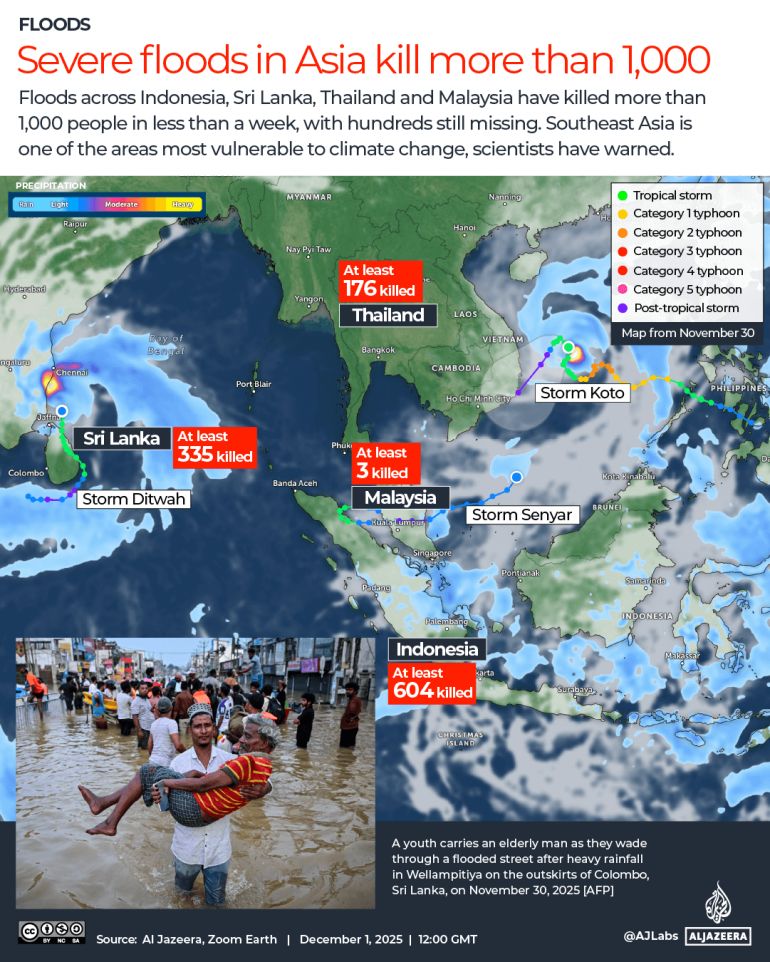
- Floods across Indonesia, Sri Lanka, Thailand and Malaysia have killed more than 1,140 people in less than a week.
- At least 604 people have been reported killed in Indonesia, 366 in Sri Lanka, 176 in Thailand and three in Malaysia.
- Sri Lanka and Indonesia have deployed military personnel to help victims of the devastating flooding.
- The Indonesian Agency for Meteorology, Climatology and Geophysics has issued a forecast for rain across much of the country.
- Search-and-rescue operations have continued in multiple areas across all of the affected countries.
Here’s what happened today
We will be closing this live page soon, but before we do, here’s a look at the day’s major developments:
- More than 1,140 people have been killed in floods across Indonesia, Sri Lanka, Thailand and Malaysia.
- A deluge of showers has been reported in India’s southern state of Tamil Nadu as Deep Depression Ditwah, downgraded from cyclone, moves northwards. Some flight cancellations have been reported between Chennai and Port Blair.
- Electricity supplies are being restored in the Indonesian province of West Sumatra, but power remains disrupted in North Sumatra and Aceh.
- Tens of thousands of children are out of school in Indonesia and Thailand due to the floods and landslides.
- Experts say devastating flooding in Asia can be attributed, in part, to prolonged La Nina cycles, which are making rain-heavy storms and monsoons stronger.
- Sri Lanka’s president has declared a state of emergency to deal with the disaster.
What caused the flooding?
In Sri Lanka, the monsoon season typically lasts from about June to September.
However, this year it has been exacerbated by two separate cyclonic storm systems: Ditwah and Senyar. Ditwah first formed as a deep depression over the Bay of Bengal. It made landfall on Friday in Sri Lanka, triggering mass floods and landslides, before shifting back over the bay.
The storm is expected to weaken as it moves north, deluging India’s southern coast with heavy rains.
In Indonesia and Thailand, Senyar formed in the Strait of Malacca, a stretch of water connecting the Indian Ocean and the South China Sea.
Senyar brought enormous rainfall, high-speed winds and waves to Indonesia’s island of Sumatra and at least eight southern Thai provinces. The storm also brushed neighbouring Malaysia, killing two people.
Sri Lanka witnessing ‘humanitarian crisis of historic proportions’
The director-general of Sri Lanka’s disaster management centre says the country is facing a “humanitarian crisis of historic proportions” as more than 1.1 million people are displaced by floods and landslides.
All 25 districts have been affected, Sampath Kotuwegoda told Al Jazeera, as the country continues to deploy rescue missions to search for the missing and help survivors.
“We have to resettle people, we have to rebuild the nation again and this is going to be a huge task,” Kotuwegoda said.
Neighbouring countries including India, Pakistan, Bangladesh and Japan have sent emergency management teams, Kotuwegoda added, but more international support is needed to respond to the needs.
Floods devastate Palembayan, leaving homes destroyed and families grieving
In Indonesia’s Palembayan, row after row of houses have collapsed, with crushed vehicles dotted along mud-laden streets and piles of motorcycles tangled up in heaps after being carried away by landslides and fast-flowing floodwaters.
Rescue teams were seen carrying away a body across a swathe of rural land now covered in debris, uprooted trees and household furniture.
“These used to be the houses of my parents, my brother; also, my rice-milling place. Now all are gone,” said Muhammad Rais, who lives in Palembayan and lost two family members.
“We have nothing left.”
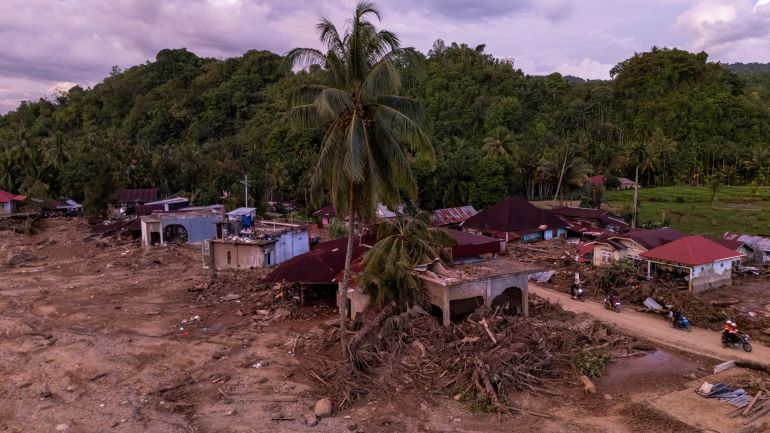
WATCH: Drone video shows devastation from floods in Indonesia’s Sumatra
Indonesia ‘not prepared’ for disastrous flooding: Minister
As the death toll on Indonesia’s island of Sumatra climbs to 604, Minister of Home Affairs Tito Karnavian says the government was not ready to manage the fallout.
The comments came during a coordination meeting in the capital Jakarta.
“The disaster is quite extensive in Aceh, North Sumatra and West Sumatra,” Indonesian outlet Tempo reported Tito as saying.
“Similar to what happened in North Sumatra, it happened very quickly, and maybe we were not prepared for it.”
At the same meeting, head of the Indonesian Meteorology, Climatology, and Geophysics Agency Teuku Faisal Fathani said he had warned local governments of tropical Cyclone Senyar eight days before it made landfall, repeating the warning again four and two days before it hit.
Indonesian government to investigate origin of washed-up logs
Throughout the catastrophic flooding that rocked Sumatra over the weekend, residents noted a common phenomenon – huge piles of logs that crowded on shorelines, rumbled through floodwaters, and piled up where homes once stood.
Although at first the Environment Ministry dismissed accusations that the logs may have originated from illegal logging activities, officials have since pledged to investigate, Antara news agency reported.
“The circulating information said it was the result of illegal logging, some said it was rotten wood,” Home Affairs Minister Tito Karnavian told reporters.
“However, I cannot answer something I haven’t seen myself, nor have I obtained official data, and I need to investigate with law enforcement officials.”
The Forestry Ministry separately said it would investigate the logs’ provenance.
From 2001 to 2024, Indonesia lost 320,000sq km (123,553sq miles) of tree cover, according to watchdog Global Forest Watch, equivalent to about 20 percent of its total tree cover area in 2000.
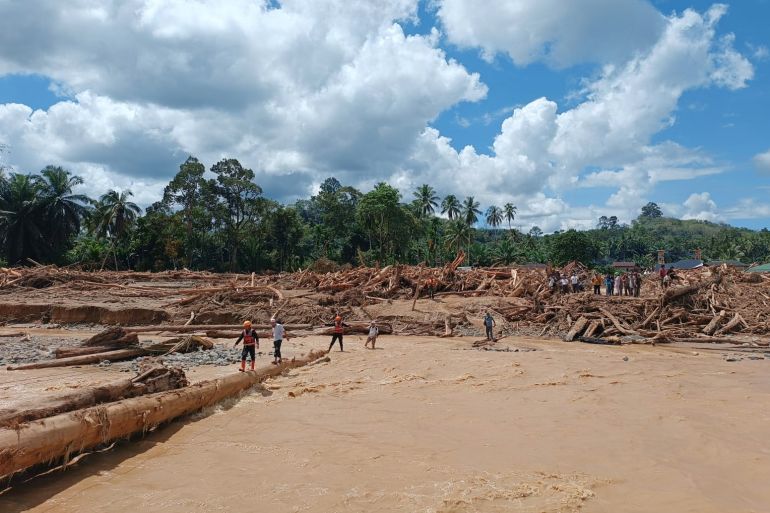
Tens of thousands of children out of school in Indonesia, Thailand: NGO
Tens of thousands of children are out of school in Indonesia and Thailand due to the floods and landslides, Save the Children has said.
According to an assessment carried out by the organisation, about 76,000 children are out of school in southern Thailand.
In Indonesia, at least 1,000 schools have been damaged and closed in Aceh and Sumatra, with others being used as emergency shelters.
IFRC calls for improved early warning systems
The International Federation of Red Cross and Red Crescent Societies has called for better early warning systems and an “urgent need for stronger legal and policy frameworks to protect people in disasters” in the wake of deadly floods and mudslides in Asia.
“Families have lost homes and incomes, and thousands are sheltering in evacuation centers. Health risks from waterborne diseases and sanitation challenges are rising, while flooded roads and damaged bridges are cutting off access to essential services,” it said in a press release.
Alexander Matheou, IFRC director for the Asia Pacific region, said there is a need for “better early warning systems, shelter for people to go to in times of flooding, more nature-based solutions … social protection systems in disaster”.
“These floods are a stark reminder that climate-driven disasters are becoming the new normal, and investment in resilience and preparedness is critical,” the statement added.
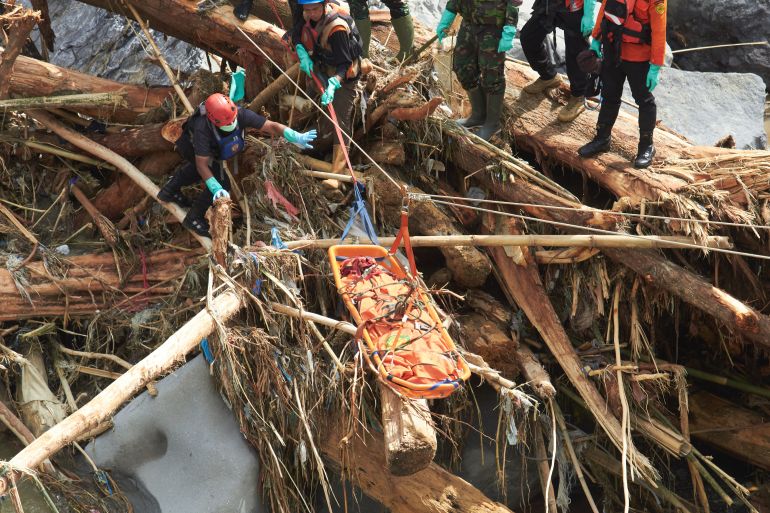

Why were the floods so deadly?

Roxy Mathew Koll, a climate scientist who authored the latest series of the Intergovernmental Panel on Climate Change reports, has told Al Jazeera that the cyclone warnings reached communities in the affected countries long before Cyclones Senyar and Ditwah hit the coasts.
There were heavy rain alerts after the satellites successfully tracked the storms, Koll said, and yet more than 1,000 people died across Indonesia, Sri Lanka and Thailand.
Koll noted that both cyclones that hit Indonesia and Sri Lanka were not the strongest storms of recent decades, with relatively lower wind speeds, from 60-80km/h (37-50mph). However, they carried extraordinary amounts of water and moisture.
One common thread tying the extreme weather events in Asia is that they hit places where steep terrain, encroached channels, limited warning-to-evacuation capacity, and fragile infrastructure compounded the danger, said Koll.
“While the cyclone warnings were accurate, the authorities failed to translate a meteorological alert into safety on the ground,” added Koll, noting that the effect was harshest on the poorer sections of society that had their homes and farms wiped out.
A mere forecast cannot make up for decades of unplanned growth, weak land-use regulation and the absence of safe alternatives, he said, describing this so-called “last mile” as the weakest link in South Asia’s disaster preparedness.

Sri Lanka death toll hits 366
The number of people killed in Sri Lanka has risen to 366, the country’s disaster management centre is reporting.
Another 367 people remain missing.
Thailand: 80 percent of Songkhla province’s tap water restored
Services are slowly returning to Thailand’s hardest-hit southern province of Songkhla, where at least 131 people have been killed.
About 80 percent of the province’s tap water has returned for use, the Thai Enquirer reported, citing the provincial water authority. Full water service is expected by Wednesday.
Three mobile water treatment units are pumping out about 180,000 litres (48,000 gallons) daily, while the first batch of about 26,000 residents is expected to receive 9,000 baht ($282) each in assistance payments starting today.
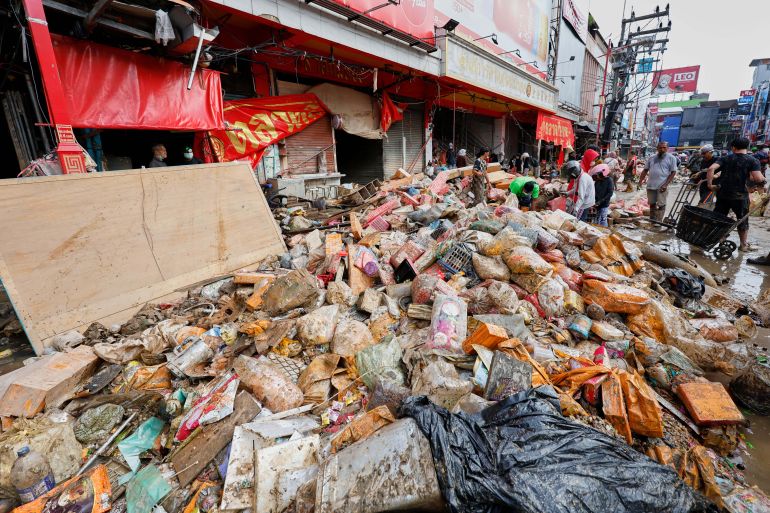

More than 1,000 killed in Indonesia, Sri Lanka, Thailand and Malaysia
Catastrophic floods in Pakistan displace millions this year
As Sri Lanka, Indonesia, Thailand and parts of Malaysia reel from deadly floods and mudslides, Pakistan is another country in Asia that has faced catastrophic flooding this year.
Since June, flooding across Pakistan has displaced more than four million people, killed at least 1,000, damaged more than 230,000 houses and washed away almost 23,000 livestock.
Climate change is seen as one of several factors contributing to the deluge. Pakistan ranks among the top 10 most climate-vulnerable nations, but it contributes less than 1 percent of global emissions.

India’s Chennai airport announces flight cancellations
The airport in the Indian state of Tamil Nadu has announced the cancellation of several flights due to heavy rain.
At least 10 flights between Chennai and Port Blair have been cancelled, the Hindustan Times reported, citing a statement issued by the airport.
Downpours have been reported in several locations in Tamil Nadu, including Chennai, Thiruvallur, Kancheepuram, Cuddalore, and Ranipet.
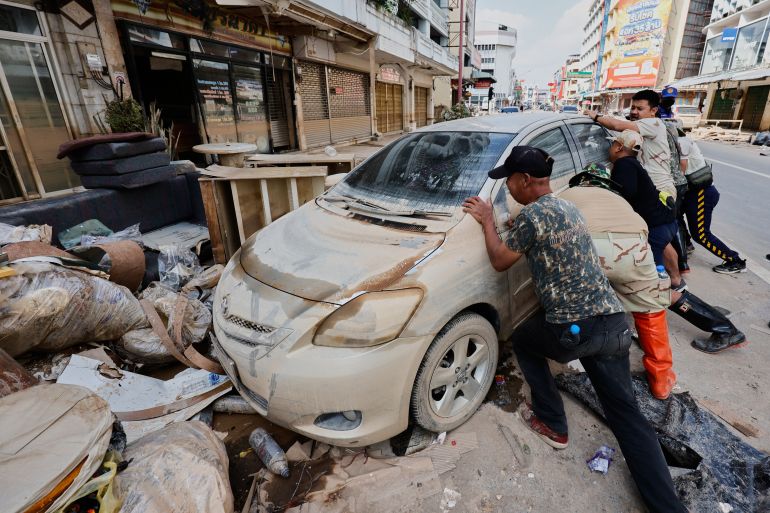
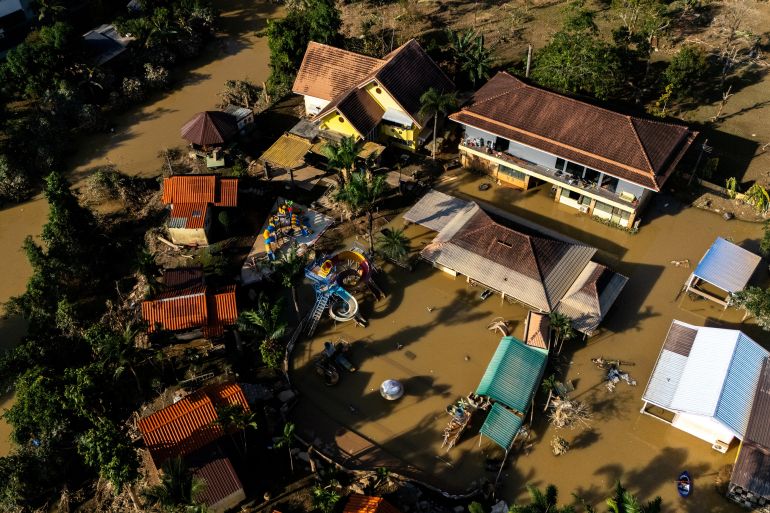
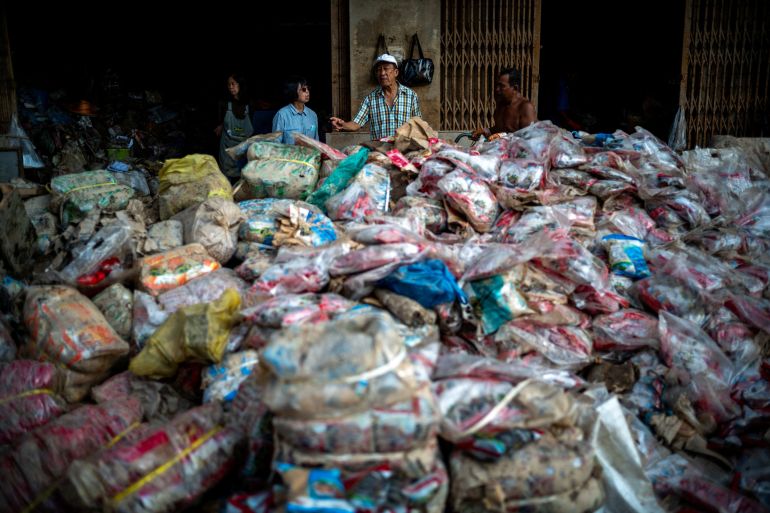
Photos: Stranded vehicles, submerged resort in Thailand’s Songkhla province

What is the weather forecast in Indonesia, Sri Lanka, Thailand and India?
Here’s what weather authorities are predicting:
- Indonesia: President Prabowo Subianto said “the worst has passed”, but the state weather agency is warning of moderate to heavy rain – accompanied by lightning and strong winds – in the region surrounding the capital Jakarta, as well as thunderstorms in West Nusa Tenggara, West Java and South Kalimantan provinces.
- Sri Lanka: Showers are expected to continue in Northern, Western, Sabaragamuwa and Southern provinces, and in Kandy and Nuwara Eliya districts, along with thunderstorms in the province of Uva and in Batticaloa and Ampara in Eastern Province.
- Thailand: Isolated rain will hit pockets of the country as the storm system weakens. Winds and waves in the Gulf of Thailand and the Indian Ocean are expected to exceed 1 metre (3 feet), and ships have been warned to proceed with caution.
- India: A deluge of showers has been reported in the southern state of Tamil Nadu as former Cyclone Ditwah moves northwards. Officials have issued thunderstorm, wind and lightning alerts in coastal Andhra Pradesh and Puducherry.
COP30 climate deal ‘left a lot to be desired’
The annual gathering of world leaders at COP30 in Brazil ended last week with an agreement that failed to mention phasing out fossil fuels, the primary driver of climate change, which, experts say, has increased the intensity and frequency of floods and other weather-related events globally.
Under the deal, developed nations are called to “at least triple” climate resilience funding for the developing world, alongside a pledge to re-evaluate climate-trade barriers.
The conference in Belem “left a lot to be desired”, according to Shweta Narayan, campaign lead at Global Climate and Health Alliance, a consortium of health professionals and civil society organisations around the world.
“The urgency of lived reality in the world, and the pace of decision-making at these conferences do not match,” she told Al Jazeera.
Narayan said the final agreement was a “huge disappointment in the core process itself for its inability to even recognise that fossil fuels are the root cause of the climate crisis”.
And that lack of acknowledgement, she noted, represents the massive gaps between the extreme weather’s impacts and policymakers.
Heavy rains reported in India’s Tamil Nadu
Heavy rains have been reported in India’s southernmost state of Tamil Nadu in the aftermath of Cyclone Ditwah.
Several parts of the state witnessed intense rainfall, including Tiruvallur and Chennai, where high tides caused damage along Marina Beach, according to the Hindustan Times.