Skip linksSkip to Content
play
Live
Navigation menu
  • News
    • Africa
    • Asia
    • US & Canada
    • Latin America
    • Europe
    • Asia Pacific
  • Middle East
  • Explained
  • Opinion
  • Sport
  • Video
    • Features
    • Economy
    • Human Rights
    • Climate Crisis
    • Investigations
    • Interactives
    • In Pictures
    • Science & Technology
    • Podcasts
    • Travel
play
Live

In Pictures

Gallery|Religion

On Hawaii island, the West’s only all-granite, hand-carved Hindu temple

Monks say they created an entire village in India for the artisans who hand-built the temple over 33 years.

The sun shines down on the golden spires of the Iraivan Temple at Kauai's Hindu Monastery.
The sun shines down on the golden spires of the Iraivan Temple at Kauai's Hindu Monastery in Kapaa, Hawaii. The temple is made entirely of hand-carved granite, which the monks have been constructing for the last 33 years. [Jessie Wardarski/AP Photo]
By AP
Published On 23 Nov 202323 Nov 2023

Share

facebooktwitterwhatsappcopylink

Save

It is the only all-granite, hand-carved Hindu temple in the West built without power tools or electricity, and it is nestled on one of the smaller islands in Hawaii surrounded by lush gardens and forests.

On the island of Kauai, the presence of the Iraivan Temple – a white granite edifice with gold-leafed domes, modelled after millennia-old temples in southern India – is unexpected and stunning. Less than 1 percent of Hawaii’s 1.4 million residents are Hindus and on Kauai, the number of Hindus may not even exceed 50, according to some estimates.

But that has not deterred the two dozen monks living at the Kauai Aadheenam campus from being good neighbours and stewards of their faith, drawing pilgrims and seekers from around the globe. In this all-male temple-monastery complex, the monks study and practise Shaivism, a major tradition within Hinduism, which holds Lord Shiva as the supreme being.

One of the order’s monks, who has spent decades supervising the temple’s construction and tending to its gardens, is Paramacharya Sadasivanatha Palaniswami, who came to the Kauai community of Kapaa in 1968 with his teacher and the centre’s founder, the late Satguru Sivaya Subramuniyaswami.

He says the Iraivan Temple was inspired by the founder’s mystical vision of Lord Shiva seated on a large boulder on these grounds. Its construction began in 1990 and continued after the founder’s death in 2001. The word “Iraivan” means “he who is worshipped” in Tamil, a language spoken about 13,000km (8,000) miles away in southern India’s Tamil Nadu state.

Advertisement

The monks created an entire village in India for the artisans who hand-built the temple over the last 33 years, said Palaniswami.

“Our guru believed that electricity brings a magnetic force field and a psychic impact,” he said. “It’s like when the power goes out during a storm, something different happens when there is no electricity. There is a certain quiet, a calmness.”

Illuminated only by oil lamps, Iraivan has no fans or air-conditioning. Its architectural style is inspired by the Chola Dynasty, which ruled parts of India and Sri Lanka for about 1,500 years, starting in 300 BC.

The main deity is the 318kg (700-pound) quartz crystal shivalingam, an abstract representation of Shiva. The campus also houses Kadavul Temple dedicated to Shiva in the cosmic dancer form, or Nataraja.

Priest Pravinkumar Vasudeva arrived in March, when the temple – a formation of 3,600 stones, pillars and beams made with roughly 3.2 million pounds of granite – was consecrated. He is still amazed it stands on this tiny island.

“In India, you could possibly build something like this, but it hasn’t been done,” he said. “Here, it is nearly impossible, but it has been done.”

Monks say the order began in 1948 with founder Subramuniyaswami, a former San Francisco ballet dancer who sought out a spiritual teacher. In northern Sri Lanka, Guru Yogaswami initiated him into Shaivism and instructed him to build “a bridge between the East and the West”, said Palaniswami, the garden-tending monk.

Based in San Francisco in 1969, the founder “felt the sacred pull” of the Kauai property while on a retreat there, the monk said. It was a rundown Tropical Inn resort at the time.

To native Hawaiians, the plot of land was known as Pihanakalani, or “the fullness of heaven”. Cognizant of that connection, Subramuniyaswami wanted to make sure the new temple aligned with native Hawaiian spirits.

So, 35 years ago, he reached out to Lynn Muramoto, a local Buddhist leader who had navigated a similar situation. She is the president of the Lawai International Center on Kauai, which is home to 88 Shingon Buddhist shrines on an ancient sacred site where Hawaiians once came for healing.

She visited the temple site with the late Abraham Kawai’i, a revered Hawaiian spiritual practitioner, or kahu, and witnessed the “deeply moving” moment when Kawai’i called the location “perfect”.

Sabra Kauka, a native Hawaiian cultural practitioner on Kauai, said she was “a little aghast” in the beginning, but then consulted Aunty Momi Mo’okini Lum, her calabash aunt who is descended from Moikeha, the chief from Tahiti who built Pihanakalani some 1,000 years ago.

Advertisement

Lum told her the monks had the means to take care of the land in perpetuity. “And so I laid down my concerns,” she said.

Kauka praised the monks’ landscaping, from plant choices to controlling invasive species.

“The very fact that we have people on this island who care for our historic places, realise the value of them and are taking care of them in an exquisite way is remarkable,” Kauka said.
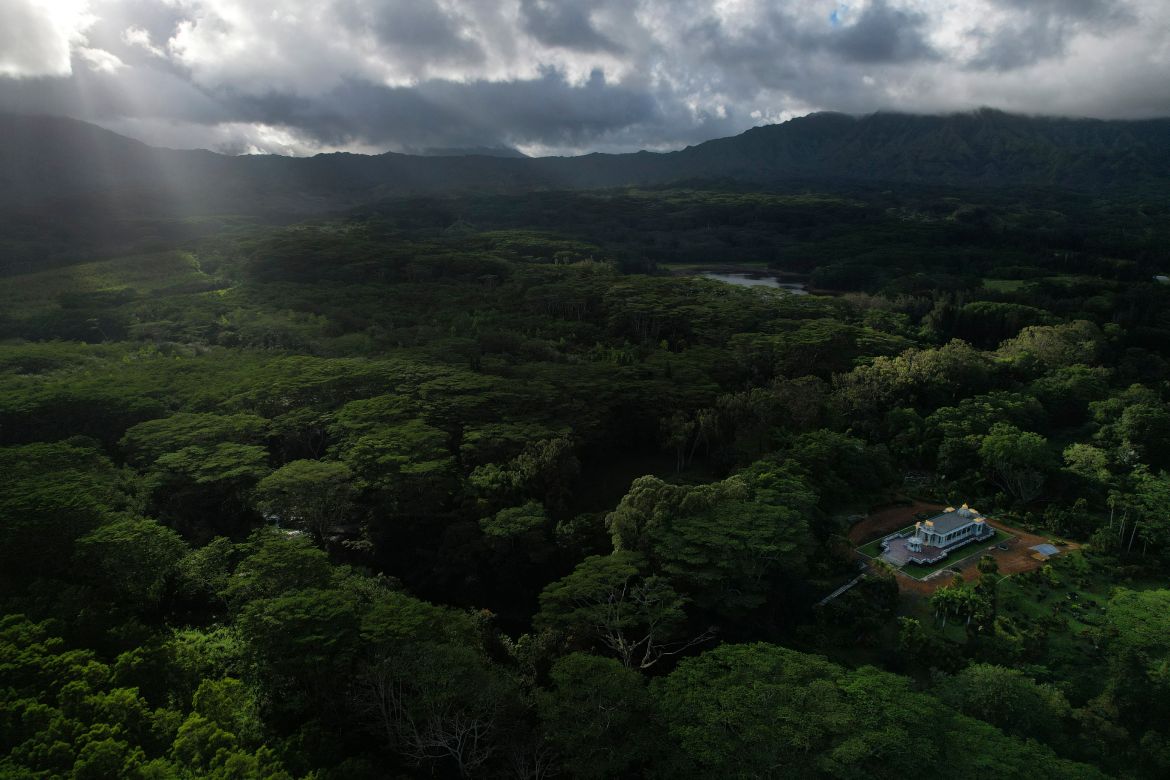
The sun shines down onto the Iraivan Temple surrounded by lush forest at Kauai's Hindu Monastery, on July 10, 2023, in Kapaa, Hawaii. The temple is made entirely of hand-carved granite, which the monks have been constructing for the last 33 years. It was completed in March and marked with a special opening ceremony the same month.
The Iraivan Temple is nestled on one of the smaller islands in Hawaii, surrounded by lush gardens and forests. It was completed in March and marked with a special opening ceremony the same month. [Jessie Wardarski/AP Photo]
Advertisement
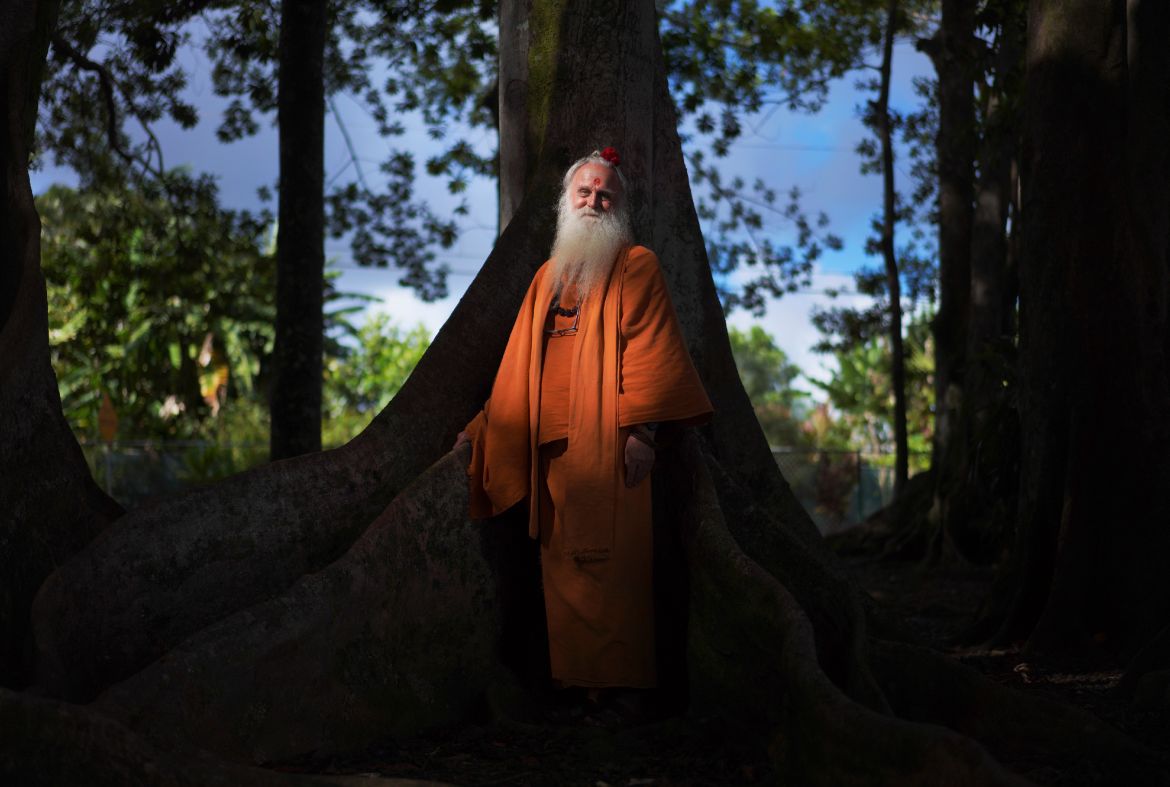
Paramacharya Sadasivanatha Palaniswami stands at the base of a Rudraksha tree, which produces a bright blue fruit at the Kauai Hindu Monastery.
Paramacharya Sadasivanatha Palaniswami stands at the base of a Rudraksha tree, which produces a bright blue fruit at the Kauai Hindu Monastery. Over the last 50 years, Palaniswami, who knows every sector of the 382-acre (154.5-hectare) ground, has carved out tranquil spaces conducive to meditation and reflection. [Jessie Wardarski/AP Photo]
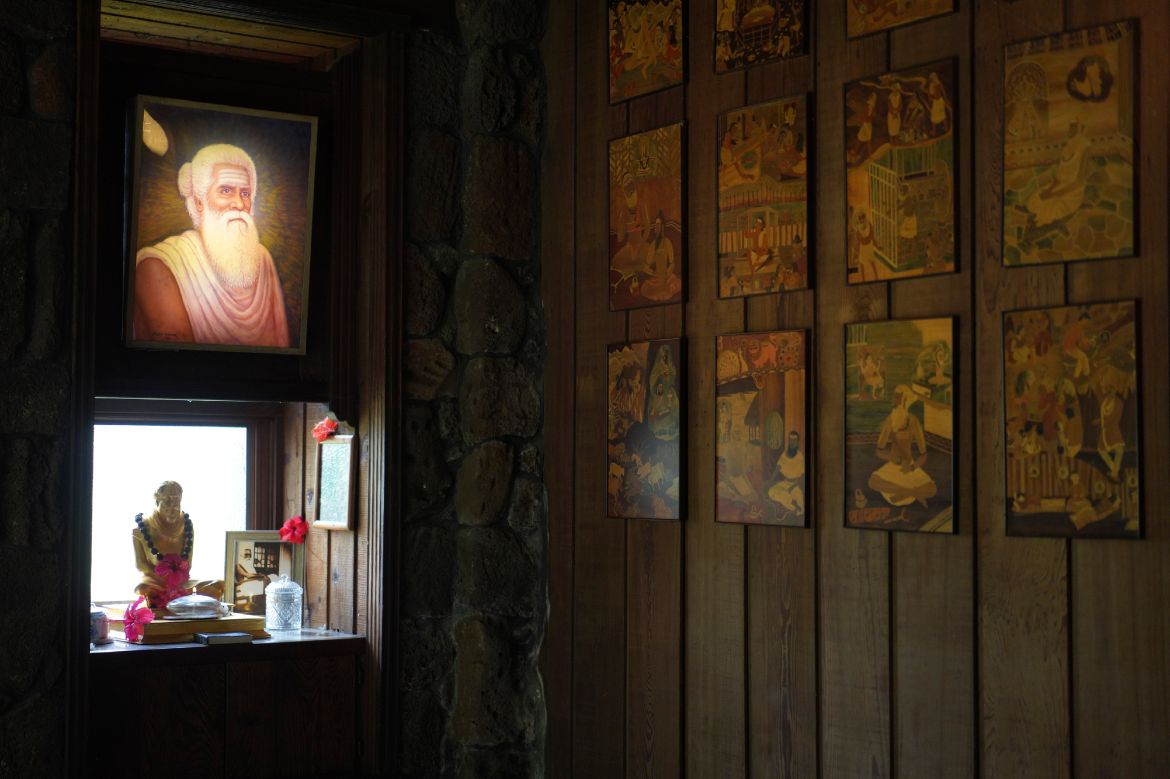
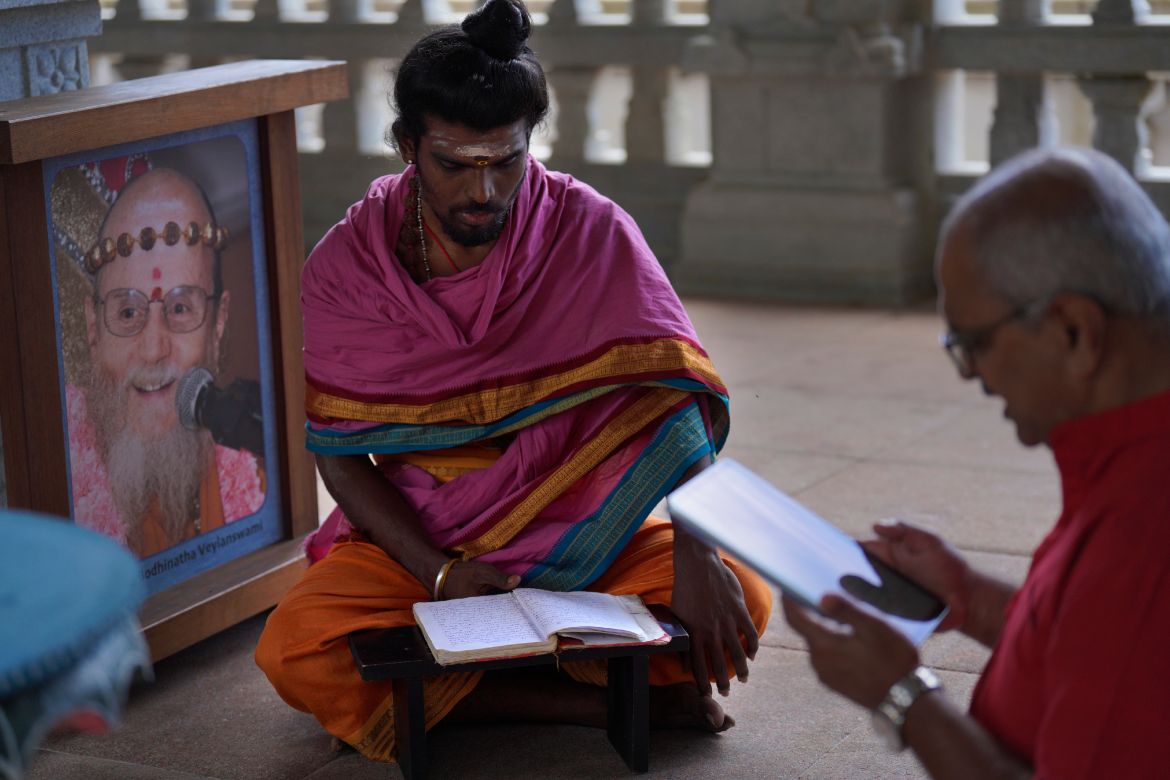
A lit photo of Satguru Sivaya Subramuniyaswami, left, the founding guru of Kauai's Hindu Monastery, hangs in a meditation room.
A lit photo of Satguru Sivaya Subramuniyaswami, left, the founding guru of Kauai's Hindu Monastery, hangs in a meditation room. The temple monastery was founded in 1970. [Jessie Wardarski/AP Photo]
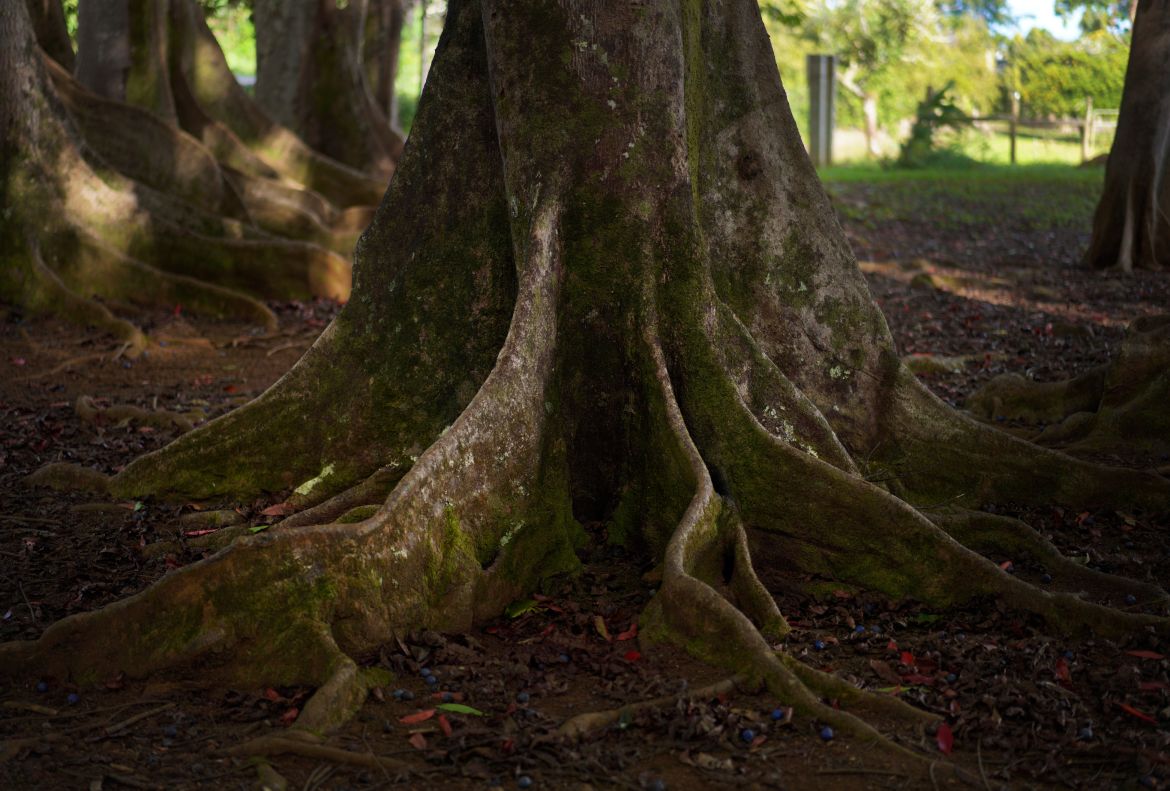
The large roots of Rudraksha trees, which provide bright blue sacred fruit, line the forest floor on the edge of the Kauai Hindu Monastery.
The large roots of Rudraksha trees, which provide bright blue sacred fruit, line the forest floor on the edge of the monastery. Some 45 years ago, Palaniswami and his guru planted seedlings that were about 8cm (3 inches) tall. They now tower over 30 metres (100 feet) and make up the Rudraksha forest. [Jessie Wardarski/AP Photo]
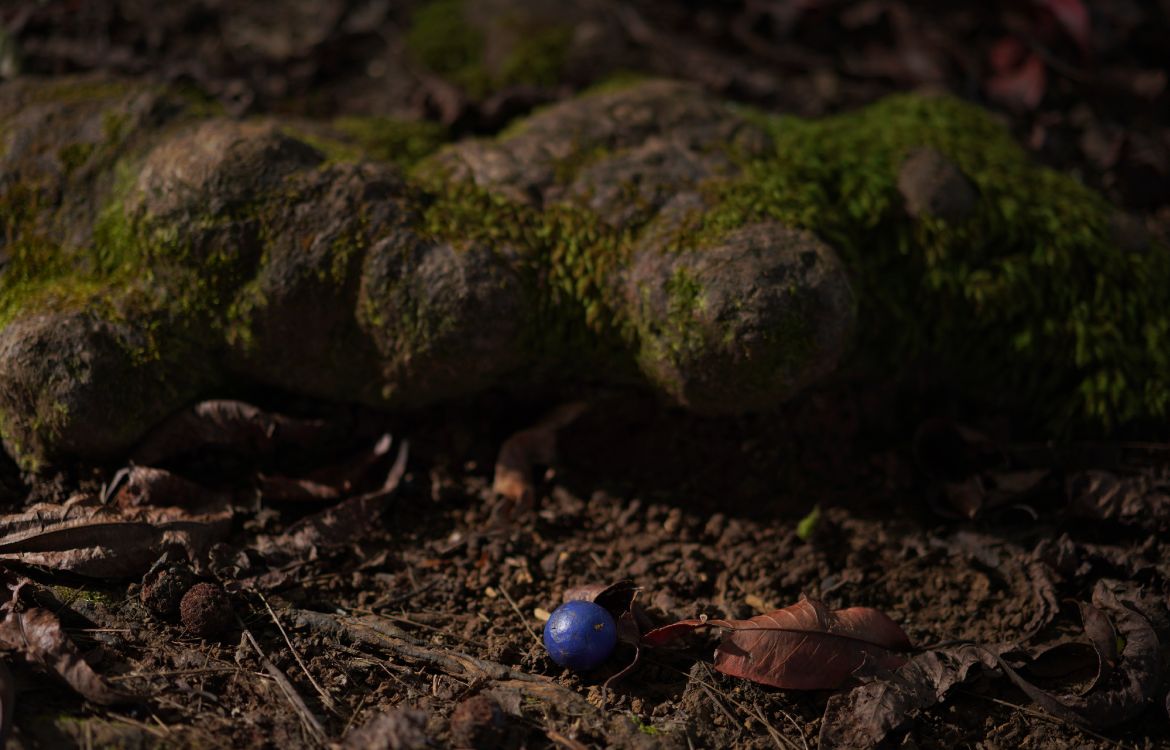
A piece of sacred fruit lays at the base of a Rudraksha tree at the Kauai Hindu Monastery.
A piece of sacred fruit lays at the base of a Rudraksha tree at the Monastery. The word 'Rudraksha' in Sanskrit means 'the tear of Shiva'. The trees bear cerulean fruit, and its seeds are used for prayer, meditation and protection. [Jessie Wardarski/AP Photo]
Visitors stand at the edge of the Rudraksha forest at the Kauai Hindu Monastery in Kapaa, Hawaii.
Guests are allowed to take the sacred, bright blue Rudraksha fruits that have fallen around the base of the trees. The monks pressure-wash the seeds, stringing them into necklaces. [Jessie Wardarski/AP Photo]
Advertisement
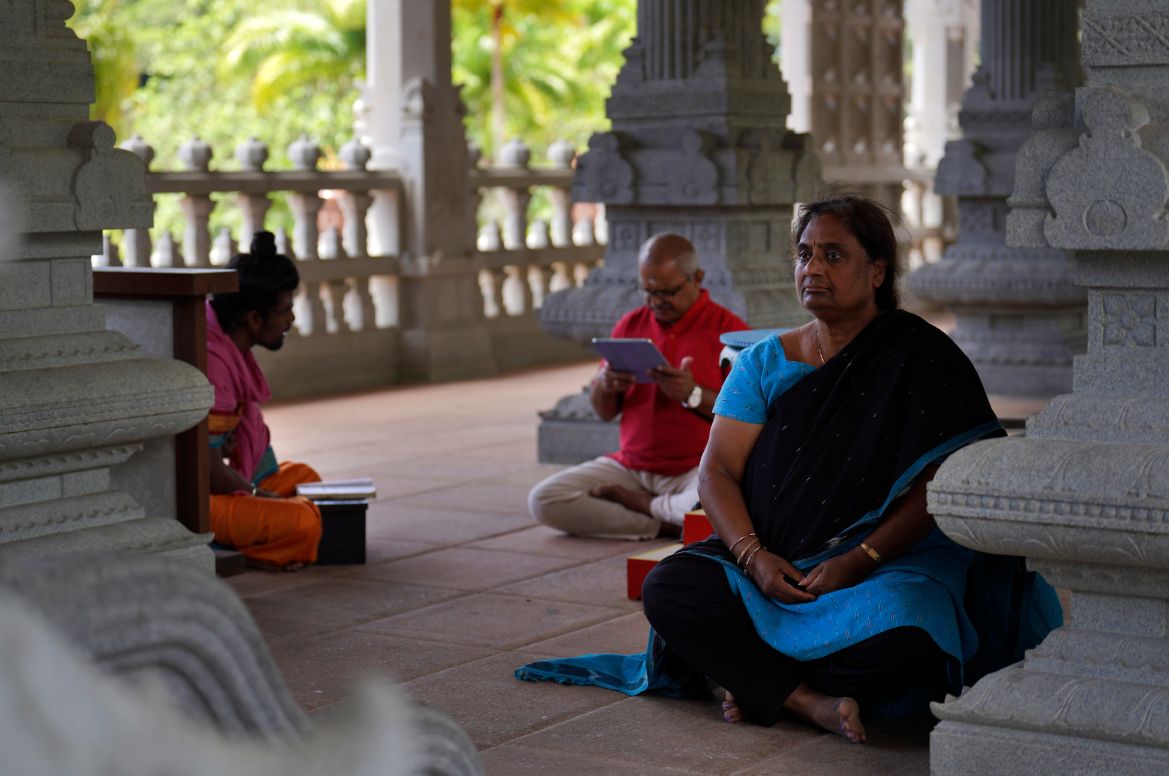
Devajyothi Kondapi, right, a pilgrim who visits from Portland, Oregon a few times a year, meditates in the Iraivan Temple as her husband practices a chant, at Kauai's Hindu Monastery.
Devajyothi Kondapi, right, a pilgrim who visits from Portland, Oregon, a few times a year, meditates in the Iraivan Temple as her husband practises a chant at the monastery. Kondapi believes the monks, their discipline and authenticity make it 'a divine place'. [Jessie Wardarski/AP Photo]
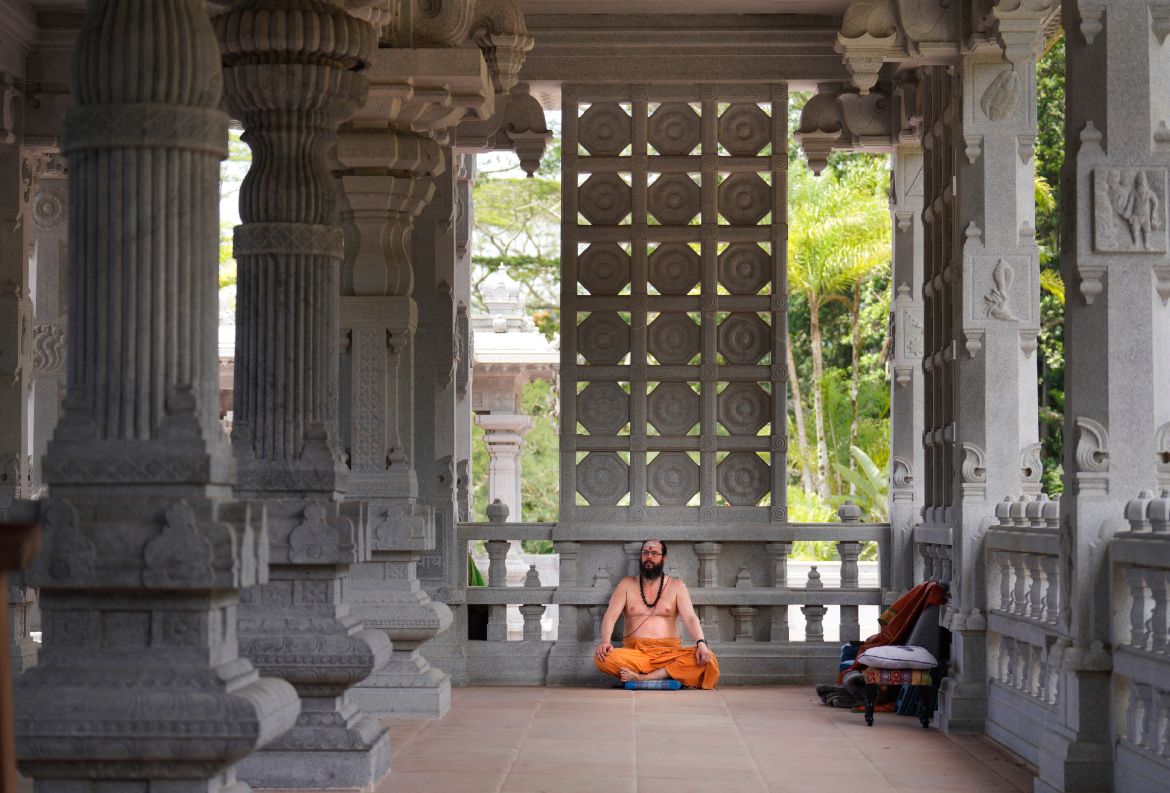
Sannyasin Siddhanathaswami sits in the Iraivan Temple at the Kauai Hindu Monastery in Kapaa, Hawaii.
Sannyasin Siddhanathaswami sits in the Iraivan Temple at the Kauai Hindu Monastery. The word 'Iraivan' is an ancient Tamil word that means 'he who is worshipped'. [Jessie Wardarski/AP Photo]
Pravinkumar Vasudeva, left, who serves as priest of Iraivan Temple, teaches a pilgrim from Portland, Oregon, at the Kauai Hindu Monastery.
Pravinkumar Vasudeva, left, who serves as a priest of Iraivan Temple, teaches a pilgrim from Portland, Oregon, at the monastery. [Jessie Wardarski/AP Photo]
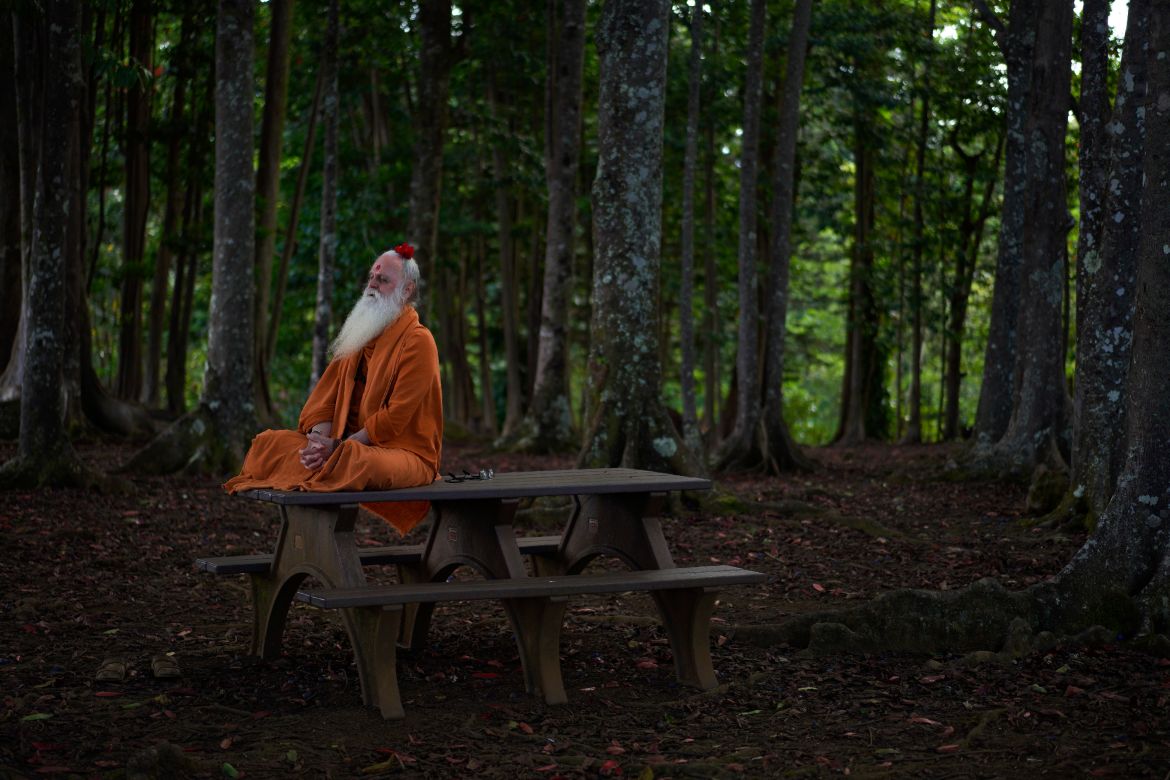
Paramacharya Sadasivanatha Palaniswami sits on a picnic table surrounded by Rudraksha trees, chanting a Sanskrit verse in honor of his guru, at Kauai's Hindu Monastery.
Paramacharya Sadasivanatha Palaniswami sits on a picnic table surrounded by Rudraksha trees, chanting a Sanskrit verse in honour of his guru, at the monastery. [Jessie Wardarski/AP Photo]
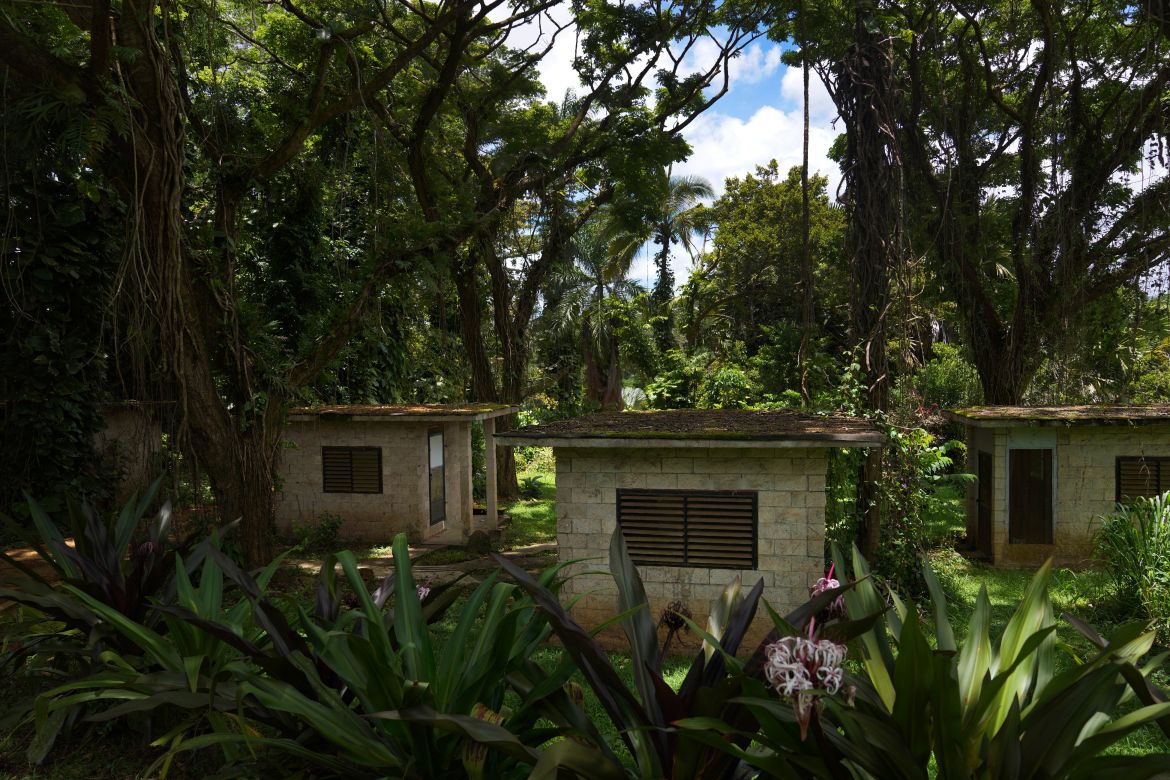
The monks of Kauai's Hindu Monastery sleep in 10-by-10 huts in the wood in Kapaa, Hawaii.
The monks of Kauai's Hindu Monastery sleep in huts in the woods. Their day begins at 4am with temple worship and guided meditation. And during the day, they perform different tasks that are either assigned or for which they volunteer. [Jessie Wardarski/AP Photo]
Acharya Kumarnathaswami shapes a piece of wood at Kauai's Hindu Monastery in Kapaa, Hawaii.
The monks, who take vows of celibacy, nonviolence and vegetarianism, are guided and inspired by the philosophy of Shaivism, one of the major Hindu traditions, which worships Shiva as the supreme being. [Jessie Wardarski/AP Photo]
Visitors of the Kauai Hindu Monastery gather for a photo with Hanuman, the Hindu monkey deity renowned for his courage, power, and faithful selfless service to Lord Rama.
Visitors of the Kauai Hindu Monastery gather for a photo with Hanuman, the Hindu monkey deity. In this sculpture, Hanuman carries the Iraivan Temple. [Jessie Wardarski/AP Photo]
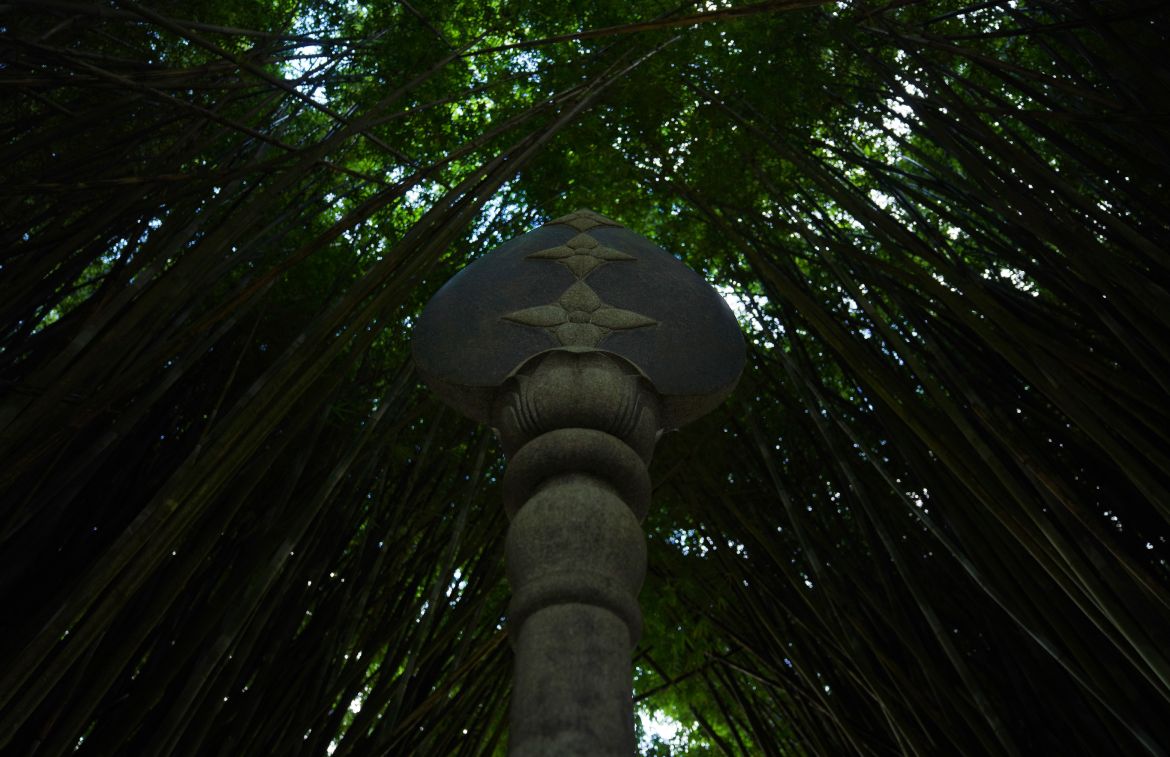
A statue of a spear, which is the weapon of Lord Muruga, the Hindu god of war, stands amidst a cave of bamboo, at Kauai's Hindu Monastery.
A statue of a spear, which is the weapon of Lord Muruga, the Hindu God of war, stands amid a cave of bamboo at the monastery. [Jessie Wardarski/AP Photo]


  • About

    • About Us
    • Code of Ethics
    • Terms and Conditions
    • EU/EEA Regulatory Notice
    • Privacy Policy
    • Cookie Policy
    • Cookie Preferences
    • Accessibility Statement
    • Sitemap
    • Work for us
  • Connect

    • Contact Us
    • User Accounts Help
    • Advertise with us
    • Stay Connected
    • Newsletters
    • Channel Finder
    • TV Schedule
    • Podcasts
    • Submit a Tip
    • Paid Partner Content
  • Our Channels

    • Al Jazeera Arabic
    • Al Jazeera English
    • Al Jazeera Investigative Unit
    • Al Jazeera Mubasher
    • Al Jazeera Documentary
    • Al Jazeera Balkans
    • AJ+
  • Our Network

    • Al Jazeera Centre for Studies
    • Al Jazeera Media Institute
    • Learn Arabic
    • Al Jazeera Centre for Public Liberties & Human Rights
    • Al Jazeera Forum
    • Al Jazeera Hotel Partners

Follow Al Jazeera English:

  • facebook
  • twitter
  • youtube
  • instagram-colored-outline
  • rss
Al Jazeera Media Network logo
© 2026 Al Jazeera Media Network