Jordan’s King Abdullah dissolves parliament
Move paves way for elections which the opposition says it will boycott unless its demands for representation are met.
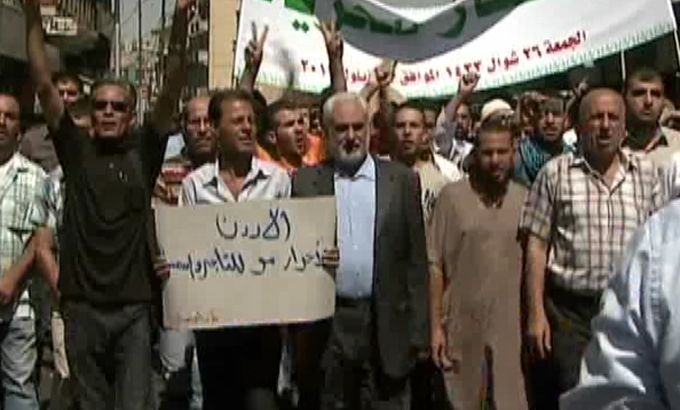
King Abdullah of Jordan has dissolved the country’s parliament, paving way for elections expected early next year.
The announcement was made on the eve of a rally organised by the Muslim Brotherhood, the country’s main opposition group, which is hoping to stage its largest demonstration on Friday calling for political and economic reforms.
“The king has decided to dissolve the chamber of deputies from this Thursday and to call early elections,” a statement said, without giving the date. The monarch has said he wants polls to be held by the end of 2012.
The Muslim Brotherhood said earlier it was going ahead with its planned rally in central Amman, the capital, on Friday with an estimated 50,000 supporters expected to attend.
A demonstration in support of the king was called off over fears of unrest as it would have coincided with the opposition rally, organisers said.
“We have postponed indefinitely our demonstration scheduled at the same time as the Muslim Brotherhood’s to avoid any problems,” said Jihad al-Sheik, head of an internet-based youth group that organised the event.
The cancellation came “after a request to that effect from the director of general security, Hussein al-Majali, MPs and tribal leaders” to prevent unrest.
The Brotherhood and a coalition of tribal and other groups have been pressing the monarch to speed up what they
consider to be the slow pace of political reform.
King Abdullah has repeatedly said he wants elections to be held later this year or at the latest early next year.
A conservative government led by Jordanian Prime Minister Fayez al-Tarawneh passed an electoral law last July that has angered the country’s opposition.
The opposition says it will boycott upcoming elections unless its demands for wider representation are met.
The electoral law keeps intact a system that marginalises the representation of Jordanians of Palestinian origin, on whom Islamists rely for their support, in favour of native Jordanians who keep a tight grip on power and are the backbone of the powerful security forces.
A boycott by the country’s only effective opposition, the Islamic Action Front (IAF), the political arm of the Muslim Brotherhood, is threatening to damage the legitimacy of any future parliament.
Numerous demonstrations have taken place in Jordan since January 2011 to call for political and economic reforms and demand an end to corruption.
Election boycott threat
The Brotherhood says it would boycott the polls as it did in 2010 to protest against the lack of solid reforms, while calling for a parliamentary system where the prime minister is elected, rather than named by the king.
In an exclusive interview with AFP news agency last month, the king said a decision by the Islamists to boycott the vote was “a tremendous miscalculation.”
“As constitutional monarch, my mandate is to be the umbrella for all political groupings and all segments of our society, and as part of that responsibility, I am telling the Muslim Brotherhood that they are making a tremendous miscalculation,” he said.
“The countdown to the elections has already started. Registration is under way. We have already crossed the one-million person mark. Parliament will be dissolved. The elections date will be announced. And we will have a new parliament by the new year.”
King Abdullah has ordered parliament to increase seats reserved for party candidates, urging the Islamists to take part in the polls. MPs raised the number from 17 to 27, but failed to satisfy opposition groups.
“This elections law is not perfect. We all understand that. But there is no better consensus on an alternative. What is critical is that we keep going forward, and — mark my words — we will have a new parliament by the new year,” the king said.
“So I am telling the Muslim Brotherhood, you have a choice. To stay in the street or to help build the new democratic Jordan.”