What is stoking Iraqi rage?
We ask what really lies behind the prevailing unrest and if the president will be able to contain the sectarian anger.
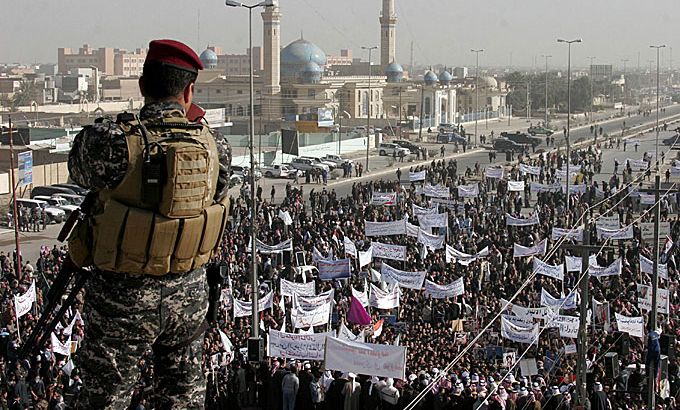
The Iraqi government is dealing with the anger of thousands of protesters this week.
|
“Certain elements of Iraqiya are resorting to sectarian[ism] trying to mobilise for the upcoming local elections, and it’s very apparent that those who have been very negative in pushing for the services to the people or assisting parliament with new laws, are the same people polarising the population.” – Saad al-Muttalibi, a member of the State of Law Coalition |
Mass rallies are taking place in Ramadi and Fallujah against what is seen as an unfair crackdown on Sunnis.
What are the challenges facing the Nouri al-Maliki administration, a government of national unity formed in 2010?
The unrest is part of a broader sectarian tension that threatens the stability of the war-torn country, a year after the last US troops left.
Many Sunnis see the arrest of the nine guards of Sunni Iraqi finance minister, Rafia al-Issawi, as the latest in a series of moves by al-Maliki’s Shia-dominated government against their community.
Last year the arrest warrant against top Sunni official, Tariq al-Hashemi – plunged the country into chaos. He is now in exile in Turkey.
|
“It is interesting hearing how this [Assawi’s case] is a judicial process. The problem is that Iraq has become politicised on every single level including the judiciary, as well as the security apparatus, the police, the army, every single level of Iraq has now been politicised, and therefore every single decision made.” – Anas al-Tikriti, the CEO of Cordoba Foundation |
Al-Hashemi had been given multiple death sentences for allegedly running hit squads.
Iraq’s Kurds are also at odds with the central government on issues that include the distribution of land for the development of oil resources in the Kurdish region.
So will these recent protests foment further sectarian violence in Iraq?
Joining presenter Adrian Finighan on Inside Story are guests: Saad al-Muttalibi, a member of the state of law coalition, and a political advisor to the Iraqi dialogue and reconciliation ministry; Anas al-Tikriti, the CEO of Cordoba Foundation and a former member of the Muslim Association of Britain; Hiwa Osman, an Iraqi Kurdish journalist.
|
“Iraq is the fourth or the fifth most corrupt country in the world, according to Transparency International. Baghdad is still the worst city to live in in the world, according to the Mercer Index in London. These indices have nothing do with sectarianism, nothing to do with politics, it has everything to do with the performance of the government.” Hiwa Osman, an Iraqi Kurdish journalist |