Iran tests missiles amid war games
Tehran test-fires two short-range missiles during military exercise, state TV reports.
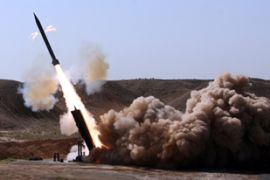
The latest tests are likely to further increase tensions between Iran and the West over Tehran’s nuclear ambitions.
‘Great Prophet four’
On Saturday, the elite Revolutionary Guards said it would begin missile war games codenamed ‘Great Prophet four’ from Sunday in a bid to “maintain and improve” the deterrent capability of Iran’s armed forces.
| in depth | |||||||||||||
|

Hossein Salami, the Guards’ air force commander, said the main aim of the manoeuvres was to “evaluate the technical developments recently achieved in surface-to-surface missiles”, Revolutionary Guards website Sepahnews reported.
Salami said there would be “simultaneous” and “successive” firing of missiles in the exercises.
Iran stages regular military manoeuvres in strategic Gulf waters, showcasing its long- and medium-range missiles as well as other weaponry.
The Islamic republic has in the past threatened to target US bases in the region and to block the strategic Gulf Strait of Hormuz waterway for oil tankers if its nuclear sites are attacked.
Sunday’s missile exercise comes two days after the International Atomic Energy Agency (IAEA) said Iran was building a second uranium enrichment plant, triggering condemnation from Western leaders.
Israel and the United States have never ruled out a military option to thwart Iran’s nuclear drive, which they suspect of having a military aim. Tehran denies the charge.
Access welcomed
On Saturday, Iran’s nuclear chief Ali Akbar Salehi said the new plant will be put under the supervision of the IAEA.
Hillary Clinton, the US secretary of state, welcomed the decision to grant access to the IAEA.
“It is always welcome when Iran makes a decision to comply with the international rules and regulations, and particularly with respect to the IAEA,” she said.
Mahmoud Ahmadinejad, the Iranian president, who returned from a meeting of the United Nations General Assembly in New York on Saturday, said the disclosure of the new facility was a success for Iran.
“This issue was turned around in a way that (now) we believe they regret bringing it up,” he said.
“They may pursue this issue through the media but it has become a firm blow to the arrogance,” Ahmadinejad said in reference to the United States and other Western powers, he said.
The announcement of the new facility came just days before an October 1 meeting in Geneva between Iran and six world powers to discuss Tehran’s disputed atomic programme.