Police crackdown on anti-Putin protesters
Russian riot police detain several opposition leaders to stop them from taking part in a Moscow rally.
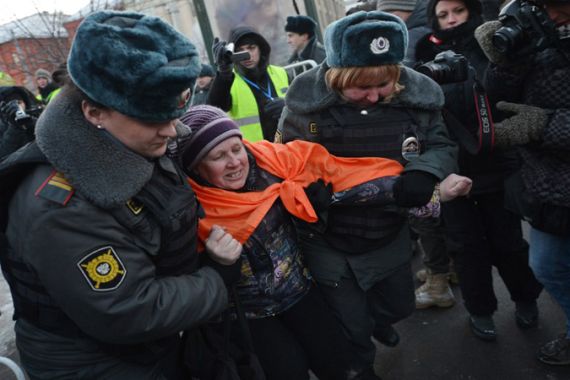
Russian riot police have detained about 40 protesters and several opposition leaders to stop them from taking part in a banned rally against President Vladimir Putin in front of the former KGB security police’s headquarters in Moscow.
Police moved in lines to channel participants in the rally toward a nearby metro station and cleared the Lubyanka Square where the rally had taken place on Saturday.
Leftist Sergei Udaltsov and anti-corruption blogger Alexei Navalny were detained in the square, where witnesses said about 3,000 people gathered, and protest leaders Ilya Yashin and Ksenia Sobchak were detained on their way.
All four were released without charge hours later, indicating they had been detained to prevent them stirring up the crowd at the protest.
Some of the other detainees appeared to include journalists. One man shouted “I can show you my press card!” as he was dragged toward a police van.
The rally was intended to celebrate the first anniversary of demonstrations that grew into the biggest protests against Putin since he rose to power 13 years ago, but police were out in force to keep order and helicopters buzzed overhead.
Despite the risk of arrest, protesters stood clapping. Some chanted “Free political prisoners” and “Shame”.
Moscow city authorities refused to authorise the protest and police in helmets and flak jackets told people to leave as they gathered for the rally despite the freezing cold.
Anti-corruption protests
The protests began a year ago over suspicions that Putin’s United Russia party benefited from widespread vote-rigging when it won a parliamentary election. Opponents say Putin’s domination of Russia is dooming the country to economic and political stagnation at a time when it needs reform.
The protests reached their peak at the turn of the year but started to wane after Putin won nearly two-thirds of votes in the presidential election in March, enabling him to return for his third presidential term after four years as prime minister.
The demonstrations accelerated the birth of a civil society two decades after the collapse of the Soviet Union, but opposition leaders accuse Putin of clamping down on dissent and freedom of expression since he began his new presidential term in May.
Laws passed since May broaden the definition of treason, increase the punishment for protesters who step out of line, and tighten control over the Internet and on campaign and lobby groups that receive foreign funding.
Several opposition leaders, including Navalny, face criminal charges that they say are politically motivated and intended to intimidate them into giving up their opposition activities.
Putin, 60, denies any crackdown. He maintains a grip on state media and has retained support in the industrial and provincial areas that are his traditional power base.