[QODLink]
Central & South Asia
'Mumbai gunman' retracts confession
Mohammed Ajmal Kasab tells court in India that he was tortured while in custody.
Last Modified: 18 Dec 2009 11:22 GMT
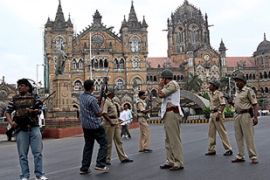
The main station is Mumbai was one of several sites targeted during the deadly three-day siege [EPA]

A man accused of taking part in a deadly siege in the Indian city of Mumbai in 2008 has retracted his confession, claiming that police tortured him into admitting his role in the attacks.

Mohammed Ajmal Kasab, 21, told the judge in a special court on Friday that he came to Mumbai as a tourist and was arrested 20 days before the siege began.

He denies being a man photographed with an assault rifle in photographs taken during the three-day siege of Mumbai's main train station, one of several sites targeted by the gunmen.

One hundred and sixty-six people died in the attacks, in which 10 men armed with rifles stormed two luxury hotels, a Jewish centre and the train station. Nine of the gunmen were killed.

'Death' threat

Kasab said that police took him from his cell on the day the attacks started because he resembled one of the gunmen.

He claims that they shot him to make it look as if he had been involved in the attacks and re-arrested him.

Kasab said he was initially brought into police custody after wandering around the city late at night, looking for a place to stay.

His Pakistani citizenship aroused suspicion, he said.

Kasab, who earlier confessed to opening fire on people inside the station, could face the death penalty if convicted.

Source:
Agencies
Topics in this article
People
City
Featured on Al Jazeera
Al Jazeera's exclusive publishing of a key Guantanamo prison military document lays bare the brutality of force-feeding.
Former military official says poverty and anger in indigenous communities mean conditions for an "insurgency" are ripe.
A four-part series that gives a rare insight into the country on the move, with history in tow.
Series on the Palestinian 'catastrophe' of 1948 that led to dispossession and conflict that still endures.
Featured
Once a bustling haven, Elasha Biyaha has almost become a ghost town as residents flee.
Two years since the start of the uprising, rebels and Assad's forces remain locked in conflict.
Lebanon-based militia is assisting villagers caught up in the conflict.
A four-part series that gives a rare insight into the country on the move, with history in tow.
Extensive coverage of war crimes tribunals and controversial calls for blasphemy laws.
join our mailing list