Profile: Nicolas Maduro
Former trade unionist rose through party ranks to become the late Hugo Chavez’s preferred successor as president.
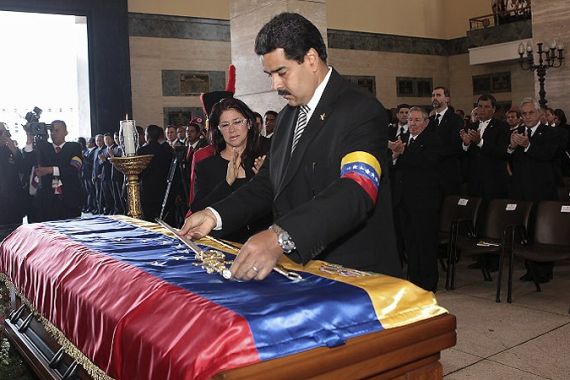
Nicolas Maduro, Venezuela’s interim president, is the ruling PSUV party’s candidate in the April 14 vote called after the death of late president Hugo Chavez.
Maduro vowed at his swearing-in ceremony at the National Assembly in Caracas to follow the example set by his late predecessor.
The former trade unionist, who Chavez named as his preferred successor in December, made the pledge in his inaugural speech on March 8.
The country’s opposition have criticised Maduro’s appointment, arguing that under the constitution Diosdado Cabello, the speaker of the National Assembly, should take over as leader.
The minister of foreign affairs since 2006, Maduro was born in the Venezuelan capital and educated at a public high school.
Maduro became politically active as a teenager when he joined the Socialist League and travelled to Cuba for training in union organising.
He did not attend university and joined the union for workers in the Caracas metro system upon his return home, rising through the ranks.
“Maduro has a very strong ideological orientation, close to the communist ideology,” Professor Ramon Pinango, a sociologist from the Venezuelan University of IESA, told Al Jazeera. “Contrary to Diosdado, he is not very pragmatic.”
‘Closer to the Cubans’
Maduro was first elected to office in 1998 and quickly became one of Chavez’s most loyal associates.
As foreign minister he is considered partially responsible for spearheading the creation of the Bolivarian Alliance for the Americas, with other left-leaning Latin American governments, and expanding ties between Venezuela, Russia and China.
Maduro was among the few aides to be seen at Chavez’s side during the late president’s visits to Cuba for treatment for cancer.
He was named vice-president in October 2012, with Chavez declaring him his preferred successor two months later, following the recurrence of the president’s cancer.
Inside the PSUV, the ruling socialist party, Maduro is seen to be “closer to the Cubans and the Castro brothers” than Cabello, Ysrael Camero, professor and political analyst at the Central University of Venezuela, told Al Jazeera.
“He represents the civilian sector inside the political party,” notes Camero, as opposed to Cabello – who is said to have more support from the military.