[QODLink]
Americas
Cuba to allow mobile phones
President Raul Castro has been improving Cubans' access to consumer goods.
Last Modified: 03 Apr 2008 11:04 GMT
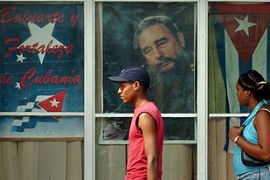
Under Fidel Castro few people were permitted
access to mobile phones [EPA]

Cuba's goverment is to permit the unrestricted use of mobile telephones for the first time.

The Cuban telecommunications monopoly ETECSA said it would begin a mobile phone service for the general public in the next few days, according to a statement in the official Communist Party newspaper Granma on Friday.
The move is the latest step by Raul Castro, Cuba's president, to improve ordinary people's access to consumer goods since he took over power from his ill brother Fidel in February.

Mobile phones were previously only allowed for people working for foreign firms or in key Cuban government posts.
Some Cubans have reportedly managed to obtain phones by having foreigners sign contracts in their names, however their usage remains uncommon in Cuba.
 
But the new phone service may prove too expensive for many Cubans.
 
ETECSA said it would permit the public to sign pre-paid contracts in Cuban convertible pesos, which are worth 24 times the regular pesos that Cuban state employees are paid in.
 
It also said the new service would be used to fund development of Cuba's telecommunications systems and land line telephone services.
 
A few weeks ago Raul Castro lifted the ban on many electrical appliances, including DVD players and computers.

Cuba's government controls well over 90 per cent of the economy, and it ensures that most Cubans have free housing, education and health care and receive ration cards that cover basic food needs.

The average monthly state salary is just 408 Cuban pesos, a little less than $20.
Source:
Agencies
Topics in this article
People
Country
Featured on Al Jazeera
More and more people in the US are living in poverty - yet Mitt Romney's policies would further shred the safety net.
The US has more wireless devices than people but without a large increase in bandwidth capacity, networks might crash.
Is Israel being deliberately indecisive on whether or not to support the Syrian opposition?
The contradictions of Obama's policy toward Iran went unnoticed in the US, but not in Iran and Israel, writes Porter.
<  > 
join our mailing list

Enter Zip Code
Go