Nigeria fuel-price protest enters second day
Demonstrators demanding cancellation of subsidy cuts and an end to corruption pile pressure on government.
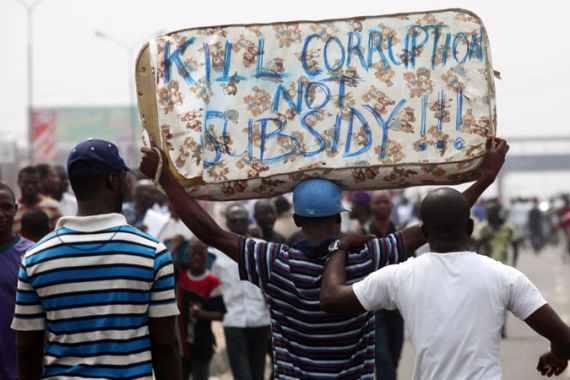
 |
| Protesters have increased pressure on President Jonathan to reinstate the fuel subsidy [AFP] |
Nigerians have taken to the streets in growing numbers on the second day of protests against a sharp increase in petrol prices, increasing pressure on President Goodluck Jonathan to reverse his removal of fuel subsidies.
Africa’s biggest oil producer removed on January 1 subsidies on fuel, which many citizens see as their only welfare benefit, more than doubling fuel prices to to at least $3.50 per gallon.
Tuesday’s protests, during which several thousand people take to the streets, were bigger than on Monday in Nigeria’s largest city, Lagos, and in the capital, Abuja. They were also on par with the previous day in other major cities.
Angry youths put up a burning roadblock outside luxury enclaves in Lagos.
|
The Stream looks at the Nigerian protests |
But Jonathan’s resolve in the face of the kind of protests that have derailed past attempts to scrap the fuel subsidy showed no sign of weakening.
Activists wore shirts bearing symbols for a loose-knit group called “Occupy Nigeria”, inspired by those near Wall Street in New York.
Anger extended to government corruption in Nigeria, a nation beset by politicians and military rulers who have stolen billions of dollars in oil revenues over the years.
Protesters also demanded a stronger government response to ongoing religious violence in Nigeria that, according to an Associated Press news agency count, killed at least 510 people last year alone.
The attacks blamed on a radical Islamist group known locally as Boko Haram have raised tensions between Christians and Muslims in Nigeria.
On Tuesday, a mob attacked a mosque and a Quranic school in Benin City, causing some casualties, according to Nwakpa O Nwakpa, the Nigerian Red Cross spokesman.
Media reports suggested at least five people died in the attack, but there was no immediate confirmation from the government.
An aid worker who declined to be identified because of the sensitivity of the subject told Reuters news agency the violence in Benin had forced 3,000 Muslims of northern origin to flee.
A mob had tried to burn down a mosque on Monday in the city as well.