GCC seeks Iran nuclear guarantees
Gulf Arab leaders have called on Iran to do more to show it was not trying to obtain an atom bomb, thereby saving the region from another war.

Gulf Arab countries, wary of Iran’s power since the 1979 Islamic Revolution, share US concern about the prospect of Iran having a nuclear bomb but fear another military conflict in the region after the 2003 US-led invasion of Iraq.
Gulf Arabs are also worried about the possible environmental effects of a US attack on Iran‘s nuclear plant at Bushehr on the opposite side of the Gulf, or of leakage from unmonitored Iranian sites.
“We appreciate Iran’s efforts to reassure the region over its programme,” Sheikh Abdullah bin Zayed al-Nahayan, United Arab Emirates foreign minister, said after a summit of the Gulf Cooperation Council (GCC) in Riyadh on Saturday.
“But for the sake of stability and to avoid any environmental disaster, there needs to be more Iranian guarantees and we are trying to ensure this.”
Mediator role?
The minister declined to say whether the political and economic alliance, comprising Saudi Arabia, Kuwait, Bahrain, Oman, Qatar and the UAE, might try to use its close links to Washington to mediate in the dispute.
“We hope this crisis will be brought to an end through peaceful dialogue and (Iran) cooperating with the International Atomic Energy Agency (IAEA)” |
Abdullah said Iran had “commitments” to its Gulf Arab neighbours as well as the international community to ease concern over its nuclear plans.
Iran says its nuclear programme is for peaceful purposes and has vowed revenge if attacked by the United States or US ally Israel.
“We hope this crisis will be brought to an end through peaceful dialogue and (Iran) co-operating with the International Atomic Energy Agency (IAEA),” Abdul-Rahman al-Attiya, GCC secretary-general, said after the Riyadh talks, attended by leaders of major oil-exporting nations.
The one-day summit took place as France and Britain, with US backing, drafted a UN resolution demanding a halt to Iran‘s nuclear fuel programme.
Veto option
Russia and China, which have vetoes on Security Council resolutions, may oppose sanctions against Iran, the world’s fourth biggest oil exporter. The GCC states have not said what their position on sanctions would be.
 |
|
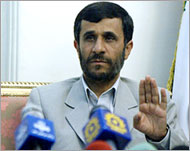
Iran says its nuclear programme |
Popular concern over a nuclear Iran in the Arab world is mainly limited to the Gulf region. Iran‘s pro-Palestinian rhetoric plays well to Arab publics who view their governments as doing little to stand up to US backing for Israel.
Arab countries bordering Israel are at least as concerned about Israel’s suspected nuclear arsenal.
“These (Gulf Arab) countries do not want Iran to have a nuclear weapon, but they also do not want it taken by force,” said Saudi political analyst Dawoud al-Shiryan.
Gulf countries, particularly heavyweight Saudi Arabia, fear pressure on them to follow in Iran‘s footsteps if it obtains the bomb – challenging the quietist ethos of Gulf states and their alliance with Washington.