Poll: Arab distrust of US growing
People in Arab nations believe the Iraq war has brought less peace, more terrorism and contrary to Washington’s claims, will result in less democracy, a new poll indicates.
The survey of six Arab countries, also found a plurality of respondents got their news from Aljazeera, currently at the centre of a storm over an alleged US idea to bomb its headquarters.
When asked which country was the biggest threat to them, most respondents chose Israel or the United States, while France was nominated as the country most respondents would like to be a superpower.
The University of Maryland/Zogby International poll published on Friday was conducted in Jordan, Lebanon, Morocco, Saudi Arabia and the United Arab Emirates in October.
Eighty-one per cent of respondents said the Iraq war had brought “less peace” to the Middle East, while only 6% believed it had enhanced peace.
More terrorism
Seventy-eight per cent of people questioned believed the Iraq war had resulted in more terrorism than before, while 58% said it brought less democracy, with only 9% believing it enhanced democratic development.
|
“They think the Iraq war has brought nothing but disaster” Shibley Telhami, University of Maryland professor |
While the administration of President George Bush frequently argues that it has liberated Iraqis from Saddam Hussein, only 6% of those surveyed believed that the Iraqi people were better off after the war. Seventy-seven per cent thought they were worse off.
“In addition to the Arab-Israeli issue, which has been the prism of how Arabs have looked at the US, there is an added new prism, and that is Iraq,” said Shibley Telhami, Anwar Sadat Professor for Peace and Development at the University of Maryland.
“They think the Iraq war has brought nothing but disaster.”
Only 6% thought spreading democracy was an objective in the war in Iraq, while 76% thought control of oilfields was important, and 68% believed support for Israel was the key motivating factor.
Growing hostility
“The American presence itself is something they fear … the perception of threat is there, because it does mean that in general people are rooting against the US in Iraq,” said Telhami.
The survey makes unwelcome reading for US diplomats, who have repeatedly tried to improve US standing in the Middle East.
Undersecretary for Public Diplomacy Karen Hughes confronted some of the hostility during a regional visit in September.
 |
|
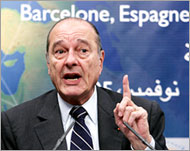
Arab opinion of French President |
The poll also asked, in a world with one superpower, which c country respondents would like to fulfil that role.
Twenty-one per cent said France, 13% said China and 10%said Pakistan. Only 6% voted for the United States, which came in just behind Britain, at 7%.
French President Jacques Chirac, emerged as the most popular leader.
Trusting Aljazeera
Forty-five per cent of those surveyed said they watched Aljazeera most for international news, followed by 11% for Dubai-based MBC.
Britain’s Daily Mirror newspaper reported the existence of a memo which summarised a conversation between Bush and British Prime Minister Tony Blair in which the US president was reported to have said he wanted to bomb the channel’s headquarters in Doha, Qatar.
Telhami said that he proved in a statistical analysis of similar findings regarding Aljazeera last year, that the station was not colouring Arab views of the United States.
He said Arab viewers without satellite television access were no less resentful of those who did subscribe to the channel.