Skip linksSkip to Content
play
Live
Navigation menu
  • News
    • Africa
    • Asia
    • US & Canada
    • Latin America
    • Europe
    • Asia Pacific
  • World Cup
  • Middle East
  • Explained
  • Opinion
  • Video
    • Features
    • Economy
    • Sport
    • Human Rights
    • Climate Crisis
    • Investigations
    • Interactives
    • In Pictures
    • Science & Technology
    • Podcasts
    • Travel
play
Live

In Pictures

Gallery|Humanitarian Crises

Forgotten tribes of South Sudan

Arab nomads found deep in the heart of South Sudan live in isolation, but are not immune from war and disease.

Save

Share

facebookxwhatsapp-strokecopylink
The Falata tribal elders and paramount Chief Ahmed Omar Younis [with green scarf]. This group comprises several hundred people across numerous travelling camps.
By Ashley Hamer
Published On 29 Jan 201529 Jan 2015

Upper Nile, South Sudan – The reclusive Falata people represent Arab tribes who migrated from western Africa to greater Sudan starting in the 19th century, reportedly settling in the region on their return from a pilgrimage to Mecca.


They are nomadic Muslims who rear vast herds of cattle and move across a wide territory in Chad, southern Sudan and South Sudan’s Upper Nile state since Sudan split into two countries in 2011. The total Falata population may number as many as three million.


They claim to have at least 60,000 heads of cattle, but to reveal the exact number would be impolite – akin to asking someone how much money is in their bank account.


Access to these transient, private people is difficult. No organisation – government or NGO – had visited them until recently when Christian aid organisation World Vision arrived to implement its mass livestock vaccination campaign in South Sudan, with the goal of immunising more than 300,000 animals.


More on this story


The youth, wearing vibrant embroidered kaftans and caps, were responsible for serving tea and grilled beef to the elders and guests seated on mats in the shade.
Advertisement
Falata children do not attend formal schooling, but are taught to read the Quran from a learned elder who teaches from one book and wooden tablets.
The nomadic lifestyle means children move with the herd and help with maintaining the camp.
The Falata, crossing a wide territory in Chad, Sudan, Ethiopia, and South Sudan, travel with camels as well as cattle.
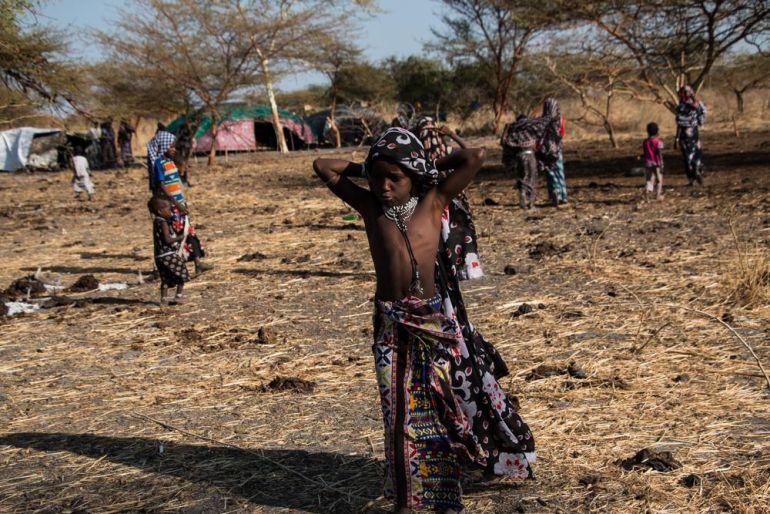
Falata marriages are polygamous; girls marry from 16 years of age and give birth to as many as 14 children. The women are loud and feisty. They decorate themselves in colourful embroidered cloth and wear hand-stitched bead jewellery.
Physical beauty is important to the Falata. They etch delicate tattoos and scars into their skin for pure decoration.
Advertisement
There may be as many as 60,000 cattle in the herd belonging to this particular group of Falata. Christian charity World Vision is conducting a mass livestock immunisation campaign in South Sudan with the aim of vaccinating more than 300,000 animals.
The nomadic lifestyle means children move with the cattle herd and help with maintaining the camp.


  • About

    • About Us
    • Code of Ethics
    • Terms and Conditions
    • EU/EEA Regulatory Notice
    • Privacy Policy
    • Cookie Policy
    • Cookie Preferences
    • Accessibility Statement
    • Sitemap
    • Work for us
  • Connect

    • Contact Us
    • User Accounts Help
    • Advertise with us
    • Stay Connected
    • Newsletters
    • Channel Finder
    • TV Schedule
    • Podcasts
    • Submit a Tip
    • Paid Partner Content
  • Our Channels

    • Al Jazeera Arabic
    • Al Jazeera English
    • Al Jazeera Investigative Unit
    • Al Jazeera Mubasher
    • Al Jazeera Documentary
    • Al Jazeera Balkans
    • AJ+
  • Our Network

    • Al Jazeera Centre for Studies
    • Al Jazeera Media Institute
    • Learn Arabic
    • Al Jazeera Centre for Public Liberties & Human Rights
    • Al Jazeera Forum
    • Al Jazeera Hotel Partners

Follow Al Jazeera English:

  • facebook
  • twitter
  • youtube
  • instagram-colored-outline
  • rss
Al Jazeera Media Network logo
© 2026 Al Jazeera Media Network