NATO sets up defence system in Turkey
Patriot missile system battery designed to defend Turkey from Syrian attack goes operational as tensions rise in region.
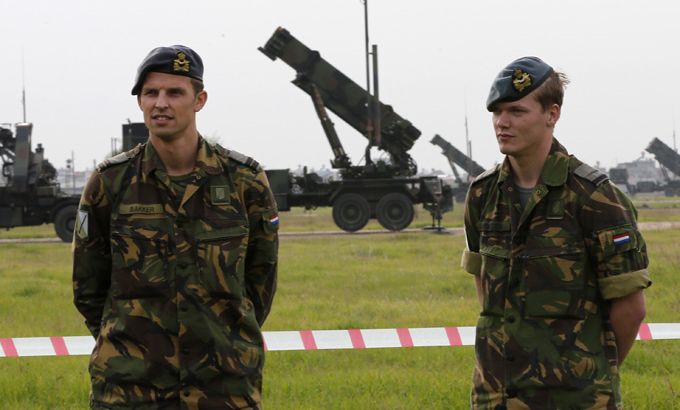
The first of six Patriot missile batteries being sent to defend Turkey from possible attack from Syria is now operational, NATO has said.
The battery, provided by the Netherlands, “will help to protect the (southern) city and people of Adana against missile threats,” it said in a statement on Saturday.
The Patriots are capable of shooting down hostile missiles in mid-air.
The frontier has become a flashpoint in the 22-month uprising against President Bashar al-Assad, with Syrian government shells frequently landing inside Turkish territory, drawing a response in kind from Ankara’s military.
“Behind us there is the first NATO Patriot battery in Turkey which is operational at the moment. That means that it is up and running. It is under NATO command and control,” said Polish Army Lieutenant Colonel Dariusz Kacperczyk, NATO spokesman for the Patriot deployment.
A battery sent by the Netherlands, consisting of five missile launchers, has been deployed next to an airport on the
edge of Adana, a city of about 1.6 million, located 120km from the Syrian border.
A second battery of seven launchers is at a US-Turkish air base east of the city.
At Adana airport, the truck-mounted launchers were raised in the air, pointing at Syria.
“Think of it as a bullet being fired from one side and we have got a fierce bullet that shoots down the other bullet,”
said Lieutenant-Colonel Marcel Buis, commander of the Dutch Patriots.
The batteries are being stationed around three southeastern Turkish cities and NATO says it will protect 3.5 million Turks from missile attack.
All batteries are expected to be in place and operational by the end of January.
Rising tension
Tensions have increased in recent weeks after NATO said it had detected launches of short-range ballistic missiles inside Syria, several of which have landed close to the Turkish border.
Turkey has scrambled warplanes along the frontier, fanning fears the war could spread and further destabilise the region.
Syria has called the deployment of the Patriot batteries “provocative” while Iran and Russia, which have supported Syria throughout the uprising, have criticised NATO’s decision, saying the Patriot deployment would intensify the conflict.
Turkey and NATO have strongly denied the Patriot missiles are a precursor to a no-fly zone that Syrian rebels have been requesting to help them hold territory against a government with overwhelming firepower from the air.
All six Patriot batteries will be connected directly to allied air command in Ramstein, Germany.
The Ramstein command and control centre receives intelligence on missile firings in Syria and will alert the Patriot batteries to any missile launch.
The Patriot batteries will then watch the arcs of the missiles and react if they threaten a Turkish city.