Drug-resistant malaria sparks alert
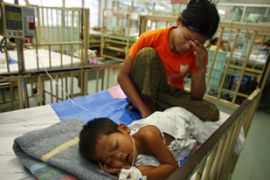
Outbreak of drug resistant strain in Cambodia could kill millions, scientists warn.
In the study conducted at Radboud University in the Netherlands volunteers using the drug chloroquine were given gradual exposure to malaria-infected mosquitoes.
The experiment produced dramatic results, with all 10 subjects in the vaccine group all acquiring immunity to malaria, while five others in a non-vaccinated comparison group did not.
Scientists warned, however, that the trial, while significant, was not practical on a large scale, although it did show that the principles involved offered one of the best hopes yet of developing an effective malaria vaccine.
Hotspot
| Deadly disease |
|
Source: WHO |
The Cambodian study focused on malaria cases around the town of Pailin, a former stronghold of the Khmer Rouge, close to the border with Thailand.
The region has long been known as a hotspot for drug-resistant malaria, with the drugs chloroquine and fansidar losing effectiveness there in the 1950s and 1960s, before becoming ineffective elsewhere.
News that the same region is now developing a resistance to artemisinin, has raised fears that one of the world’s frontline drugs used in combating the disease could soon become ineffective.
The drug, commonly given as artesunate, only became widespread in the treatment of malaria about a decade ago.
Among the biggest worries, scientists say, is that artemisinin resistance could spread to Africa, where 90 per cent of the world’s malaria deaths occur.
“Artemisinins are essential weapons in our war against malaria,” said Nick White, one of the scientists involved in the study.
“If they become ineffective, we have no immediate replacement. The consequences could be devastating. Elimination of malaria will not be possible and millions of lives could be lost.”
Wonder cure
Derived from an ancient Chinese herbal remedy, artemisinin had been considered a wonder cure for malaria because it was fast-acting, had few side effects and was almost 100 per cent effective.
| In depth |
  Interview: Youssou N’Dour’s anti-malaria campaign Interview: Youssou N’Dour’s anti-malaria campaign |
The drug, produced from the sweet wormwood tree, had been used in Chinese traditional medicine for centuries and was reportedly given by China to Cambodia’s Khmer Rouge regime in the 1970s, when its use as a malaria treatment was rediscovered.
According to scientists involved in the Pailin study, this, and the fact that it is possible to buy artemisinin unregulated from street vendors in the area, has probably fuelled the emergence of drug resistant malaria in the region.
Arjen Dondorp, the leader of a WHO-backed study, said that while 100 per cent resistance had not yet emerged in Pailin, it was taking significantly longer for the drug to clear the parasite from a patient’s bloodstream than elsewhere.
“It is a very worrying trend because instead of being able to kill the parasite in 48 hours it now takes about 84 hours,” he said.
“This longer time means that in some patients the parasite is not completely eradicated from the body, allowing the few parasites that are left to grow and reappear weeks later.”