Skip linksSkip to Content
play
Live
Navigation menu
  • News
    • Africa
    • Asia
    • US & Canada
    • Latin America
    • Europe
    • Asia Pacific
  • Middle East
  • Explained
  • Opinion
  • Sport
  • Video
    • Features
    • Economy
    • Human Rights
    • Climate Crisis
    • Investigations
    • Interactives
    • In Pictures
    • Science & Technology
    • Podcasts
    • Travel
play
Live

In Pictures

Gallery|Climate Crisis

Mountain villages fight for future as melting glaciers spell floods

Fifteen million people worldwide are at risk of glacial lake flooding, with two million of them in Pakistan.

A view of Passu village, located in the Gojal valley in the Karakoram mountain range in the Gilgit-Baltistan region of Pakistan.
A view of Passu village, located in the Karakoram mountain range in the Gilgit-Baltistan region of Pakistan, a country where two million people are at risk of glacial lake flooding, according to a February study in the scientific journal Nature Communications. [Akhtar Soomro/Reuters]

By Reuters

Published On 27 Nov 202327 Nov 2023

Share

facebooktwitterwhatsappcopylink

Save

On the steep slope of a glacier jutting through the Hunza Valley in Pakistan’s mountainous far north, Tariq Jamil measures the ice’s movement and snaps photos. Later, he creates a report that includes data from sensors and another camera installed near the Shisper glacier to update his village an hour’s hike downstream.

The 51-year-old’s mission: mobilise his community of 200 families in Hassanabad, in the Karakoram mountains, to fight for a future for their village and way of life, increasingly under threat from unstable lakes formed by melting glacier ice.

When glacial lakes overfill or their banks become unsound, they burst, sparking deadly floods that wash out bridges and buildings and wipe out fertile land throughout the Hindu Kush, Karakoram, and Himalayan mountain ranges that intersect in northern Pakistan.

Himalayan glaciers are on track to lose up to 75 percent of their ice by the century’s end due to global warming, according to the International Centre for Integrated Mountain Development (ICIMOD).

After all the sensors are installed, village representatives will be able to monitor data through their mobile phones. “Local wisdom is very important,” Jamil said. “We are the main observers. We have witnessed many things.”

Hassanabad is part of the United Nations-backed Glacial Lake Outburst Flood (GLOF) II project to help communities downstream of melting glaciers adapt.

Amid a shortfall in funding for those most vulnerable to the impacts of climate change, village residents say they urgently need increased support to adapt to threats of glacial lake floods.

Advertisement

“The needs are enormous,” said Karma Lodey Rapten, regional technical specialist for climate change adaptation at the United Nations Development Programme (UNDP).

Pakistan is the only country to receive adaptation funding from the Green Climate Fund – the Paris Agreement’s key financing pot – to ease the risk of such floods.

While countries like Bhutan have worked with other funders to minimise the threat from glacial lake floods, the $36.96m GLOF II scheme – which ends this year – is a global benchmark for other regions grappling with this threat, including the Peruvian Andes and China.

Since 2017, weather stations as well as sensors measuring rainfall, water discharge, and river and lake water levels have been installed under the administration of Islamabad and UNDP. GLOF II has deployed speakers in villages to communicate warnings, and infrastructure like stone-and-wire barriers that slow floodwater.

In Hassanabad, a villager regularly monitors the feed from a camera installed high up the valley, checking water levels in the river by the glacier’s base, during risky periods such as summer, when a lake dammed by ice from the Shisper glacier often forms.

Pakistan is among the world’s most at-risk countries from glacial lake floods, with 800,000 people living within 15km (9.3 miles) of a glacier. Many residents of the Karakorams built their homes on lush land along rivers running off glaciers.

Tariq Jamil, 51, chairman of the Community Based Disaster Risk Management Centre, in Hassanabad village, Hunza valley, in the Karakoram mountain range in the Gilgit-Baltistan region of Pakistan.
Tariq Jamil, 51, is chairman of the Community Based Disaster Risk Management Centre in Hassanabad village in the Hunza Valley in the Karakoram mountains. Jamil's village has had close calls from floods. Over the past three years, residents have repeatedly evacuated just in time to avoid loss of life, and many fear a flood while they sleep. Others have struggled financially as their land and homes have been destroyed, most recently in 2022. [Akhtar Soomro/Reuters]
Advertisement
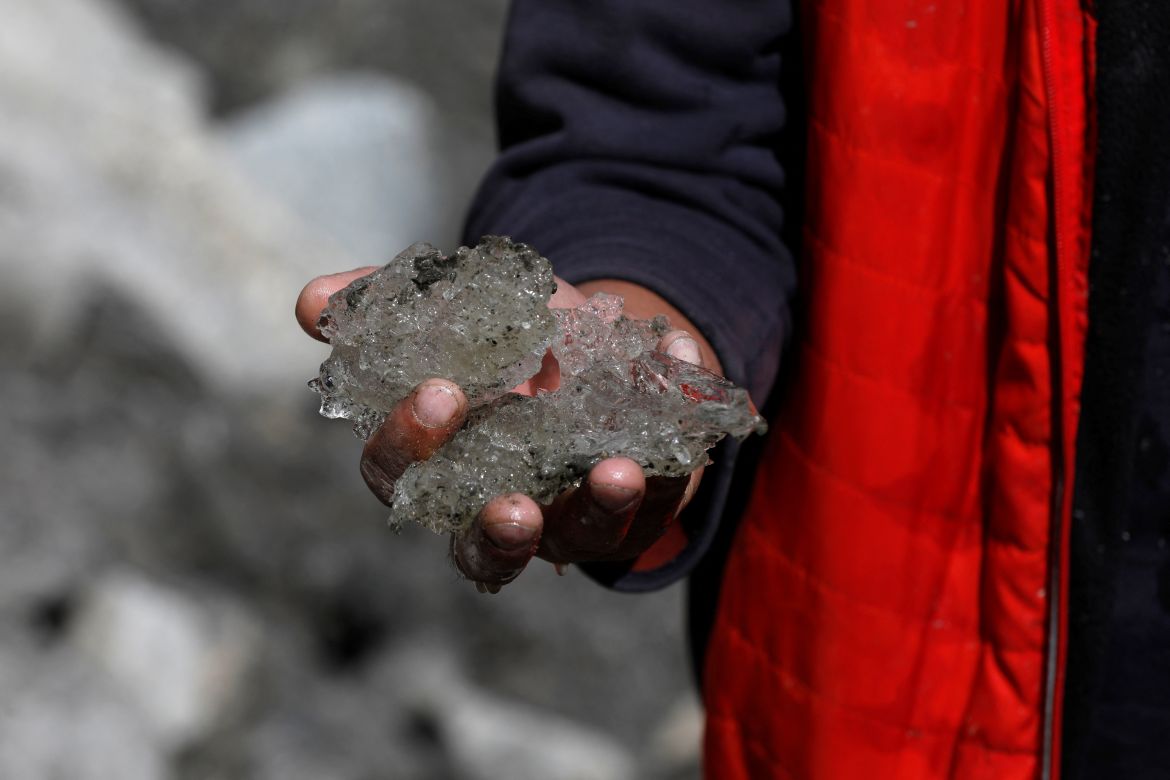
Tariq Jamil, 51, chairman of the Community Based Disaster Risk Management Centre, poses with ice taken from the Shisper glacier, near Hassanabad village, Hunza valley, in the Karakoram mountain range in the Gilgit-Baltistan region of Pakistan.
From 2018 to 2021, about 14 incidents of glacial lake outburst flooding (GLOF) occurred in Pakistan, but that increased to 75 in 2022, according to UNDP. [Akhtar Soomro/Reuters]
Tariq Jamil, 51, chairman of the Community Based Disaster Risk Management Centre, monitors a metrological website on his mobile phone and laptop, at home in Hassanabad village, Hunza valley.
In Hassanabad, Jamil is trying to manage these risks. He and 23 other volunteers have trained in first aid and evacuation planning. They monitor the glacier and consult with outside experts and officials each summer. [Akhtar Soomro/Reuters]
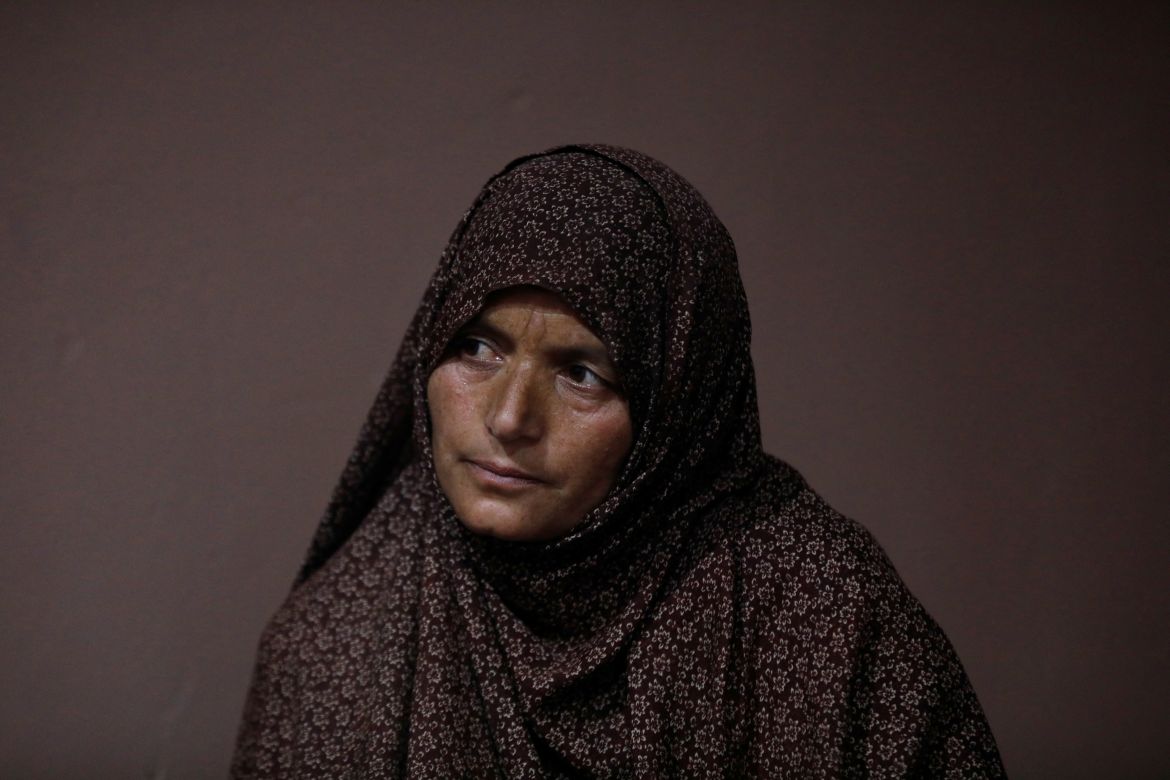
Zahra Ramzan, 40, at her home in Chalt village, in the Karakoram mountain range in the Gilgit-Baltistan region of Pakistan.
Zahra Ramzan, 40, at her home in the Karakoram mountain village of Chalt, where a torrent of black water rushed down the valley last year. Ramzan's 11-year old son, Ali Mohammad, was swept away. "I'm in very deep grief. I could not see my son again, even a body," she said. [Akhtar Soomro/Reuters]
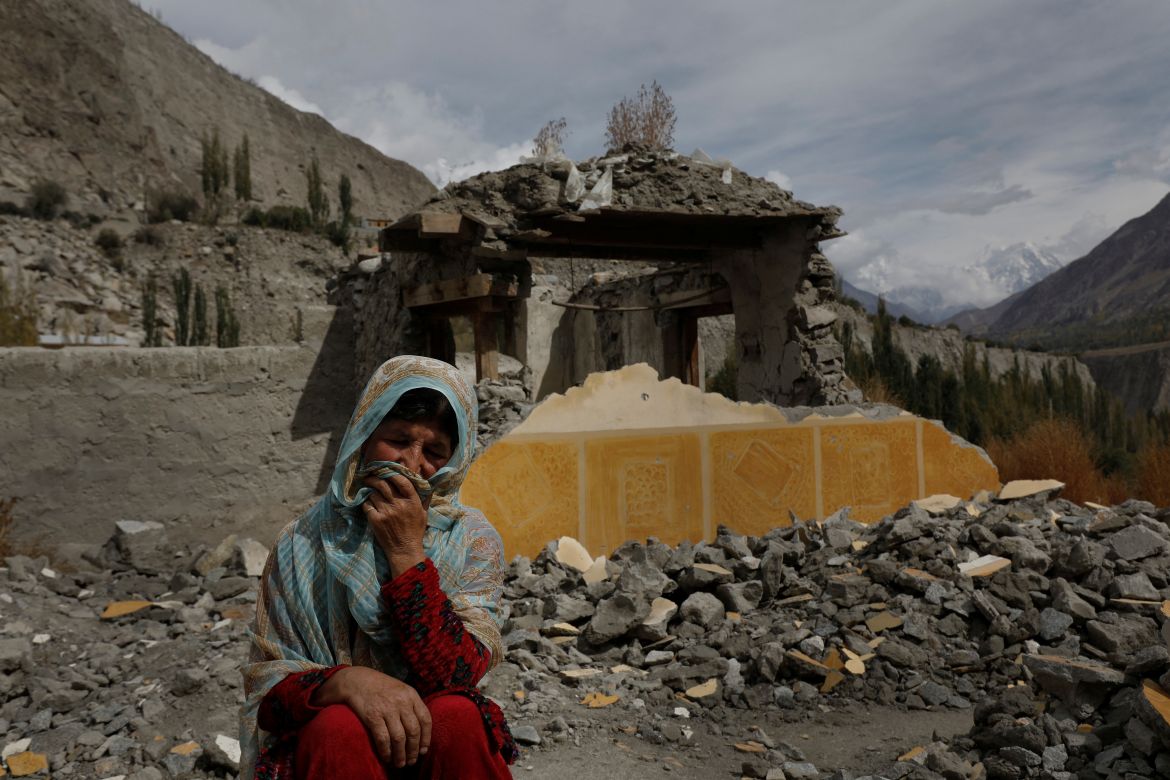
Dilshad Bano, 51, sits on the floor near her house which was damaged after a Glacial Lake Outburst Flooding (GLOF) incident, in Hassanabad village, Hunza valley, in the Karakoram mountain range in the Gilgit-Baltistan region of Pakistan.
Dilshad Bano, 51, sits near her house, which was damaged after a glacial lake outburst flooding (GLOF) incident, in Hassanabad village. [Akhtar Soomro/Reuters]
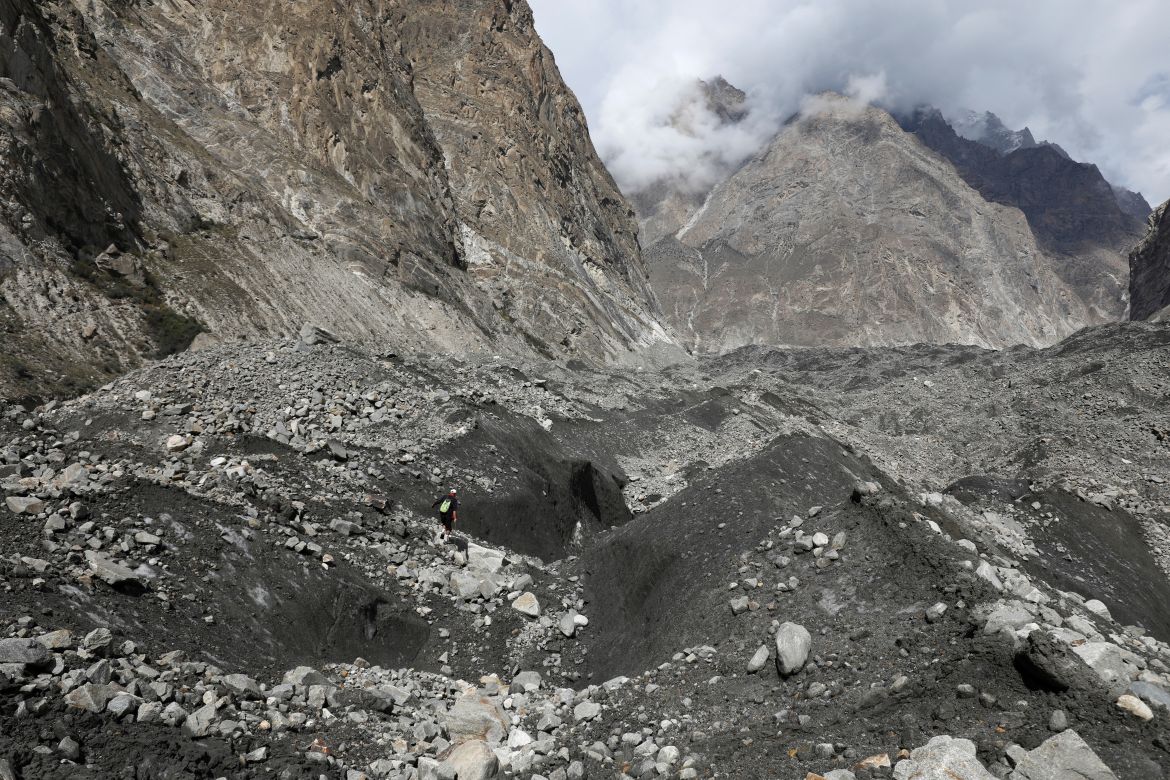
A view of the Passu Glacier in the Karakoram mountain range in the Gilgit-Baltistan region of Pakistan.
With the UN's COP28 climate summit scheduled to begin on November 30, pressure is ramping up on wealthy countries to fulfil promises to help developing nations. The Green Climate Fund said in October that it had raised $9.3bn, short of its $10bn target. [Akhtar Soomro/Reuters]
Advertisement
Tariq Jamil, 51, chairman of the Community Based Disaster Risk Management Centre, walks with a hiking stick to check the ice on the Shisper glacier, near Hassanabad village, Hunza valley, in the Karakoram mountain range in the Gilgit-Baltistan region of Pakistan.
Pakistan is the only country to receive adaptation funding from the Green Climate Fund - the Paris Agreement's key financing pot - to ease the risk of such floods. [Akhtar Soomro/Reuters]
An Automatic Weather Station monitors the Shisper glacier in Hassanabad village, Hunza valley, in the Karakoram mountain range, in the Gilgit-Baltistan region of Pakistan.
An automatic weather station monitors the Shisper glacier in Hassanabad village. Since 2017, weather stations as well as sensors measuring rainfall, water discharge, and river and lake water levels have been installed under the administration of Islamabad and UNDP. [Akhtar Soomro/Reuters]
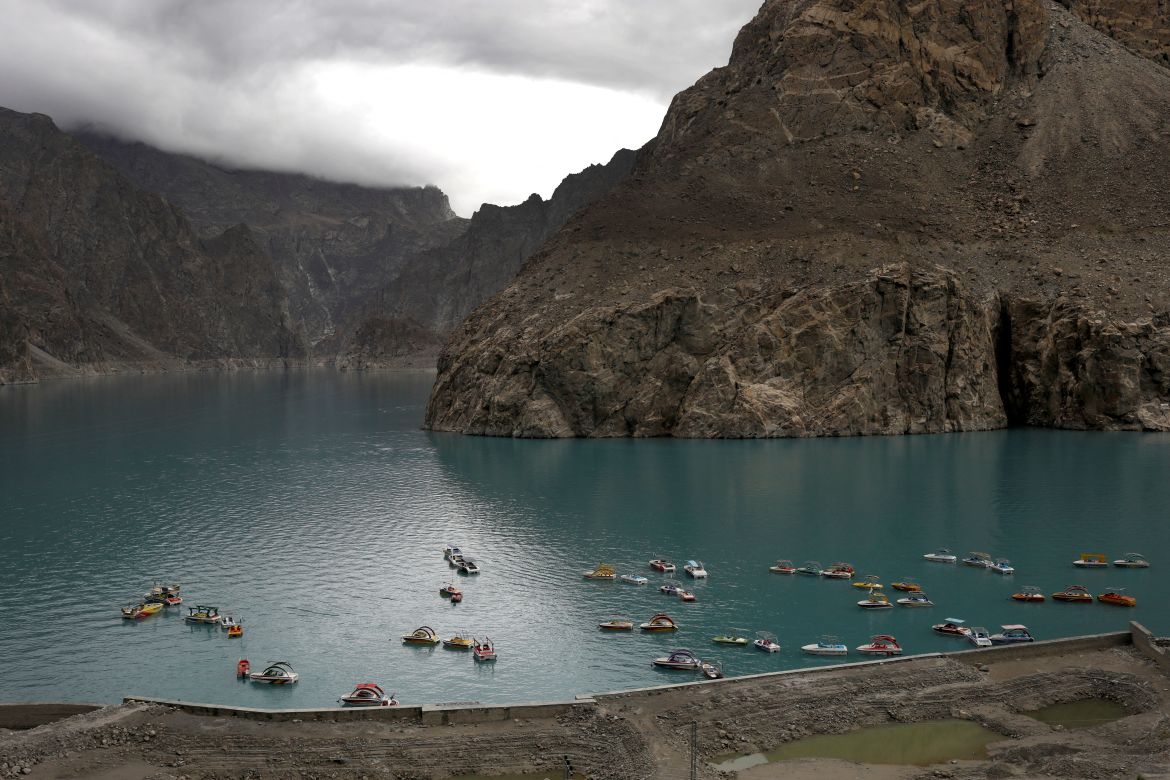
Boats gather on Attabad lake, which was formed due to a landslide in Attabad, in the Karakoram mountain range in the Gilgit-Baltistan region of Pakistan.
In northern Pakistan, such moraine-dammed lakes are linked to comparatively few GLOFs, according to ICIMOD researcher Sher Muhammad, but in other parts of mountainous Asia they have been associated with higher casualty rates than ice-dammed lakes. The risks of both types of lakes may increase, Muhammad said. [Akhtar Soomro/Reuters]
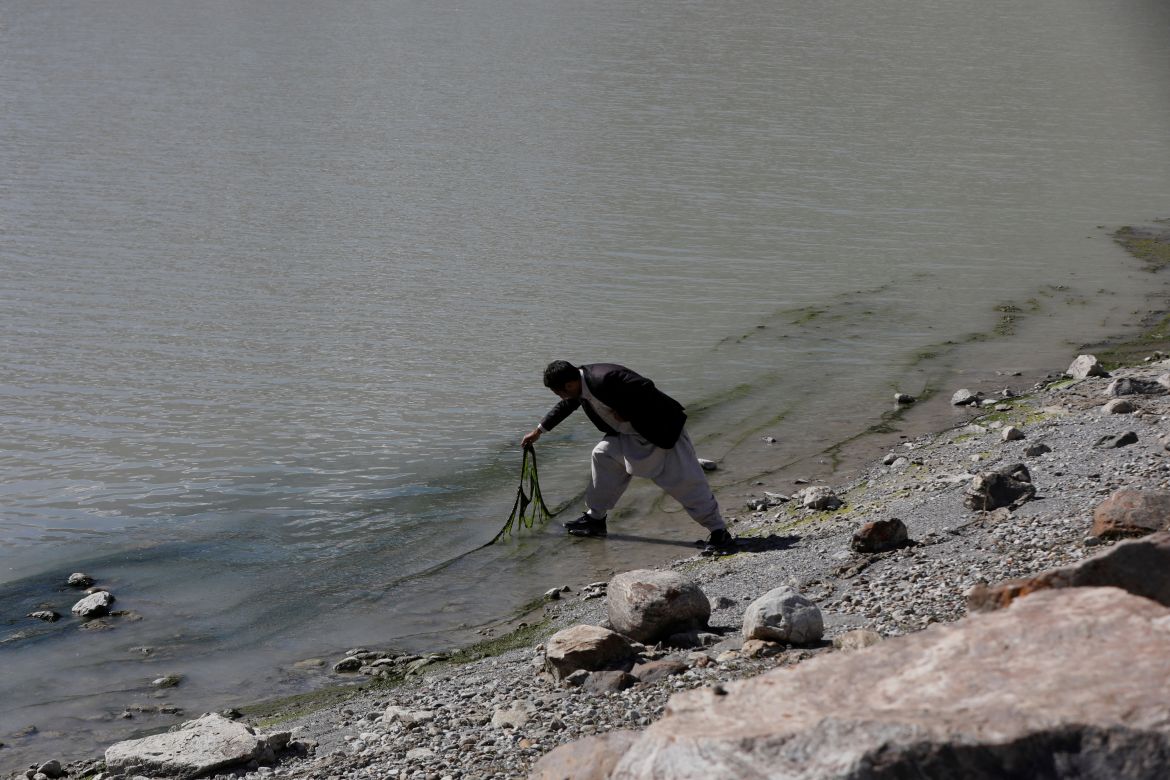
Muhammad Yasin, 35, an environmental sciences graduate researcher, lifts algae from the surface of stagnant water at the Gamoo Bhr glacial lake near the Darkut glacier in Darkut village, Yasin valley, in the Gilgit-Baltistan region of Pakistan.
Muhammad Yasin, 35, an environmental sciences graduate researcher, lifts algae from the surface of stagnant water at the in the Gilgit-Baltistan region of Pakistan. Yasin is studying the extent to which the Darkut glacier is melting. "We have [told] the community that risk factors exist in this lake, you should be aware of this," he said. [Akhtar Soomro/Reuters]
A view of the newly built Hassanabad bridge, which replaced a bridge that collapsed when the Shisper glacier caused Glacial Lake Outburst Flooding (GLOF), in Hassanabad village, Hunza valley, in the Karakoram mountain range, in the Gilgit-Baltistan region of Pakistan.
In Hassanabad, the prospect of moving also fills many residents with disbelief. Their families have lived off orchard fields surrounded by soaring mountains for 400 years, growing produce and grazing livestock high in the plains. Many say they have no resources to move from the village, where their ancestors are buried. [Akhtar Soomro/Reuters]
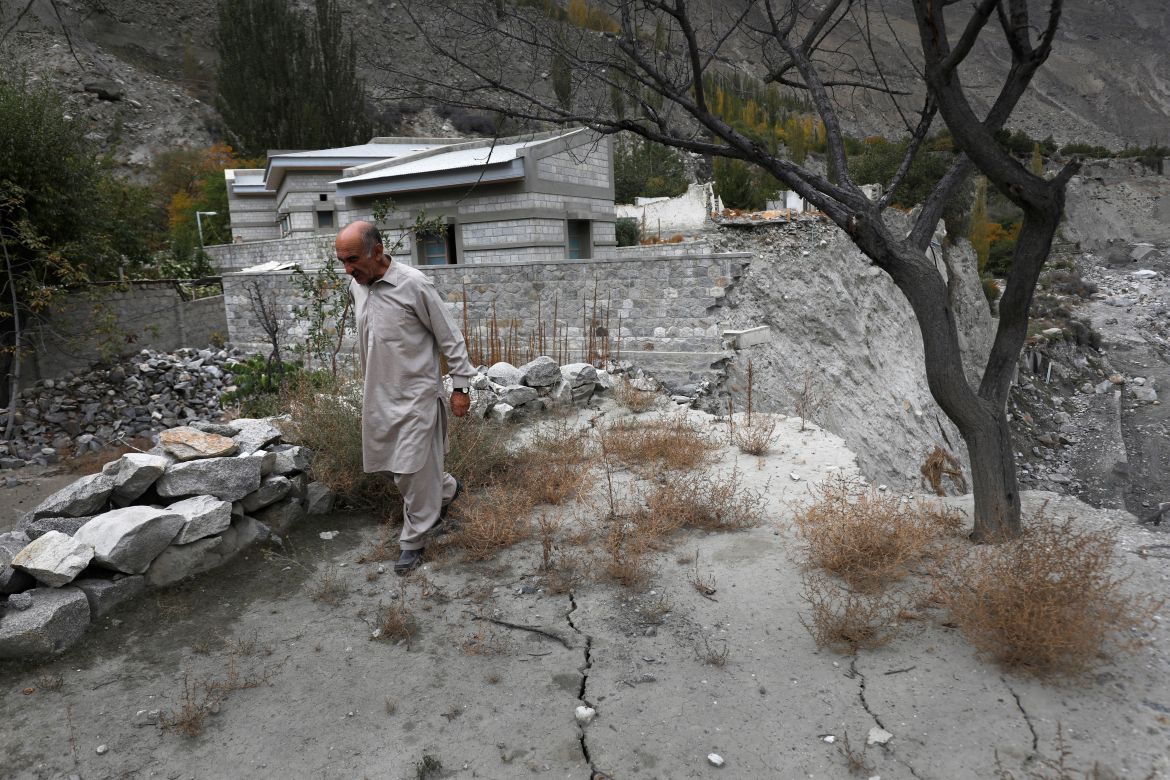
Community leader Sultan Ali, 70, walks over cracks that developed after a Glacial Lake Outburst Flooding (GLOF) swept away part of the land in Hassanabad village, Hunza valley, in the Karakoram mountain range in the Gilgit-Baltistan region of Pakistan.
Community leader Sultan Ali, 70, walks over cracks that developed after glacial lake outburst flooding (GLOF) swept away part of the land in Hassanabad village. [Akhtar Soomro/Reuters]
A community hall and houses show signs of damage after a Glacial Lake Outburst Flooding (GLOF) incident occurred from the nearby Shisper glacier, in Hassanabad village, Hunza valley, in the Karakoram mountain range in the Gilgit-Baltistan region of Pakistan.
A community hall and houses show signs of damage after a GLOF incident occurred from the nearby Shisper glacier, in Hassanabad village. [Akhtar Soomro/Reuters]
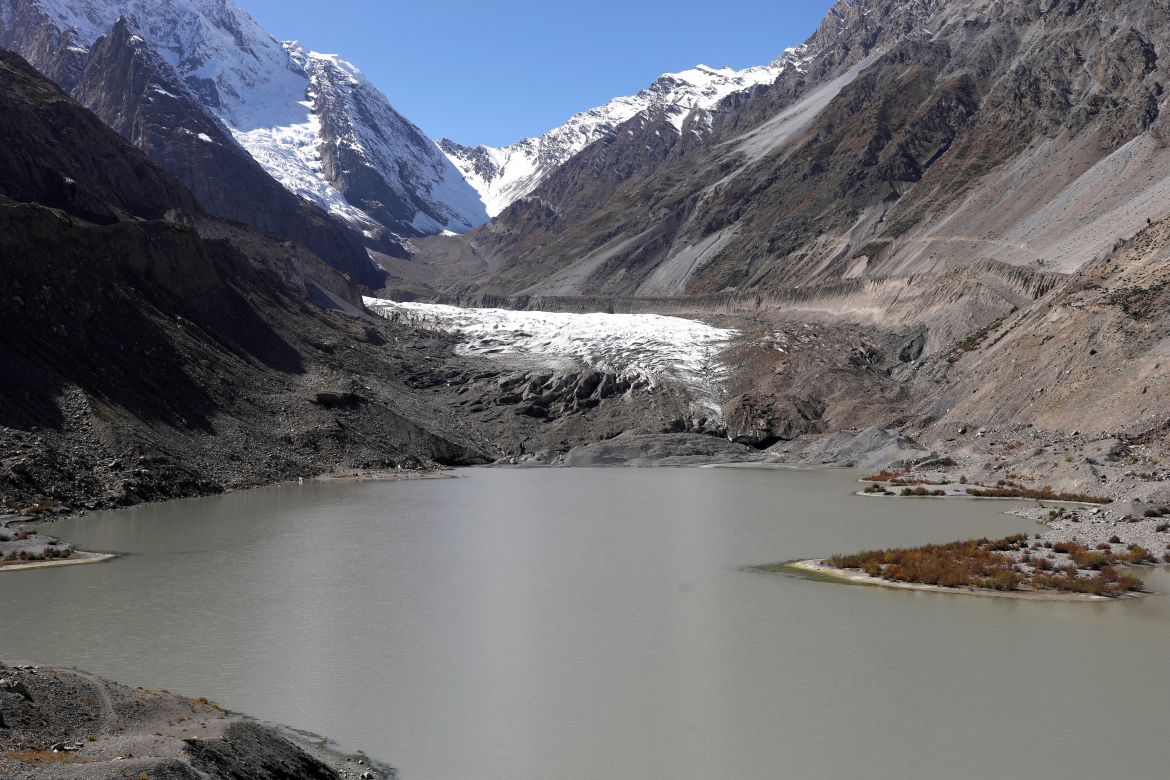
The Gamoo Bhr glacial lake pools in front of the Darkut glacier in Darkut village, Yasin valley, in the Gilgit-Baltistan region of Pakistan.
Darkut village, also part of GLOF II, sits surrounded by mountains and glaciers above verdant plains where yaks graze. At the bottom of nearby Darkut glacier lies a deep turquoise lake. "Until 1978, this whole place was a glacier, the pool of water came later," said 75-year-old Musafir Khan, pointing at the lake that formed as the glacier receded. [Akhtar Soomro/Reuters]


  • About

    • About Us
    • Code of Ethics
    • Terms and Conditions
    • EU/EEA Regulatory Notice
    • Privacy Policy
    • Cookie Policy
    • Cookie Preferences
    • Accessibility Statement
    • Sitemap
    • Work for us
  • Connect

    • Contact Us
    • User Accounts Help
    • Advertise with us
    • Stay Connected
    • Newsletters
    • Channel Finder
    • TV Schedule
    • Podcasts
    • Submit a Tip
  • Our Channels

    • Al Jazeera Arabic
    • Al Jazeera English
    • Al Jazeera Investigative Unit
    • Al Jazeera Mubasher
    • Al Jazeera Documentary
    • Al Jazeera Balkans
    • AJ+
  • Our Network

    • Al Jazeera Centre for Studies
    • Al Jazeera Media Institute
    • Learn Arabic
    • Al Jazeera Centre for Public Liberties & Human Rights
    • Al Jazeera Forum
    • Al Jazeera Hotel Partners

Follow Al Jazeera English:

  • facebook
  • twitter
  • youtube
  • instagram-colored-outline
  • rss
Al Jazeera Media Network logo
© 2025 Al Jazeera Media Network