Skip linksSkip to Content
play
Live
Navigation menu
  • News
    • Africa
    • Asia
    • US & Canada
    • Latin America
    • Europe
    • Asia Pacific
  • Middle East
  • Explained
  • Opinion
  • Sport
  • Video
    • Features
    • Economy
    • Human Rights
    • Climate Crisis
    • Investigations
    • Interactives
    • In Pictures
    • Science & Technology
    • Podcasts
    • Travel
play
Live

In Pictures

Gallery|Soleimani assassination

Tears, cries of vengeance as Tehran bids farewell to Soleimani

Sea of mourners dressed in black gather in Tehran to pay homage to revered general killed in US air strike.

Abbas Aslani, of the Center for Middle East Strategic Studies, a think-tank close to the office of the Iranian president, said the killing of Soleimani has made Iranians “rally around the flag”.
Iranians took to the streets of Tehran to pay their respects to slain Quds Force commander Qassem Soleimani and express their anger at his killing. [Mohammad Ali Najib/Al Jazeera]
Published On 6 Jan 20206 Jan 2020

Share

facebooktwitterwhatsappcopylink

Save

Tehran, Iran – The remains of Qassem Soleimani, head of the country’s elite Quds Force killed in a US air strike, arrived in Tehran on Monday after a day of funeral processions in the cities of Ahvaz and Mashhad, which saw hundreds of thousands – if not millions – of people pour onto the streets in a burst of grief and anger.

The reception to Soleimani’s assassination on Friday has already been compared with the burial of Iran’s first Supreme Leader Ayatollah Khomeini, who died of natural causes and was buried in Tehran in 1989. Millions of people took to the streets that day, in what was then described as the biggest funeral procession in Iran’s modern history.

Iranian leaders have pledged “severe revenge” in response to Soleimani’s killing, which has triggered a dramatic escalation of tensions in the Middle East.

Abbas Aslani, of the Center for Middle East Strategic Studies, a think-tank close to the office of the Iranian president, said the assassination of Soleimani has made Iranians “rally around the flag”.

At Tehran’s Valiasr Square, an oversized red banner, covering several floors of a mid-rise building, showed a white silhouette image of Soleimani. “Your blood challenges any adversary,” read an inscription in English underneath his image.

At the Tehran Metro, passengers were heard chanting, “No compromise, no surrender.”

Soleimani’s remains were originally scheduled to arrive in Tehran on Sunday night. But the ceremony in Mashhad was delayed for hours due to the size of the crowd that showed up and paid tribute at the Imam Reza Shrine, the heart of the Shia faith in Iran.

Advertisement

In Tehran on Monday, a sea of men, wearing all-black outfits, and women in black chadors, waited for the arrival of Soleimani’s remains, as loudspeakers blared mourning hymns. A traffic jam has formed in the intersections leading to the unfinished grand mosque, named after Khomeini, where the current Supreme Leader Ayatollah Ali Khamenei led the prayers for Soleimani. Khamenei was seen sobbing as he led the prayers alongside President Hassan Rouhani.

Also among those in the crowd was Ismail Haniya, the leader of the Palestinian group Hamas. In his speech, he urged “unity … to punish those behind the heinous crime”, referring to Soleimani’s assassination.

On Tuesday, Soleimani’s remains will be taken to his hometown of Kerman for the last rites before his burial.

Mourners attend a funeral ceremony for Iranian Gen. Qassem Soleimani and his comrades, who were killed in Iraq in a U.S. drone strike on Friday, at the Enqelab-e-Eslami (Islamic Revolution) square in
The reception to Soleimani's assassination has been compared with the burial of Iran's first Supreme Leader Ayatollah Khomeini in 1989. [Ebrahim Noroozi/AP Photo]
Advertisement
Analysts say that by ordering the killing of Soleimani, US President Donald Trump has turned him from a revered warrior to a martyr.
Iranian leaders have pledged 'severe revenge' in response to Soleimani's killing, which has triggered a dramatic escalation of tensions in the Middle East. [Mohammad Ali Najib/Al Jazeera]
Soleimani was a veteran of the Iran-Iraq War that lasted for eight years, and it was during that time that he honed his military skills. Some of the mourners in the crowd were seen carrying photos of
Soleimani was a veteran of the Iran-Iraq War that lasted for eight years. Some of the mourners in the crowd carried photos of him as a young soldier. [Mohammad Ali Najib/Al Jazeera]
The remains of Abu Mahdi al-Muhandis was also brought to Iran, alongside that of Soleimani’s, and the mourners also paid their respect to the fallen Iraqi militia commander.
The remains of Iraqi militia commander Abu Mahdi al-Muhandis, who was also killed in the US air raid on Friday in Baghdad, were also brought to Iran. [Mohammad Ali Najib/Al Jazeera]
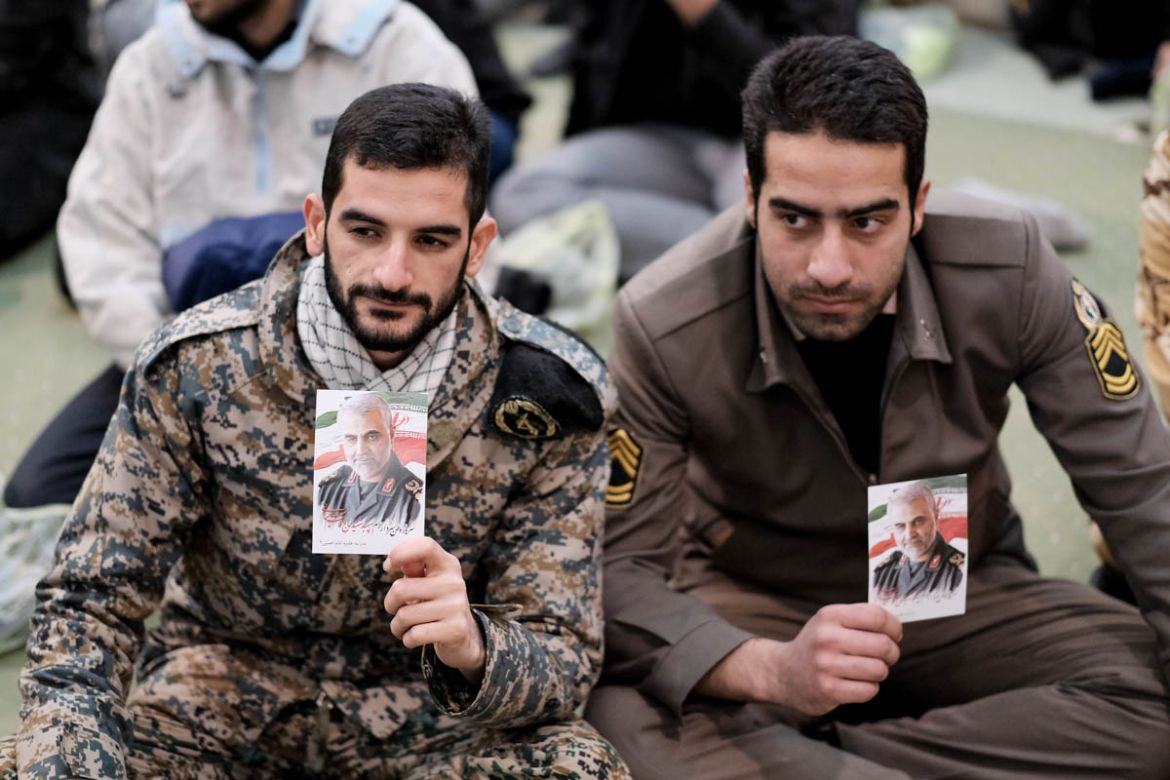
Uniformed men from different branches of the Iranian military service were among those in the crowd. In Iran, military service is mandatory among men, aged 18 to 40, and it could last for up to two ye
Uniformed men from different branches of the Iranian military were among those in the crowd. In Iran, military service is mandatory among men, aged 18 to 40, and it could last for up to two years. [Mohammad Ali Najib/Al Jazeera]
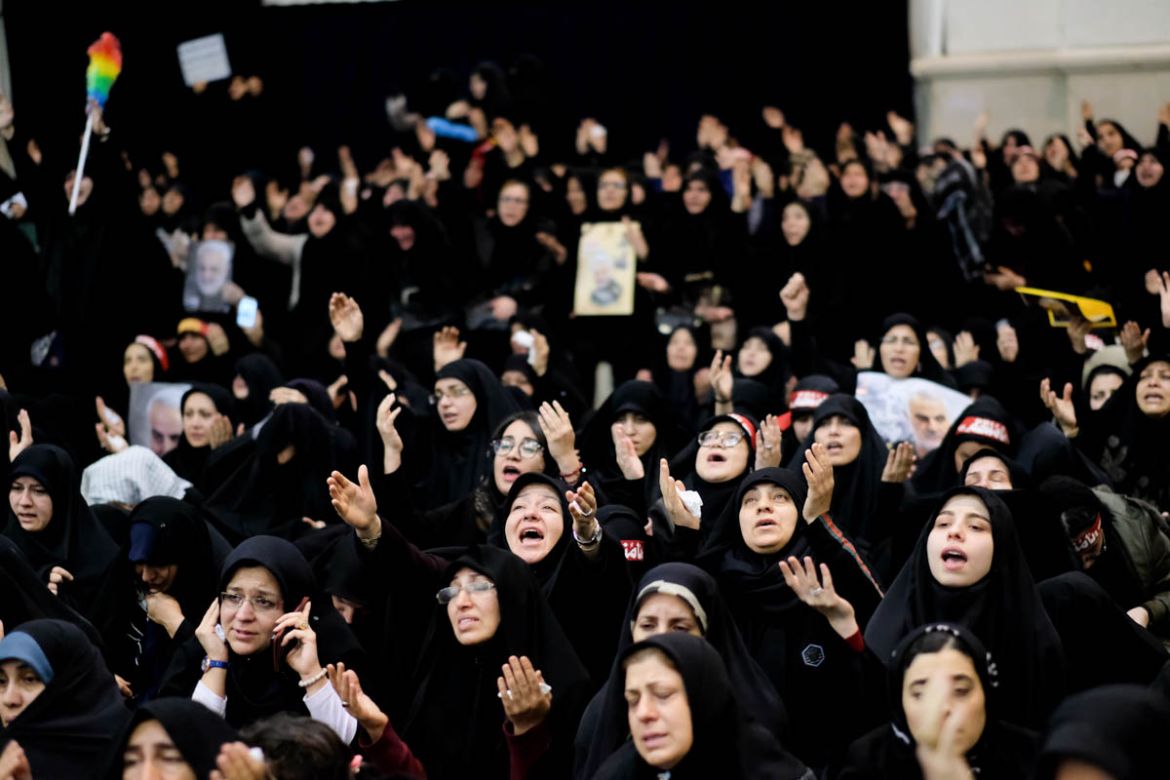
A mix of grief and anger befall of the crowd of mourners as they awaited the funeral cortege of Soleimani.
Grieving mourners awaiting the funeral procession for Soleimani. [Mohammad Ali Najib/Al Jazeera]
Advertisement
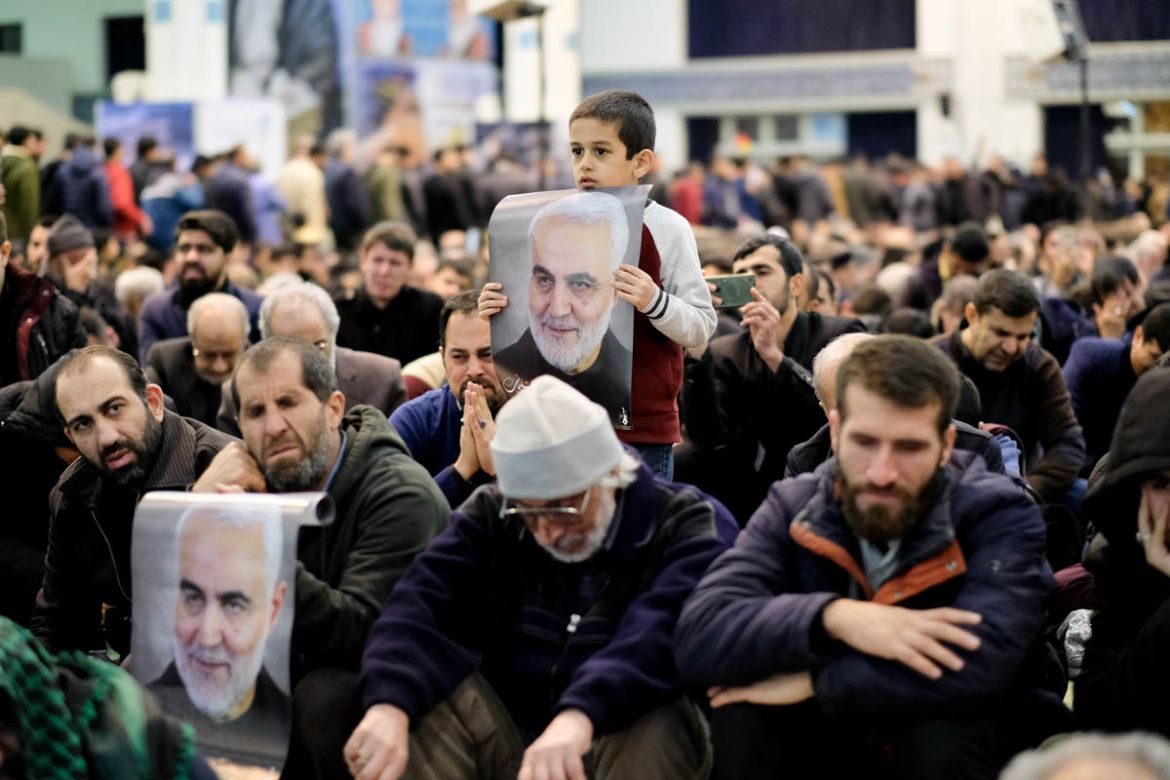
Many of the mourners, who waited since Sunday night, for the arrival of Soleimani’s remains, waved different images of the slain commander, while others carried miniature flags of Iran.
Many of the mourners, who waited since Sunday night, for the arrival of Soleimani's remains, waved different images of the slain commander, while others carried Iranian flags. [Mohammad Ali Najib/Al Jazeera]
From the metro station to the streets of Tehran, Iranians from diverse backgrounds took to the streets to express their anger at the US killing of Soleimani.
Abbas Aslani, of the Center for Middle East Strategic Studies, a think-tank close to the office of the Iranian president, said the killing of Soleimani has made Iranians 'rally around the flag'. [Mohammad Ali Najib/Al Jazeera]
A repeated cry among the group of mourners for Soleimani is a call to “avenge” his killing.
A repeated cry among the group of mourners for Soleimani was a call to 'avenge' his killing. [Mohammad Ali Najib/Al Jazeera]
An Iranian man, who took his son to the funeral march of Soleimani, said that he is willing to take up arms again and return to military service, to avenge the death of the Quds Force commander.
An Iranian man, who took his son to the funeral march of Soleimani, said he is willing to take up arms again and return to military service, to avenge the killing of the Quds Force commander. [Mohammad Ali Najib/Al Jazeera]


  • About

    • About Us
    • Code of Ethics
    • Terms and Conditions
    • EU/EEA Regulatory Notice
    • Privacy Policy
    • Cookie Policy
    • Cookie Preferences
    • Accessibility Statement
    • Sitemap
    • Work for us
  • Connect

    • Contact Us
    • User Accounts Help
    • Advertise with us
    • Stay Connected
    • Newsletters
    • Channel Finder
    • TV Schedule
    • Podcasts
    • Submit a Tip
  • Our Channels

    • Al Jazeera Arabic
    • Al Jazeera English
    • Al Jazeera Investigative Unit
    • Al Jazeera Mubasher
    • Al Jazeera Documentary
    • Al Jazeera Balkans
    • AJ+
  • Our Network

    • Al Jazeera Centre for Studies
    • Al Jazeera Media Institute
    • Learn Arabic
    • Al Jazeera Centre for Public Liberties & Human Rights
    • Al Jazeera Forum
    • Al Jazeera Hotel Partners

Follow Al Jazeera English:

  • facebook
  • twitter
  • youtube
  • instagram-colored-outline
  • rss
Al Jazeera Media Network logo
© 2025 Al Jazeera Media Network