Skip linksSkip to Content
play
Live
Navigation menu
  • News
    • Africa
    • Asia
    • US & Canada
    • Latin America
    • Europe
    • Asia Pacific
  • Middle East
  • Explained
  • Opinion
  • Sport
  • Video
    • Features
    • Economy
    • Human Rights
    • Climate Crisis
    • Investigations
    • Interactives
    • In Pictures
    • Science & Technology
    • Podcasts
    • Travel
play
Live

In Pictures

Gallery|Environment

Tamil Nadu farmers fight drought with organic farming

Some farmers in Tamil Nadu state have survived severe drought by adopting traditional crops and farming methods.
Drought adaptation/Please Do Not Use
Balakrishnan Marimuthu's four-acre (1.6 hectare) farm could not yield even 10 percent paddy this year, as compared with a harvest of 110 sacks (each weighting 60kg) last year. After the crop failed owing to lack of rain, Balakrishnan sowed green gram to offset his loss and improve the soil quality of land. [Sharada Balasubramanian/Al Jazeera]
By Sharada Balasubramanian
Published On 5 May 20175 May 2017

Share

facebooktwitterwhatsappcopylink

Save

Tamil Nadu, India – The southern Indian state of Tamil Nadu has been reeling under its worst drought in more than 100 years.

It has plunged the state into an agrarian crisis, with reports of distressed farmers committing suicide.

In the coastal town of Vedaranyam, facing the Bay of Bengal sea, however, some farmers have overcome the drought with simple but innovative practices.

Farmers in this important coastal agricultural region in Nagapattinam district have gone back to traditional crops and farming methods to fight the lack of irrigation water as well as soil salinity.

The salinity has increased as sea water has intruded over the years.

The Centre for Indian Knowledge Systems, an NGO in the district, has been giving technical support to farmers for more than two decades, helping them to switch from chemical to organic farming.

It has supplied drought-resistant, traditional crops that consume less water and helped farmers to build ponds to store rain water.

This year, farmers using chemical fertilisers lost their crops completely.

Traditional crops, which once ruled this agricultural landscape, faded with the onset of the green revolution – the boost in crop production after the application of hybrid seeds and chemical fertilisers in the 1970s.

Today, farmers are going back to traditional crops such as coconuts, vegetables and pulses, with rising consumer demand for such produce in India .

The traditional crops have medicinal value, are well-suited to the local soil conditions and can survive drought.

Advertisement

In Vedaranyam, where cases of farmers committing suicide have been reported, traditional organic farming offers a ray of hope in the fight against crop failure.

Drought adaptation/Please Do Not Use
Balakrishnan had dug two farm ponds. Unexpected rains fell for two days in February, filling the ponds and a well. The rainwater stored in ponds allowed him to risk experimenting with coconut farming. The rains are no longer predictable and farmers believe that farm ponds could be the solution to water insecurity in the future. [Sharada Balasubramanian/Al Jazeera]
Advertisement
Drought adaptation/Please Do Not Use
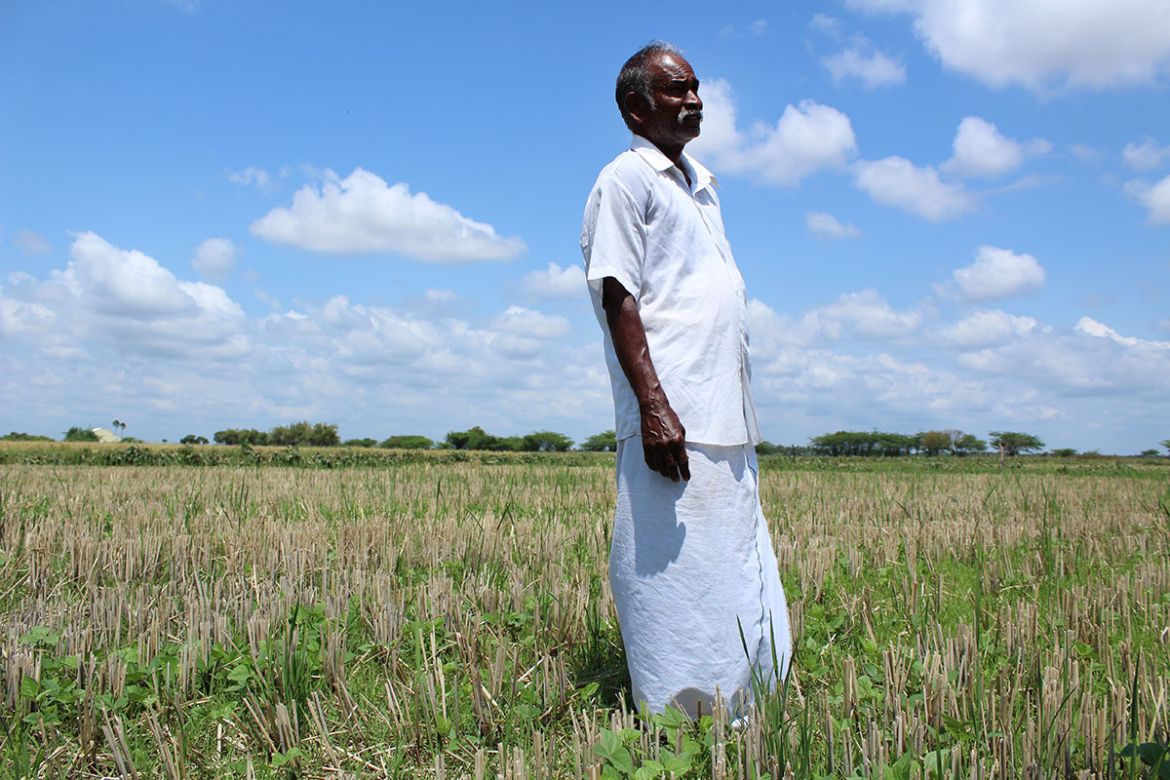
Ganesan Manikka Gounder, another farmer in the same village, lost his paddy completely this year. However, he had sowed another traditional, drought-resistant variety called Mapillai Samba with great success. This rice, also known as 'Bridegroom's rice', lost its importance after the Green Revolution. In the past, men were asked to lift a heavy stone (called illavata kal locally) if they wanted to win a girl's hand in marriage. They were fed Mappillai samba rice for six months in order to be able to lift the heavy stone. [Sharada Balasubramanian/Al Jazeera]
Drought adaptation/Please Do Not Use
The crop grows up to 7ft tall and requires little maintenance. Ganesan says: 'Mappillai Samba has medicinal values and fetches a higher price. Though the yield from traditional varieties may not be as high as modern rice varieties, farmers do not have to spend on labour.' [Sharada Balasubramanian/Al Jazeera]
Drought adaptation/Please Do Not Use
After crops failed on his six-acre (2.4 hectare) land, Jayapal Kaliyaperumal switched to vegetables and green gram. He also grew manure crops such as Kavalai for strengthening the soil. He says: 'It is important to grow manure crops and even leave the land alone for six months to regenerate. In the present scenario, farmers are continuously rotating crops, not allowing the soil to replenish.' [Sharada Balasubramanian/Al Jazeera]
Drought adaptation/Please Do Not Use
Balasubramaniam Palanisamy, an organic farmer from Chettipayalam village, says: 'I switched to organic farming 15 years ago, which has improved the soil quality to withstand drought. With light showers in the midst, the water was enough to grow traditional, drought-resistant and salt-resistant crop kaivara samba rice. Organic farmers in this region survived the drought this year.' [Sharada Balasubramanian/Al Jazeera]
Drought adaptation/Please Do Not Use
Venugopal Sundarraj from Kathripuram village grows only traditional varieties organically. This year, he grew three indigenous varieties, and all of them gave him a good harvest of two tonnes per acre. [Sharada Balasubramanian/Al Jazeera]
Advertisement
Drought adaptation/Please Do Not Use
Karun Kuravai, a traditional crop that can survive drought and salinity, gave Venugopal a good harvest this year. [Sharada Balasubramanian/Al Jazeera]
Drought adaptation/Please Do Not Use
Farm ponds have increased water levels in Alangadu village. Such ponds can be a source of water for cattle and crucial for vegetable farming. R Thilakar, a farmer, says: 'Farm ponds are a must in every farm. They can save rain water, and people can practise aquaculture to increase their incomes.' [Sharada Balasubramanian/Al Jazeera]
Drought adaptation/Please Do Not Use
Raja Ramu was among the farmers from Alangadu village who faced complete paddy loss this year. After analysing the quality of the soil, he sowed cotton here. He says: 'Cotton can grow with little bit of saline water. Many farmers in this village followed this and are growing cotton.' [Sharada Balasubramanian/Al Jazeera]
Drought adaptation/Please Do Not Use
Rajaraman Narayanasamy, a traditional farmer from Thandankulam village close to the sea, was the only one who did farming this year. His farm is just a kilometre from the sea where ground water is salty. Rajaraman grew paddy on half of his land, and in the rest he planted vegetables such as brinjal, bottle gourd, okra, spinach, tomato and chilli. He says: 'I sell vegetables on my cycle and earn Rs 20,000 ($311). I produced paddy worth Rs 45000 ($701) this year.' [Sharada Balasubramanian/Al Jazeera]
Drought adaptation/Please Do Not Use
Azolla, a floating plant that grows on water, was cultivated by Rajaraman in Thandavankulam village. Native fish were bred in his farm pond as well to supplement his income. He says: 'Fodder shortage is huge now, so if azolla is fed to the cattle, a cow will give half a litre more milk, and it will also reduce salinity in my farm pond.' [Sharada Balasubramanian/Al Jazeera]
Drought adaptation/Please Do Not Use
'Simple solutions like small check dams, farm ponds can help farmers grow vegetables. The government is spending millions on the rural employment guarantee scheme. If that can be used to construct farm ponds using the local farmers, there will be benefits,' says R Thilakar, a farmer from Nemmilli village. [Sharada Balasubramanian/Al Jazeera]
Drought adaptation/Please Do Not Use
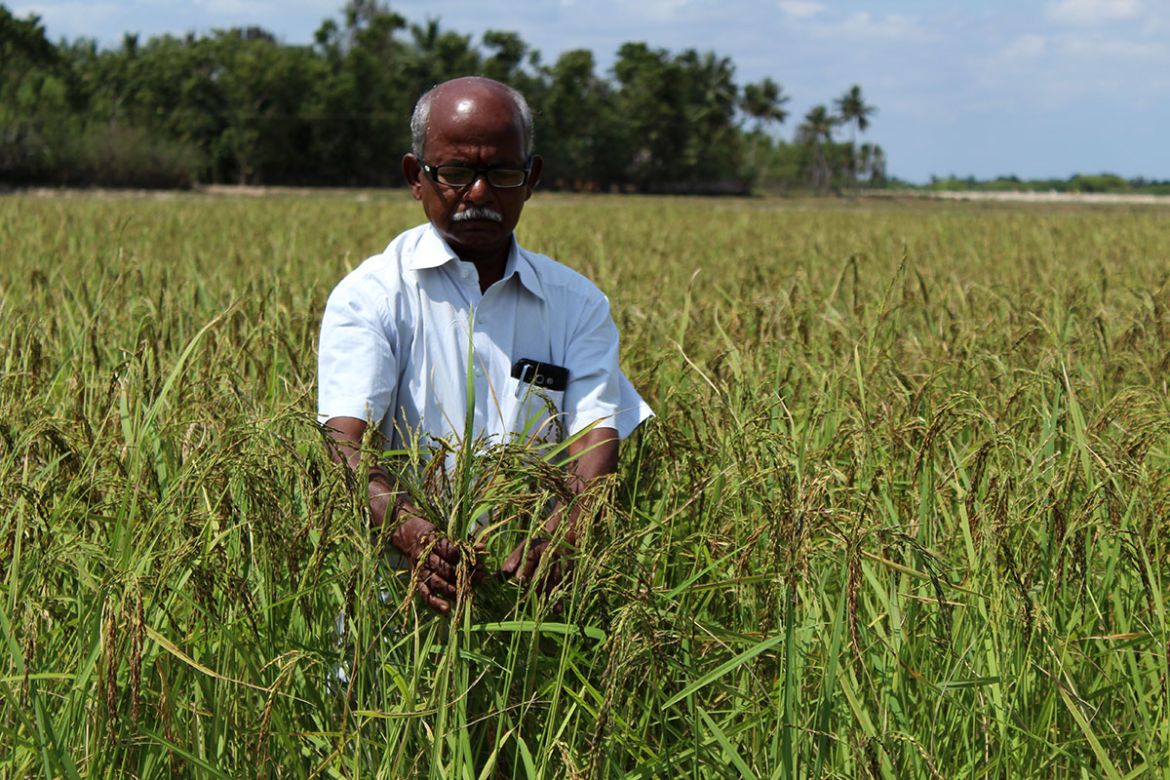
Balasubramaniam, an organic farmer, did not suffer crop loss this year. He harvested three tonnes of rice on his two acres of land. He says: 'I removed weeds on time, and applied organic manure regularly.' [Sharada Balasubramanian/Al Jazeera]
Drought adaptation/Please Do Not Use
He advocates organic farming as a solution to drought. 'Irrespective of whether one is growing traditional or modern variety, organic practices must be adopted as it consumes less water," says Balasubramaniam. He adds that pearl millets can be grown here, especially in a situation where there is less water. Earlier farmers did grow this variety, but abandoned the crop over time. [Sharada Balasubramanian/Al Jazeera]


  • About

    • About Us
    • Code of Ethics
    • Terms and Conditions
    • EU/EEA Regulatory Notice
    • Privacy Policy
    • Cookie Policy
    • Cookie Preferences
    • Accessibility Statement
    • Sitemap
    • Work for us
  • Connect

    • Contact Us
    • User Accounts Help
    • Advertise with us
    • Stay Connected
    • Newsletters
    • Channel Finder
    • TV Schedule
    • Podcasts
    • Submit a Tip
    • Paid Partner Content
  • Our Channels

    • Al Jazeera Arabic
    • Al Jazeera English
    • Al Jazeera Investigative Unit
    • Al Jazeera Mubasher
    • Al Jazeera Documentary
    • Al Jazeera Balkans
    • AJ+
  • Our Network

    • Al Jazeera Centre for Studies
    • Al Jazeera Media Institute
    • Learn Arabic
    • Al Jazeera Centre for Public Liberties & Human Rights
    • Al Jazeera Forum
    • Al Jazeera Hotel Partners

Follow Al Jazeera English:

  • facebook
  • twitter
  • youtube
  • instagram-colored-outline
  • rss
Al Jazeera Media Network logo
© 2026 Al Jazeera Media Network