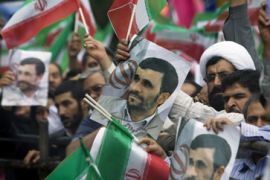
Iran’s political future
Will the West engage with the Islamic Republic following the re-election of Ahmadinejad?
More than 100 members of Iranian reformist groups have been arrested, accused of orchestrating violence and organising unauthorised protests after the disputed presidential election result.
Describing the election as an “epic moment”, Mahmoud Ahmadinejad, the re-elected Iranian president, praised a “very accurate” vote and said the government had little opportunity to influence procedures.
But Mir Hossein Mousavi, the leader of the reformist opposition and defeated presidential candidate, has called the elections a dangerous charade and asked for the cancellation of the vote.
Thirty years after the Islamic revolution, is the divide between reformists and conservatives deepening? In what direction will Iran move under the re-elected Ahmadinejad? And will the West engage with Iran or further isolate the Islamic Republic?
Presenter Hashem Ahelbarra is joined by Shirvin Zeinalzadeh, an international security specialist who frequently writes on Iranian affairs, and Sohrab Behdad, a professor of economics at Denison University.
This episode of Inside Story aired on Sunday, June 14, 2009.