Injuries as protests hit Saudi city
Interior ministry says police opened fire after protesters attacked a police officer in the oil-rich city of Qatif.

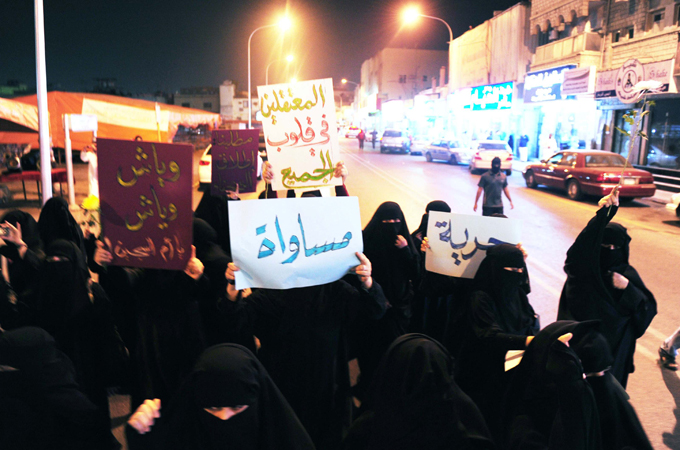 |
| At least three people were injured in the protests on the eve of the so-called ‘Day of Rage’ [Reuters] |
At least three people have been injured after police in Saudi Arabia fired in the air to disperse protesters in the eastern oil-rich city of Qatif.
The injuries came on the eve of a so-called “Day of Rage” planned in the country for Friday.
Mansur al-Turki, a spokesman for the Saudi interior ministry, said shots were fired on Thursday over the heads of the protesters after they attacked a police officer who was documenting the protest.
Around 600-800 protesters, all Shia and including women, took to the streets of Qatif to demand the release of nine Shia prisoners, said a witness, requesting anonymity for fear of reprisal.
Qatif has a large Shia community although Saudi Arabia is a Sunni-dominated kingdom.
The shooting continued for about 10 minutes and around 200 policemen were present, the witness said.
“As the procession in the heart of the city was about to finish, soldiers started shooting at the protesters, and three of them were wounded,” the witness added.
But the interior ministry spokesman insisted police fired live rounds in the air after shots were fired from among the protesters.
“A number of people from within the crowd fired live ammunition. I don’t know where they fired and how they fired,” al-Turki said.
The ministry said later two protesters – one wounded in the hand; the other in the leg – received hospital treatment for gunshot wounds.
“We have launched an investigation. We investigate what type of guns are used and what bullets,” said the spokesman.
Heavy police deployment
The incident came after calls on social networking sites Facebook and Twitter urged people to take part in protests.
Reports said more than 30,000 heeded the call and in Riyadh, the capital, police boosted their presence, parking vehicles with their lights flashing at major junctions and patrolling the roads.
Friday protests have been planned in other Gulf countries including Yemen, Kuwait and Bahrain. The time after Friday prayers has proved to be crucial in popular uprisings that have brought down Tunisian and Egyptian rulers who once seemed invulnerable.
In Washington, the United States reiterated its support for the right to peaceful assembly and said it would closely monitor unrest in Saudi Arabia and restated its support for universal values.
“We will of course continue to monitor closely this particular situation,” said Ben Rhodes, a senior foreign policy adviser to Barack Obama, the US president.
Last month, the ultraconservative Saudi government, fearing Tunisia and Egypt-style uprisings would reach its soil, unveiled unprecedented economic package worth an estimated $36bn that will give Saudis interest-free home loans, unemployment assistance and debt forgiveness.
At the same time, it reiterated that demonstrations are forbidden in the kingdom because they contradict Islamic laws and society’s values and said security forces were authorised to act against anyone violating the ban.