Egypt VP: Protests must end soon
A day after offering sweeping concessions, Omar Suleiman expresses impatience with burgeoning pro-democracy protests.
 |
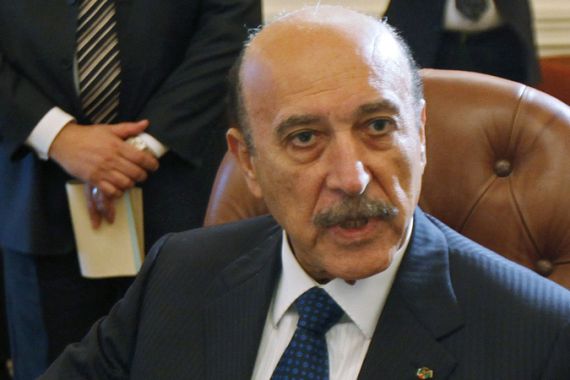
| Egyptian vice-president said the alternative to dialogue is a coup. [EPA] |
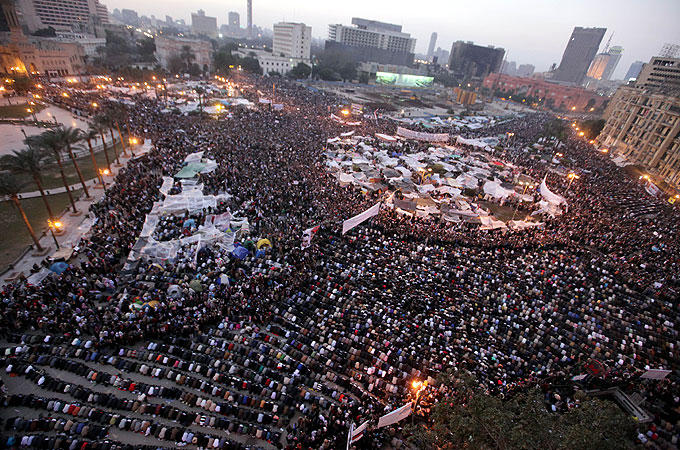
Omar Suleiman, the Egyptian vice-president, warned on Tuesday that his government “can’t put up with continued protests” for a long time, as tens of thousands of pro-democracy protesters rallied in Cairo’s Tahrir Square for the sixteenth day in a row.
In a sharply worded statement reflecting the regime’s impatience and frustration with the mass demonstrations, the newly appointed Suleiman said the crisis must be ended as soon as possible.
Increasingly the public face of the embattled government, Suleiman said there will be “no ending of the regime” and no immediate departure for President Hosni Mubarak, according to the state news agency MENA, reporting on a meeting between the vice-president and independent newspapers.
The immediate departure of Mubarak is a key demand for the pro-democracy demonstrators. Mubarak’s pledge to not seek another term later this year didn’t tame the angry protests.
Meanwhile, the UN secretary-general, Ban Ki-moon added his voice to host of countries calling for “an orderly transition” in Egypt.
Speaking at the United Nations headquarters in New York, Moon said Egyptian government must heed the call from its people for greater reform immediately.
Subtle threat
Suleiman reportedly told the editors of the newspapers that the regime wants dialogue to resolve protesters’ demands for democratic reform, adding, in a veiled warning, that the government doesn’t “want to deal with Egyptian society with police tools.”
 |
|
Click here for more on Al Jazeera’s special coverage |
At one point in the roundtable meeting, Suleiman warned that the alternative to dialogue “is that a coup happens, which would mean uncalculated and hasty steps, including lots of irrationalities. We don’t want to reach that point, to protect Egypt.”
Pressed by the editors to explain the comment, he said he did not mean a military coup but that “a force that is unprepared for rule” could overturn state institutions, said Amr Khafagi, editor-in-chief of the privately-owned Shorouk daily, who attended the briefing.
“He doesn’t mean it in the classical way.”
“The presence of the protesters in Tahrir Square and some satellite stations insulting Egypt and belittling it makes citizens hesitant to go to work,” he said.
Egyptian military, widely hailed for professionalism and restraint, has vowed not to use force against peaceful protesters. President Mubarak, his deputy and the new prime minister, Ahmed Shafiq, are all retired military officers with deep links to the institution.
Sticks and carrots
Suleiman warned that calls by some protesters for a campaign of civil disobedience are “very dangerous for society and we can’t put up with this at all.”
This comes a day after Suleiman announced a slew of constitutional reforms, to be undertaken by yet to be formed committees.
Suleiman said that one committee would carry out constitutional and legislative amendments to enable a shift of power while a separate committee will be set up to monitor the implementation of all proposed reforms. The two committees will start working immediately, he said.
Suleiman stressed that demonstrators will not be prosecuted and that a separate independent fact-finding committee would be established to probe the violence on February 2.