Deadly attacks target Iraq pilgrims
At least 70 killed in violence aimed at Shia Muslims bound for Shia shrine in Baghdad.
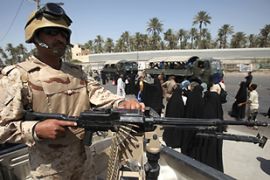
Iraq has been without a new government since the March 7 election, which produced no clear winner.
Security sources said attacks on the thousands of Shia Muslim faithful taking part in the pilgrimage to the Musa Kadhim shrine have wounded more than 300 people since Tuesday.
The deadliest attack occurred on Wednesday in northern Baghdad’s predominantly Sunni Muslim neighbourhood of Adhamiya.
A suicide bomber killed 32 people and wounded more than 90 as Shia Muslim pilgrims were about to cross a bridge leading to the shrine where Musa Kadhim, a revered imam, is buried.
The attack took place near the bridge where 900 people died in 2005 in a stampede sparked by a rumour that a suicide bomber was about to strike.
Biden’s mission
The attacks come days after the US vice-president met senior Iraqi officials in Baghdad to urge them to select new leaders without further delays.
Joe Biden met two main contestants for the prime ministerial post, Nouri al-Maliki, who heads a Shia-dominated bloc, and Iyad Allawi, the head of the a cross-sectarian coalition who narrowly won the March vote.
| IN DEPTH | |||||||||
|

Biden asked the two men to compromise.
Edmund Ghareeb, a professor of Middle East studies at the American University in Washington, said the latest attacks were part of an effort to exploit Iraq’s political vacuum to stoke sectarian conflict.
“In this vacuum there are groups which are trying to throw back Iraq to the period of sectarian conflict and to maintain this kind of tension,” he told Al Jazeera.
“And it is in many ways, I would believe, a reflection of the continuing problems which are facing Iraq, particularly the security situation.”
The bloodshed notwithstanding, hundreds of thousands of pilgrims defied the attacks to remain in Baghad for the culmination of the religious festival on Thursday.
Special safety measures
Major-General Qassim Atta, a Baghdad security spokesman, told the AFP news agency that special safety measures, including road closures, were now in place to protect the worshippers.
“We continue to organise transport for pilgrims and air surveillance for their benefit,” he said.
“The movement of motorcycles, bicycles and carts is banned throughout the city until further notice,” Atta said.
Security officials said 200,000 police and soldiers were assigned to protect the pilgrims as they headed to the Musa Kadhim shrine.
Hundreds of tents have been erected to feed people as they pour into the city for the event.
The mausoleum has previously been targeted by bombers.
In April 2009, two female suicide bombers detonated their payloads near the shrine, killing 65 people, including 20 Iranian pilgrims, and wounding 120 others.