Russia defends Medvedev-Hamas talks
Moscow says other Middle East quartet members are in some sort of contact with Hamas.
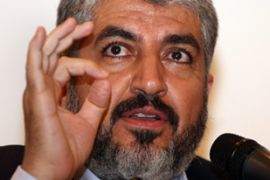
“It is known that all other participants of the Middle East quartet are also in some sort of contact with Hamas leadership, although for some unknown reason they are shy to publicly admit it,” Nesterenko said.
Sergei Lavrov, the Russian foreign minister, on Thursday briefed Mahmoud Abbas, the Palestinian president, on the meeting in Damascus, the Syrian capital.
The Russian president urged Hamas to work on a reconciliation deal with its rival Fatah, and insisted that “no one” should be excluded from the Middle East peace process, according to his spokeswoman.
“Issues related to the re-establishment of Palestinian unity as an indispensable condition for the success of Israeli-Palestinian negotiations were at the centre of the meeting,” Nesterenko said.
Israeli rebuke
Israel reacted angrily to the meeting, however, saying it expected Russia to stand by the Jewish state against “Hamas terror”.
| in depth | |||||||||
|
The Israeli newspaper Ha’aretz reported on Thursdaythat the Medvedev-Meshaal meeting “came as a surprise in Israel”.
The Israeli foreign ministry compared Meshaal to Shamil Basayev – the Chechen rebel leader killed by Russian special forces in 2006 – in a harshly-worded statement and labelled Hamas a “terrorist organisation”.
“Israel always stood behind Russia in its fight against Chechen terrorism, and would have expected similar treatment regarding Hamas terrorism against Israel,” the statement said.
During the meeting with Meshaal, Medvedev called for the quick release of Gilad Shalit, the Israeli soldier captured by Hamas in 2006.
Hamas later dismissed the Russian pressure and said Shalit would not be set free without an “honourable” prisoner exchange deal with Israel.
“The Russian president urged solving the problem of releasing… Gilad Shalit as soon as possible,” Natalya Timakova, Medvedev’s spokeswoman, said.
The Hamas leader reportedly blamed Israel for obstructing negotiationsfor Shalit’s release. The two sides have been negotiating for years through a German mediating team.
Medvedev met Meshaal following a meeting with Bashar al-Assad, the Syrian president.
Russia is a member of the so-called Middle East Quartet, but unlike its three partners it has long urged immediate engagement with Hamas. The other Quartet members (The United States, The European Union and the United Nations) insist that Hamas must first renounce terrorism and recognise the state of Israel.
Russia is one of a handful of European countries to maintain ties with the group. The United States, European Union and Israeli governments all consider Hamas a terrorist organisation.