Fatah votes for new council members
Delegates at West Bank conference hope to rejuvinate Palestinan political movement.
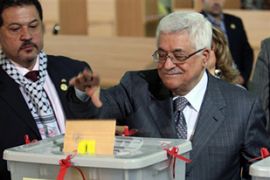
The Bethlehem conference has been billed as an opportunity for Fatah to rejuvenate itself and shed its image as corrupt and nepotistic.
Delegates ‘encouraged’
Al Jazeera’s Nour Odeh, reporting from Bethlehem, said: “Despite the accusations of nepotism and political money a lot of the delegates we’ve been speaking to have been encouraged by the voting process and the names on the list of nominees.”
| In depth |
|
|


One of the favoured candidates for election is Marwan Barghouthi, at 50 a younger, articulate and popular member of the movement, currently in an Israeli jail.
Also in the running is Mohammed Dahlan, 48, a Fatah strongman from Gaza
blamed by many for the Hamas takeover there.
While delegates in Bethlehem filled in their voting sheets, about 300 Fatah members from the Gaza Strip, barred by Hamas from attending the conference, dictated their votes by telephone or sent them in by email.
The voting has twice been delayed and what was billed as a three-day conference has dragged on.
But Saeb Erekat, the chief Palestinian negotiator and a nominee for Fatah’s central committee, said that this was in itself positive for Fatah.
“Many people think that Fatah is like many other parties in this region where its leader sits somewhere in the mountain and he sends something and people will see with one eye, hear with one ear, speak with one tongue,” he told Al Jazeera.
“Fatah is unlike this, we have, I think, 2,325 delegates. We had 2,325 opinions, every point [was discussed] … but at the end of the day, now, we have a political programme.”
Political programme
Delegates adopted the new political programme, which calls for an independent Palestinian state alongside Israel, earlier on Sunday.
|
“Fatah wants peace, but peace cannot be obtained without Israel withdrawing to the 1967 border, establishing a Palestinian state on the ’67 border with East Jerusalem as it capital” Saeb Erekat, |
Erekat said that while the programme was a call for peace, it required Israel to fulfil its commitments.
“Fatah wants peace, but peace cannot be obtained without Israel withdrawing to the 1967 border, establishing a Palestinian state on the ’67 border with East Jerusalem as it capital,” he told Al Jazeera.
The adopted programme reads: “The aim of Fatah as a liberation movement is to end the Israeli occupation and achieve independence for the Palestinian people in a state with East Jerusalem as its capital.”
While the platform reserved the movement’s right to take up arms against Israeli occupation, it also encouraged Palestinians to use more peaceful means to
pressure Israel, like demonstrations and support of a boycott of Israel abroad.
“At this stage, we are focusing on popular struggle, but the armed struggle is a right reserved to us in international law,” Nabil Shaath, a senior party member, said.
Ehud Barak, the Israeli defence minister, described the Fatah platform as “not very promising.”
“But there is no other way for the Middle East but to sit down and strike a deal and agree on a peace for the region and arrangement between us and the Palestinians,” Barak said, calling on Abbas to enter negotiations.