[QODLink]
Middle East
UAE 'boosting military imports'
United Arab Emirates jumps to third-largest importer of arms globally, think tank says.
Last Modified: 27 Apr 2009 21:03 GMT
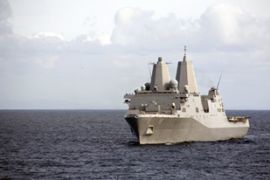
The Strait of Hormuz, near the UAE, carries millions of barrels of crude oil each day [AFP]

The United Arab Emirates has become the world's third-largest importer of weapons after China and India, rising from 16th place in just four years, a Swedish think tank has reported.

The UAE has become the biggest importer of arms in the Middle East, receiving 34 per cent of weapons sent to the region, the Stockholm International Peace Research Insititute (Sipri) says. 

In a report on arms transfers, released on Monday, it said the UAE bought 80 F-16E combat aircraft from the United States and 50 Mirage 2000-9 fighters from France over the last four years.

Owen Fay, Al Jazeera's correspondent in Doha, said the UAE's proximity to Iran could be behind its increased military spending, which is expected to exceed $7bn this year.

In depth


 Video: UAE goes shopping for US weapons

 UAE guns for advanced weaponry

He said that in the case of conflict with Iran, the Emirates would need to protect its people and oil supplies that pass through the Strait of Hormuz.

Mark Bromley, from Sipri, told Al Jazeera the UAE may be increasing its military spending due to high prices in oil. 

"States go through periods of consolidation and modernisation with their military," he said.

"It so happens that the UAE is going through a rather ambitious programme of military modernisation.

"In terms of the 'why' we can point to the recent rise in global world oil prices which is of course funding these purchases.

"What we'll see in the future is how these plans are affected by the fall in world oil prices. To date it appears the UAE is relatively unconcerned by that," he said.

'Destabilising' trend

The institute also revealed that the volume of weapons being exported to the Middle East has risen by more than a third in the past four years.

Sipri warned that this trend threatens to destabilise the region further.

Pieter Wezeman, a researcher for the institute, said: "While we are a long way from the levels [of imports] reached in the early to mid-1980s, this is still a worrying trend in a region beset by multiple sources of potential conflict and limited intergovernmental trust and transparency".

Sipri found that Israel was the second largest receiver of arms in the Middle East, with 22 per cent of the region's imports, followed by Egypt with 14 per cent.

Iran accounted for only five per cent of transfers to the Middle East for 2004 to 2008.

Source:
Al Jazeera and agencies
Topics in this article
People
Country
Featured on Al Jazeera
An interactive dashboard examines the history, successes and challenges facing the group as leaders meet in Addis Ababa.
Series on the Palestinian 'catastrophe' of 1948 that led to dispossession and conflict that still endures.
Fallout from rare strike at Arabtec Construction continues, as many South Asian labourers ordered to leave the country.
A four-part series that gives a rare insight into the country on the move, with history in tow.
Featured
Two years since the start of the uprising, rebels and Assad's forces remain locked in conflict.
A four-part series that gives a rare insight into the country on the move, with history in tow.
News and analysis of 2013 presidential contest as Ahmadinejad finishes second term.
Extensive coverage of war crimes tribunals and controversial calls for blasphemy laws.
Series on the Palestinian 'catastrophe' of 1948 that led to dispossession and conflict that still endures.
join our mailing list