Gates: Obama ‘ready to defend US’
Defence secretary warns enemies against trying to take advantage of the transition.
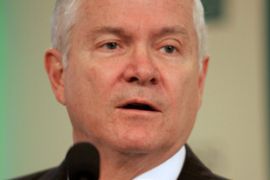
“I can assure you that a change in administration does not alter our fundamental interests, especially in the Middle East,” he said on Saturday.
Joe Biden, the US vice-president elect, has already said that countries opposed to the US could try to spark a crisis early in Obama’s administration.
But Gates told the Manama Dialogue conference: “Anyone who thought that the upcoming months might present opportunities to test the new administration would be sorely mistaken.”
“President Obama and his national security team, myself included, will be ready to defend the interests of the United States and our friends and allies from the moment he takes office on January 20th.”
Joe Biden, the US vice-president elect, has already said that countries opposed to the US could try to spark a crisis early in Obama’s administration.
Diplomatic relations
The US defence secretary also called on Sunni Arab states to support Iraq’s US-backed government by committing to full diplomatic relations with Baghdad and by writing off Iraqi debts run up during the rule of Saddam Hussein.
Most Sunni Arab countries, including Saudi Arabia, have in the past said that the Iraqi government is too close politically to Iran, whose government is Shia Muslim.
|
“Iraq wants to be your partner … Robert Gates, |
“There is no doubt that Iran has been heavily engaged in trying to influence the development and direction of the Iraqi government — and has not been a good neighbour,” he said.
“Iraq wants to be your partner … And, given the challenges in the Gulf, and the reality of Iran, you should wish to be theirs.”
Gates told the conference that Washington was not looking to remove Iran’s leaders but it did want Tehran to make changes.
“Nobody is after a regime change in Iran. What we’re after is a change in policies and a change in behaviour,” Gates said.
“The president-elect and his team are under no illusions about Iran’s behaviour and what Iran has been doing in the region and is doing in terms of its own weapons programmes.”
An Iranian delegation had been due to attend the meeting but did not show up for Gates’s address.
Iraq visit
The defence secretary later arrived at a US air base at Balad, which lies north of Baghdad, to meet General Ray Odierno, the commander of US forces in Iraq.
All of the 149,000 US soldiers in Iraq are getting ready to pull out of Iraqi cities and towns by the middle of next year.
Under the terms of a US-Iraq pact that comes into effect in January, all US forces must leave Iraq by the end of 2011.
However, Odierno said that some US troops may stay in Iraqi cities after next June, despite the US-Iraqi pact.
US soldiers working with Iraqi forces out of shared urban bases could stay in place because the US military sees them as supporting Iraqi forces rather than serving as combat troops.
“We believe that’s part of our transition teams … in the Joint Security Stations,” Odierno said.
“We believe we should still be inside of those after the summer.”
Iraq has seen a decline in the overall level of violence that came in the wake of the 2003 US-led invasion but officials say that attacks could increase in the run-up to provincial elections in January and a general election later next year.
There are also concerns that opposition fighters could launch attacks as US forces begin to leave the country’s town and cities.