UN chief urges Lebanon consensus
Talks with rival camps aimed at defusing tension over election of new president.
Published On 20 Nov 2007
At the end of his visit on Friday, Ban said it was vital that the presidential election go ahead on time next week.
He said he had told rival leaders that it was “imperative that parliament must be convened to elect a new president”, urging them to find a solution that has “the broadest possible support”.
Ban said: “The world is looking at Lebanon. This is a critical time for the future of this great country.
“If responsibilities are not shouldered, it might be moved to the brink of the abyss.
“I expect and I’m confident that all of my Lebanese friends will conduct this important political process in a democratic and non-violent manner.”
Factional feud
Tension remains Siniora’s government and the opposition, which is backed by Syria and Iran, differ over who should be chosen to replace Emile Lahoud, the current head of state.
Lahoud’s term expires on November 24 and there are concerns that the country could end up with two rival governments should no consensus on a suitable president be reached.
Lebanon’s president must be a Maronite Christian according to the country’s confessional power-sharing system, and is elected by parliament rather than by popular suffrage.
A two-thirds quorum in Lebanon’s 128-member national assembly is required to elect a new president, but members of the opposition have boycotted three special parliament sessions to elect Lahoud’s successor.
There are concerns that a vote scheduled for November 21 could also fail.
Lists handed over
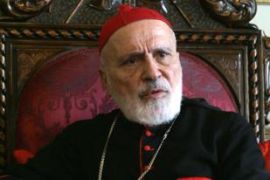
France has convinced Sfeir to draw up a list of candidates whose names could then be put to both the majority and the opposition for consideration.
Al Jazeera’s correspondent in Beirut reported that Sfeir had handed over to Berri a list of candidates.
Andre Parant, France’s charge d’affaires, confirmed that Sfeir had authorised him to confirm that both Berri and Saad Hariri, head of the majority bloc in parliament, had each been given a list of names to hash over.
“It is now up to Berri and Hariri to meet in order to try and reach consensus based on this list,” Parant said.
Preferred candidate
Nawaf al-Moussawi, a Hezbollah official, said his organisation had named its preferred candidate to the patriarch but declined to identify the nominee.
Al-Akhbar, a daily close to the opposition, said Hezbollah’s candidate is Michel Aoun, a retired general and former army commander. Aoun’s party, the Free Patriotic Movement, signed a memorandum of understanding with Hezbollah in 2006.
Meanwhile, Saad Hariri has said that he is optimistic that a deal can be reached with the opposition.
He told the AFP news agency that he believed there could be a breakthrough “at any moment” in the deadlock.
“We’re good to go,” he said. “I think there will be a consensus vote. Nothing is preventing the go.”
Source: News Agencies