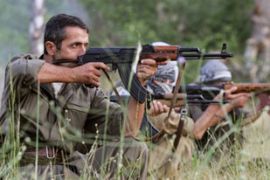
Ankara has been angered by a series of recent attacks by the PKK inside Turkey in which dozens of soldiers and civilians have been killed.
“It seems Turkey is preparing for an attack, then we have to resist,” Karayilan said.
He was speaking from his camp in the Qandil mountains straddling the Iraq-Turkey border.
On Tuesday, Tareq al-Hashemi, Iraq’s deputy president, arrived in Ankara for talks with Turkish leaders.
“A political solution must be given priority to resolve this critical issue,” he said.
“We can understand Turkey’s anger but what I’m aiming to achieve during my visit is a common understanding.”
Onus on Kurds
But James Bays, Al Jazeera’s correspondent in Baghdad, said that whatever Baghdad said, the final decision rested with Kurdish political leaders as the embattled central Iraqi government had little authority in the Kurdish north of the country.
Washington has urged Turkey to show restraint.
Ankara has long complained that neither the Iraqi government nor the US operating in Iraq have done enough to crack down on about 3,000 PKK fighters it says are based in northern Iraq.
|
|
“I think it is pretty difficult to say troops shouldn’t [invade] when the Turkish soldiers are being killed and their villages attacked”
Celtic, Karlstad, Sweden
Send us your views
|
The prospect of Turkey, a key Nato ally, sending its army into northern Iraq’s Kurdish region, sent global oil prices towards a fresh all-time high of $88 a barrel on Tuesday.
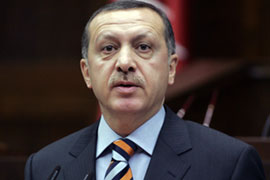
Recep Tayyip Erdogan, the Turkish prime minister, said on Tuesday that securing parliament’s permission to launch an attack did not necessarily mean a military incursion was imminent.
“I sincerely wish that this motion will never be applied. Passage of this motion does not mean an immediate incursion will follow,” he said.
He said Turkey would “act at the right time and under the right conditions”.
But Erdogan also warned that the Iraqi government as well as the regional government in northern Iraq should “put a thick wall between themselves and the terrorist organisation”, referring to the PKK.
“Those who are unable to distance themselves from terrorism cannot avoid being adversely affected by the struggle against terrorism.”
Armenian ruling
Karayilan said PKK fighters were not crossing the border to carry out attacks on Turkish territory.
 |
|
Erdogan says Turkey would act
at the right time [Reuters]
|
“It is not true that we are crossing the border. We have fighters everywhere. It is not necessary to send them from here.
“Their [Turkey’s] aim is to attack Iraqi Kurds.”
The PKK leader in Iraq said Turkey was also hoping to put pressure on the US after a congressional panel said last week that mass killing of Armenians by Ottoman Turks during World War I was genocide – a charge Turkey denies.
Turkey blames the PKK for the deaths of more than 30,000 people since the group launched its armed struggle for an ethnic homeland in southeast Turkey in 1984.