[QODLink]
Middle East
Iraq tribal leader offers US talks
Sunni Islamic Army of Iraq leader says he will negotiate if US commits to withdrawal.
Last Modified: 13 Sep 2007 04:51 GMT
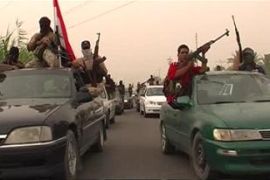
Many armed Sunni groups have turned away from al-Qaeda in Iraq in recent months
The head of the Islamic Army of Iraq has for the first time offered to open peace talks with US forces in the country, his spokesman tells Al Jazeera.
 
Ibrahim al-Shammari, the lead spokesman for one of the most significant Sunni armed groups, said the talks could take place if the US commits to a timetable for the withdrawal of its soldiers.
In an exclusive interview to Al Jazeera, al-Shammari said that although Sunni groups are turning away from al-Qaeda, it is not because of any deal with the US as claimed in Washington.
He said: "Al-Qaeda's agenda started to reveal itself clearly in October last year ... they started to consider themselves as a state and started to target other Iraqi resistance factions, including prominent Sunni personnel in our community, and this affected our relations with them.

Al Jazeera exclusive

Watch Al Jazeera's  interview with Ibrahim a-Shammari
 

"These killings started a media war between them and us, so we decided to break away quickly in order not to give our enemies the chance to benefit from it."
 
The Islamic Army in Iraq is thought to be the largest armed group and was established during the summer of 2003 to fight coalition forces.
 
When first formed, the group appeared to have the same ideologies as al-Qaeda the group has said its primary focus was the expulsion of foreign troops from Iraq.
 
The group claims it is composed primarily of Iraqis (Sunnis, Shias, and Kurds) as well as Arabs.
Source:
Al Jazeera
Topics in this article
People
Country
Organisation
Featured on Al Jazeera
Al Jazeera's exclusive publishing of a key Guantanamo prison military document lays bare the brutality of force-feeding.
Former military official says poverty and anger in indigenous communities mean conditions for an "insurgency" are ripe.
A four-part series that gives a rare insight into the country on the move, with history in tow.
Series on the Palestinian 'catastrophe' of 1948 that led to dispossession and conflict that still endures.
Featured
A four-part series that gives a rare insight into the country on the move, with history in tow.
Series on the Palestinian 'catastrophe' of 1948 that led to dispossession and conflict that still endures.
Two years since the start of the uprising, rebels and Assad's forces remain locked in conflict.
China aims to expand its influence in the resource rich area.
Extensive coverage of war crimes tribunals and controversial calls for blasphemy laws.
join our mailing list