[QODLink]
Middle East
Bush: 'Success' may bring troop cut
US president visits Iraq days before key report and says "surge" working in al-Anbar
Last Modified: 04 Sep 2007 05:41 GMT
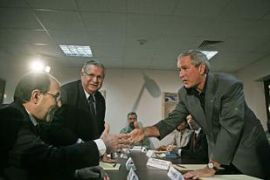
Bush met al-Maliki, left, and Talabani at
the al-Asad air base [AFP]
US military tactics in Iraq's al-Anbar province are working and troop levels could be cut if similar "successes" are repeated across the country, the US president has insisted.
 
George Bush spoke during a surprise Iraq visit on Monday before a key military report is presented to the US congress on the increase in American troop levels.
Amid a rising death toll among US soldiers, currently estimated at 3,700, and growing calls from the Democratic party and some fellow Republicans for a troop withdrawal, Bush is under increasing pressure to withdraw American troops from Iraq.
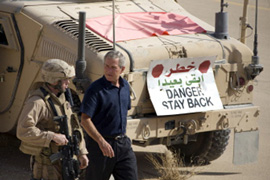
The US president told marines at al-Asad air base: "Anbar is a huge province. It was once written off as lost. It is now one of the safest places in Iraq."
 
Related link

The armies of Iraq

However, David Isenberg, a national security expert based in Washington, said: "Any place can be saved temporarily if you pump enough troops into it.
 
"Anbar province has had a reduction in violence but that has very little to do with the 'surge'."  
 
Bush said any troop reduction would be based on "a calm assessment by our military commanders on the conditions on the ground" and "made from a position of strength".
 
'No rule of law'
 
It would not be "a nervous reaction by Washington politicians to poll results in the media".
 
At the air base, Bush also held what he called "good, frank" talks with leaders of Iraq's Shia Muslim, Sunni Arab and Kurdish communities, including Nuri al-Maliki, the prime minister, and Jalal Talabani, the president.
 
Related link

Brown: Basra not a defeat

Bush's trip to Iraq coincided with the withdrawal of British troops from their last base in the southern city of Basra amid tensions between Washington and its main ally over their policy in Iraq.
 
Isenberg said: "Factions still run the city [Basra] - there is no rule of law.
 
"People feel compelled to join factions for their own safety. The region is still essentially a Wild West."
 
The US president departed from Iraq shortly before 20:00 GMT on Monday, Cynthia Bergman, a White House spokeswoman, said.
 
'War council'
 
Bush made the trip primarily to hold a "war council" with senior US and Iraqi officials before a report by General David Petraeus, the US commander in Iraq, on the effect of the "surge" in US troop levels.
 
"You are denying al-Qaeda a safe haven from which to plot and plan and carry out attacks against the United States of America," he told US soldiers who roared their approval.
 
He landed in al-Anbar province, once a Sunni Arab fighter stronghold now seen by the US military as a success story.
 
The drop in violence in al-Anbar has been attributed to Sunni Arab leaders joining forces with the US military to combat al-Qaeda fighters.
 
But security officials said that shortly before Bush's arrival, two car bombs went off in Ramadi, the provincial capital, killing four people and wounding 10.
 
In Baghdad, police found 15 corpses of men shot dead.
 
Marwan Bishara, Al Jazeera's senior political analyst, said it would be political suicide for Bush to begin a real troop withdrawal in Iraq.
 
"The US cannot withdraw from the Iraq because it will be humiliating for the American empire."
 
Report imminent
 
Bush was accompanied by Condoleezza Rice, the US secretary of state, and Stephen Hadley, his national security adviser.
 
Waiting for them at the air base were Robert Gates, the defence secretary, and General Peter Pace, the chairman of the joint chiefs of staff.
 
Bush met US soldiers at the al-Asad base
in al-Anbar during his visit on Monday [AFP]
Admiral William Fallon, the commander of US forces in the Middle East, and Petraeus were also at the base to meet Bush.

Geoff Morrell, a Pentagon spokesman, said: "This is the last big gathering of the president's military advisers and the Iraqi leadership before the president decides on the way forward."
 
Bush is on his way to Australia to attend the Asia Pacific Economic Co-operation forum summit.

His arrival coincided with a British military pullback from its base in the centre of the southern Iraqi city of Basra.
 
Next week, Petraeus and Ryan Crocker, the US ambassador in Baghdad, are to testify before congress.
 
They will focus on the impact of Bush's decision to send an additional 30,000 US soldiers to Iraq, a so-called "surge" that increased force numbers to 160,000.

Their assessment of the conflict, along with a progress report the White House must hand legislators by September 15, is expected to determine the next phase of US military involvement in Iraq.
Source:
Al Jazeera and agencies
Topics in this article
People
Country
City
Organisation
Featured on Al Jazeera
More and more people in the US are living in poverty - yet Mitt Romney's policies would further shred the safety net.
As the anniversary of the uprising nears, the country's rulers are denying foreigners entry and hiring PR firms.
Under Obama, six whistleblowers have been charged under the World War I-era Espionage Act.
Journalist who recently spent time with fighters says there is no central leadership to the armed resistance.
<  > 
join our mailing list

Enter Zip Code
Go