[QODLink]
Middle East
US accused of using neutron bombs
Former commander of Iraq's Republican Guard says US forces used weapons in 2003.

Last Modified: 09 Apr 2007 07:08 GMT

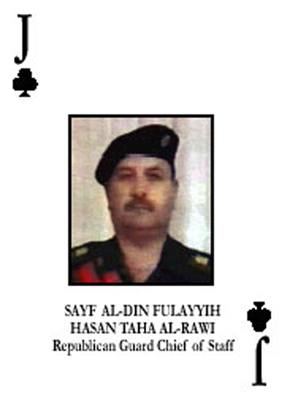
Al-Rawi, right, is still on the run

The former commander of Iraq's Republican Guard has accused the US of using non-conventional weapons in its war against the Middle East country.
 
Saifeddin Fulayh Hassan Taha al-Rawi told Al Jazeera that US forces used neutron and phosphorus bombs during their assault on Baghdad airport before the April 9 capture of the Iraqi capital.
Al-Rawi is one of the most wanted associates of Saddam Hussein, the deposed Iraqi leader, still on the run.
 
"The enemy used neutron and phosphorus weapons against Baghdad airport... there were bodies burnt to their bones," he said.

Al-Rawi is among the 55 most wanted Iraqis
sought by US-led forces[AFP] 

The bombs annihilated soldiers but left the buildings and infrastructure at the airport intact, he added.
 
A neutron bomb is a thermonuclear weapon that produces minimal blast and heat but releases large amounts of lethal radiation that can penetrate armour and is especially destructive to human tissue.
 
About 2,000 elite Republican Guard troops "fought until they were martyred", according to al-Rawi.
 
He said the Iraqi military command was surprised by the speed of the US land offensive, expecting air bombardment to last much longer.
 
"We had not expected the enemy to launch its land offensive from the very first or second day.
 
We expected the air raids to last at least a month," he said.
 
"The land offensive came at the same time as the air offensive. That was a situation we did not expect," he told Al Jazeera.
 
Al-Rawi, who carries a $1m US bounty on his head, was also the jack of clubs on the deck of cards of 55 most wanted Iraqis distributed by the Pentagon before the invasion in 2003.
Source:
Al Jazeera
Topics in this article
People
Country
Featured on Al Jazeera
Al Jazeera's exclusive publishing of a key Guantanamo prison military document lays bare the brutality of force-feeding.
Former military official says poverty and anger in indigenous communities mean conditions for an "insurgency" are ripe.
A four-part series that gives a rare insight into the country on the move, with history in tow.
Series on the Palestinian 'catastrophe' of 1948 that led to dispossession and conflict that still endures.
Featured
Two years since the start of the uprising, rebels and Assad's forces remain locked in conflict.
A four-part series that gives a rare insight into the country on the move, with history in tow.
Extensive coverage of war crimes tribunals and controversial calls for blasphemy laws.
Series on the Palestinian 'catastrophe' of 1948 that led to dispossession and conflict that still endures.
Al Jazeera looks at the escalation of military threats between N Korea and geopolitical rivals.
join our mailing list