Arabs urge Iraq pull out timetable
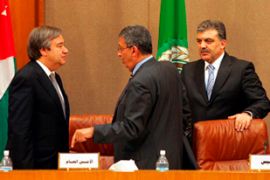
Amr Moussa calls for fair distribution of wealth and disbanding of militias in Iraq.
| Your Views | ||
|
But Arab governments have little influence in Baghdad.
The Arab League representative in Iraq resigned in January because of his frustration over the situation in the country, and what he said was apathy among Arab nations.
Developments in the Middle East peace process, the Palestinian issue, and Iran‘s nuclear ambitions also feature high on the Arab League’s meeting agenda.
Moussa, in his speech, called on Iran to co-operate with the IAEA and asked anew for a Middle East free of nuclear weapons, saying Israel should be “no exception”.
Turkey is participating in the Arab League talks for the first time.
The Turkish foreign minister, Abdullah Gul, warned the tense ethnic situation in the oil-rich northern Iraqi city of Kirkuk could have a negative effect on the entire region.
Turkey sees itself as the traditional protector of the Turkmen people who, together with the Arabs, complain of being bullied by the Kurds who make up half the population of the city and control the security services.
The minister called for “preserving the unity of Iraqi soil and the unity of Iraqi politics because a divided Iraq would cause aftershocks throughout the region”.
Gul’s warning was backed by Moussa, who emphasised the organisation’s commitment to Iraqi unity.
Arrangements for the Arab League Riyadh summit, due at the end of March, was also to be discussed.
Arabs ‘dysfunctional’
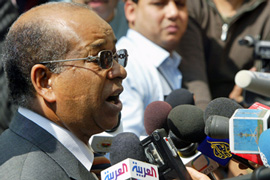 |
| Libya’s foreign minister said that his country will not participate in the Riyadh summit [AFP] |
Prior to the meeting, Abd El Rahman Shalgam, Libya‘s foreign minister, had announced that Libya would not attend the upcoming Arab summit in Saudi Arabia, adding that the Arab world “is not serious” and that “joint Arab action is dysfunctional”.
On Sunday, Shalgam expressed his despair over the way Arab countries have failed to act together on issues, citing the European Union as a successful model.
Shalgam said: “Germany and Spain can have different views and also Spain and Italy but there is seriousness in the European actions when they have to act together.
“There is no seriousness in the Arabic actions. For instance, they [Arab countries] consider Iran now as an enemy, not Israel, what is this nonsense?”