Lebanon calls for international aid
Billions of dollars offered in aid as Lebanese prime minister warns of recession.
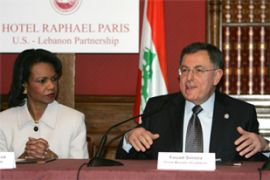
High-ranking representatives of more than 40 countries and organisations were attending the meeting, including Fuad Siniora, the Lebanese prime minister, Condoleezza Rice, the US secretary of state and Ban Ki-moon, the UN secretary general.
French officials said they expected the meeting to raise at least $5bn, matching the $4.2bn in aid and loans raised at a previous donors’ conference in Paris in 2002.
Heavily-indebted
Once-wealthy Lebanon is still struggling to rebuild after its 25-year civil war and is weighed down by $41bn of debt, equal to 180 per cent of gross domestic product.
| Your Views |
|
“Even with the entire world on his side, Siniora will lose if he hasn’t got the Lebanese on his side” |
The war in July and August last year against Israel seriously exacerbated Lebanon‘s problems, leaving much of the country’s infrastructure bombed and many Shia villages and districts wrecked.
Siniora said: “After Israel‘s onslaught on our country, we are now on the edge of a deep recession.”
He added that his government would stand firm against the Hezbollah-led protests and try to enact a planned financial reform.
“The cost of failure is too great to contemplate, certainly greater than the cost of implementing success,” he said.
The meeting comes two days after some of the worst street violence Lebanon has seen in years, with three people killed and more than 100 injured during a general strike called by the Hezbollah-led opposition.
Unpopular reforms
Hezbollah has accused Siniora of being in the pocket of the West and Lebanon‘s pro-opposition al-Akhbar daily newspaper said on Thursday the Paris conference was designed to help the government, not the country.
Siniora said at the conference that his government would continue to reach out to opposition groups
“Lebanon has learned the hard way that peaceful dialogue is the only way to resolve political difference,” he said.
Some donors are likely to link their aid offers to Siniora’s ability to push through his potentially unpopular reform package, which was unveiled this month and includes plans for privatisations, cutting state spending and hiking taxes.
Ban, speaking at the conference, said: “Success of the conference is measured not only in amount of donation, but also in implementation of reforms.”