Mubarak proposes political reforms
Egyptian president asks parliament to consider long-awaited constitutional changes.
People power
Mubarak has asked parliament to amend 34 articles in the Egyptian constitution to “consecrate the people’s sovereignty as a source of power and give parliament more authority to monitor the government”.
| “We have to go back to the gap between the regime’s actual practices and the demand for amendments … Will the regime really implement these amendments?” Hesham Kasem, president, Egyptian Organisation for Human Rights |
“Today’s historic step opens the door wide for democracy and its practice,” he said in a speech at his palace in Cairo. After he finished, the parliament met to consider his proposals.
But the plan has so far only been outline in the broadest terms and until parliament completes the details, the practical effect of the changes will remain difficult to judge.
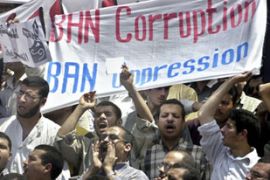
Human rights activists are sceptical of the president’s pledge as he has promised greater democracy many times before during his 25 years in power.
Most of the reforms outlined Tuesday were promised by Mubarak in his election campaign of 2005, but none came to parliament this year.
It is thought the government got cold feet when, two months after the president elections, the opposition Muslim Brotherhood did surprisingly well in legislative elections.
Muslim Brotherhood banned
The Muslim Brotherhood, which is banned from standing as a political party, has complained that the changes are designed to keep it out of the political process.
The proposed amendment would strenghten the role of political parties making it easier for them to put forward candidates for the presidency, but the group was only able to win 88 seats in the 2005 legislative elections by fielding candidates as independents.
Opposition parties and political observers have long accused the president and his National Democratic Party of rigging elections and using the emergency laws, introduced after the assassination of Anwar Sadat in 1981, to stifle dissent.
The state of emergency gives the government sweeping powers to detain suspects and restrict public gatherings.
“Terrorism is a red line that I will not allow anyone to cross,” Mubarak said on Tuesday. “I asked last year to draft a law to combat terrorism to replace the current emergency law.”
Mubarak did not say when the amendment would be passed but the government-controlled newspaper Al-Akhbar claimed that parliament was expected to pass them within three months. Afterward, the amendments would go to a referendum, the newspaper added.