Rwanda’s Kagame in France to ease relations
Kagame visits his French counterpart and says he no longer wants apology for alleged French role in Rwanda’s genocide.

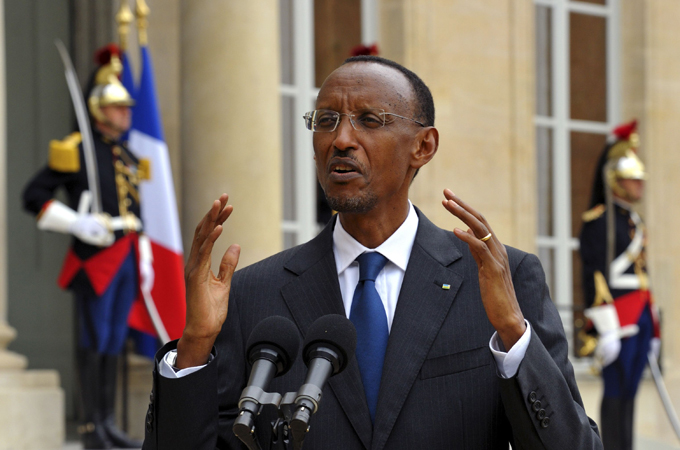 |
| Paul Kagame criticised “this attitude of always sizing up Africans” during his visit to France [Reuters] |
Paul Kagame, the Rwandan president, and his French counterpart, Nicholas Sarkozy, have moved to patch up relations between the two countries after 17 years of bitterness over the 1994 genocide.
Kagame was welcomed by Sarkozy to the Elysee Palace on the second day of his three-day trip to the French capital, his first since his government accused Paris of complicity in the massacre of 800,000 ethnic Tutsis.
Kagame said he was no longer seeking an apology from France for its alleged role in the killings.
French officials have always denied any involvement in the genocide, which the government at the time – led by ethnic Hutus – used as an excuse to massacre the minority Tutsi, the ethnic group to which Kagame belongs.
During the visit both Kagame and Sarkozy said they hoped their countries would enjoy warmer ties in future.
But Kagame criticised “this attitude of always sizing up Africans”, and what he called those who try to manage Africa from afar without respecting “the aspirations of the African people”.
Speaking on Monday, Kagame dismissed concerns about journalists and opposition activists arrested in Rwanda, telling a French questioner: “I am not accountable to you”.
France to double aid
The slaughter began after a plane carrying Rwanda’s president at the time and his counterpart from neighbouring Burundi was shot down as it approached the airport in Kigali, Rwanda capital, from Arusha, Tanzania.
Relations between France and Rwanda have been strained since Kagame accused France of doing too little to stop the ensuing genocide, while a French judge accused Kagame of ordering the attack on the presidential aircraft.
Two French pilots were killed in the attack.
Sarkozy vowed to almost double France’s development assistance from 22.7m euros per year to 42.2m, but Kagame hesitated to admit the trip was merely symbolic.
“Well, if symbolic means ‘very important’, I agree,” he laughed, in an interview with the AFP news agency in the Paris Ritz.
Jacky Rowland, Al Jazeera’s correspondent in Paris, said the visit is “very much an attempt to set the seal” on renewed relations between the two countries.
“President Nicolas Sarkozy saw it as being in France’s interest to re-establish those relations,” she said.
Rowland continued: “It’s a time that France has been losing influence in that part of Africa. He saw it as very important to get those relations back on track for commercial reasons, for geopolitical reasons.”
Sarkozy’s office said France would help Rwanda develop geothermal and methane gas energy projects, and hoped to start building a Franco-Rwandan cultural centre in Kigali before the start of next year.
“This is a new stage in the process of normalisation between the two countries, based on dialogue and mutual respect,” Frecnh government said in a positive but cautiously worded statement.
In what appeared to be a summary of his visit, Kagame told the AFP: “Really the whole purpose is to find ways of overcoming our differences over the past and going forward with a better relationship for the future.”
“I’m happy to be here, and so far, so good … I’m happy,” he added. “I asked for more trade, more partnership. The French are free to come and invest in Rwanda, in tourism, in general infrastructure and so on and so forth.
“And Rwandans are happy to come and do business in France,” he said.
The visit was a tricky one for Sarkozy, who has made it clear that he wants to build on his own trip last year to Kigali to reconcile France with Rwanda.
He faces much criticism at home for holding out a hand to Kagame.