Muslims ‘more exposed in UK towns’
Academic report finds Muslim communities in small towns are more vulnerable to attack than those living in big cities.
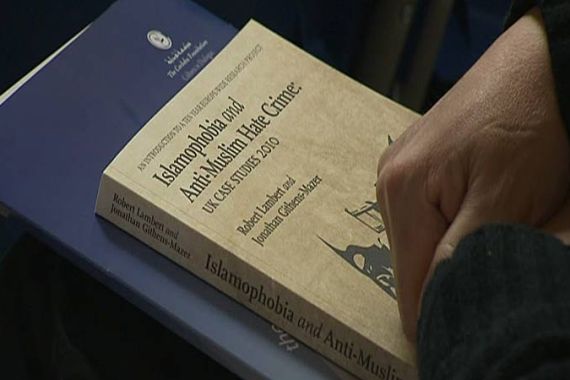
A report published by a British university has found that arson, criminal damage, violence and intimidation against Muslims in the UK have increased dramatically since the 9/11 attacks on the US in 2001.
In particular, the authors found that since Muslim communities in small towns are more isolation than in cities, they are more vulnerable to attack and this accounts for higher Islamophobia-related incidents.
The study, Islamophobia and Anti-Muslim Hate Crime: UK Case Studies, was published by the University of Exeter and is part of a 10-year academic research project undertaken by its European Muslim Research Centre.
Speaking to Al Jazeera, Jonathan Githens-Mazer, a co-author of the report, said: “There are two main things that are significant about this [report].
“One is that it talks about the experiences of Muslims that are living away from the big cities, away from big Muslim population areas and starts unpacking some of the problems they are having in these places.
“The other thing is that it starts talking about the politics of securitisation of Muslims, Muslims always being associated with terrorism, those ideas are being taken up by those who do violence against Muslims.
The study found that isolated Muslim communities in places like Colchester, Bishop’s Stortford and Boston have become especially vulnerable.
“In these small towns communities become very vulnerable because quite simply they don’t have the same support network,” Githens-Mazer said.
“And also in small towns it may be that local councils or police, as positive as they try to be about these things, really aren’t trained to deal with those issues.”
Media criticised
“The real question isn’t so much why there’s Islamically-inspired terrorism. The real question is how is it that 99.99 per cent of the community want to have nothing to do with it, want to reject it,” Githens-Mazer said.
“The fact is that academics, and in terms of communities, there’s so much work done by them to show [that the vast majority of Muslims want nothing to do with terrorism].
“But it’s not taken up by the media, and certainly not taken up by the politicians, because it doesn’t fit various narratives about, you know, evil Muslims and good non-Muslims.”
The report, which also found that there had been a rise in random attacks on women who wear headscarves, said Islamophobia can only be tackled by the combined efforts of the government and community leaders.
“There are these cases [of attacks on Muslims in small towns] but they’re not being reported, they’re not coming through,” Githens-Mazer said.
“In many cases people don’t report them because either they’re so humiliating or people are scared to go to the police and make the problem bigger than what actually happens.
“[We need] to make sure that we ensure that local councils and police working in those environments recognise that there are specific kinds of response to those communities.”