Wildfire smog sparks Moscow chaos
Dozens of planes grounded as thick smog caused by wildfires blankets the Russian capital.

Moscow’s other main airport, on the opposite side of the city from most of the blazes, freed up tarmac space to receive some planes.
Other flights decided to divert to St Petersburg, 640km to the northwest, or to Kazan, 800km east of the capital.
The emergencies ministry said more than 500 separate blazes were burning nationwide on Friday, mainly across western Russia.
At least 52 people have died and 2,000 homes have been destroyed in the fires.
Burning smell
Neave Barker, Al Jazeera’s correspondent in Moscow, said: “Earlier on in the day the air was thick with the smell of smoke.
| in depth | |||||||||||||
|
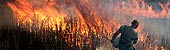
“Visibilty was about 50 metres to 100 metres or so, most of the smoke billowing in from about 100km from here, from a combination of peat fires and forest fires.”
Barker said the nature of the fires was making it even more difficult to put them out.
He said: “Because there are fires within dried out peat bogs the flames themselves keep on simmering underneath the surface of the ground.
“So despite the amount of water that is spread on to the surface to douse the flames, as soon as the humidity in the soil drops those fires can reignite themsleves.”
Intense heat
Dozens of forest and peat bog fires around Moscow have ignited amid the country’s most intense heat wave in 130 years of record-keeping.
Visibility in parts of the capital was down to a few dozen metres due to the smog, which carried a strong burning smell and caused coughing.
“It hurts my eyes,” Valeriya Kuleva, a student, said. “I’m wearing a mask but nothing helps.”
Mikhail Borodin, a Moscow resident in his late 20s, said: “It’s just impossible to work.
“I don’t know what the government is doing, they should just cancel office hours.”
Yuri Besedin, a Moscow emergency official, said: “All high-temperature records have been beaten, never has this country seen anything like this, and we simply have no experience of working in such conditions.
Besedin said 31 forest fires and 15 peat bog fires were burning in the Moscow region alone.
Explosives evacuated
Russian officials have admitted that the 10,000 firefighters battling the blazes are insufficient, an assessment echoed by many villagers, who said the fires swept through their hamlets in minutes.
To minimise further damage, Russian officials have evacuated explosives from military facilities and were sending planes, helicopters and even robots to help control blazes around the country’s top nuclear research facility in Sarov, 480km east of Moscow.
A wildfire last week caused huge damage at a Russian naval air base outside the capital, with Russian media reporting as many as 200 planes may have been destroyed.
The forecast for the week ahead, with temperatures approaching 38 degrees Celsius, shows little change in Moscow and surrounding regions, where the average summer temperature is normally around 23 degrees Celsius.