Nato discusses Afghan exit
Support for Afghan forces on the agenda as ministers meet to discuss withdrawal plans.
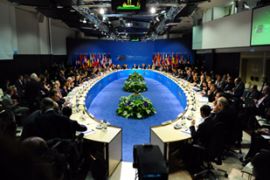
“Where it occurs, the transition must be not just sustainable but irreversible,” he said.
At the opening of the talks on Thursday, Rasmussen said: “The future of this mission is clear and visible: more Afghan capability and more Afghan leadership.”
“The Afghan government is taking more responsibility for running the country. We’re preparing to begin the process of handing over leadership, where conditions allow, back to the Afghan people,” he said.
“Increasingly this year the momentum will be ours.”
Committment
The Nato chief said that an additional 450 trainers were needed for Afghan security forfces, even though there has been some increase in recent months.
| In depth | |||||||
|
Hillary Clinton, the US secretary of state was expected to urge the delegates to commit more trainers at the meeting, which was closed to the media.
The meeting also addressed the “Afghan first” policy, whereby the use of Afghan contractors and suppliers are prioritised for all foreign agencies’ work in the country in order to help build a more profitable economy.
Nato called this policy “the most important step in promoting the development of the Afghan private sector and supporting the economic development of the country,” in a statement issued on Friday.
The transitional plan expected to be endorsed by the meeting will include a political plan for security to be cleared by Hamid Karzai, the Afghan president, a source close to the talks said.
The transition to Afghan security personnel will take place region by region and its strategy will be established by staff on the ground, the source said.
Obama committed an additional 30,000 troops to the war in December last year in order to combat Taliban and al-Qaeda fighters.
There are more than 90,000 Nato soldiers from 40 nations in Afghanistan. They entered the country following the US invasion in 2001 after the September 11 attacks on the US of the same year.
A gun battle south of Kabul, the Afghan capital, on Friday led to the deaths of two Nato soldiers from the US and five opposition fighters.
The battle occurred during a nightime raid in Logar province, with the two US troops suffering injuries from which they subsequently died, Nato’s International Security Assistance Force (Isaf) said.