Ash hits Iceland as EU chaos ends
Volcanic debris forces Reykjavik airport to close, while European flights resume.
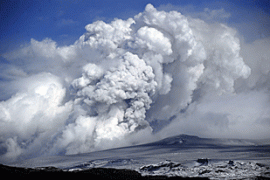
“The main issue is the ashes in the air. You don’t see them, but they are in the air, in the zone where the planes fly.”
‘Local threat’
However Magnus Tumi Gudmundsson, a geophysicist at the University of Iceland, said the ash was minimal in comparison to the peak of its eruption.
| Special report | |
|

“The threat from the volcano is now local. It is not hemispherical,” he told The Associated Press.
“It is mostly a steam plume. It is carrying only a small fraction of what it was before.”
Meanwhile the European Union has sped up action on a reform of its air traffic control system following the crisis thrown up by the volcanic ash.
“The worst is now over, but there is a huge amount of work to be done to deal with crisis management,” EU Transport Commissioner Siim Kallas said.
Aside from Iceland, flights across Europe were proceeding normally, Europe’s air traffic agency, Eurocontrol, said, with about 29,000 flights scheduled.
‘Fragmented response’
A week of airspace closures caused by the ash threat to planes created the worst breakdown in civil aviation in Europe since World War Two.
More than 100,000 flights were canceled and airlines are on track to lose over $2bn.
Kallas said the “absence of a single European regulator for air traffic control made it very difficult to respond to this crisis”.
“We needed a fast, co-ordinated European response … instead we had a fragmented patchwork of 27 national airspaces,” he said.
The EU has 27 national air traffic control networks, 60 air traffic centres and hundreds of approach centres and towers.
In contrast, the United States manages twice the number of flights for a similar cost using only about 20 control centres.
“Without a central regulator, Europe was operating with one hand tied behind its back,” he said.