India vows to hunt down Maoists
Strong response pledged after Tuesday’s deadly attack by rebels left 76 police dead.
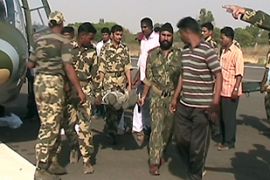
More than 500 Maoists launched the attack against a group of soldiers returning to base from a two-day patrol in Chhattisgarh states’s Dantewada district.
Many of the personnel from the Central Reserve Protection Force (CRPF) were gunned down. Others were blown up by mines the rebels had planted.
‘Walked into trap’
| IN DEPTH |
|
|
 Q&A: The Maoists of India India’s battle against the Maoists Timeline Q&A: The Maoists of India India’s battle against the Maoists Timeline |
| Maoists target Indian police |

P Chidambaram, the Indian interior minister, said the soldiers were part of a joint operation involving state forces and paramilitary fighters.
“But something has gone very wrong. They seemed to have walked into a trap set by the Naxalites [the Maoists]. Casualties are quite high and I am deeply shocked,” he said.
Every soldier on patrol was either killed or wounded, three critically, R K Vij, a police inspector, said.
The attack appears to have been in response to the government’s “Operation Green Hunt” offensive launched late last year in Maoist strongholds across north and eastern India.
Senior Maoist officials have said they will only negotiate if the government halts the offensive.
Ajai Sahni, a defence and security analyst in Delhi, said the attack shows gaps in the state’s strategy against the Maoists.
“This is an inevitable consequence of the incoherence of strategy of the bombers and the inadequate deployment of forces in the areas afflicted by the Maoist threat,” he told Al Jazeera.
Regular attacks
Rubina Khan Shapoo, a correspondent for India’s NDTV, said the attack will force Indian authorities to develop a new strategy against the rebels.
Maoists regularly ambush police and attack railway lines and factories, aiming to cripple economic activity.
The government recently hardened its rhetoric against the rebels after 10 policemen were killed in a landmine attack in the eastern Orissa state, with Chidambaram calling the rebels “cowards”.
In February, at least 25 policemen were killed in the eastern state of West Bengal when Maoists attacked a camp. And in March 2007, the Maoists were blamed for an attack that killed 55 policemen, also in Chhattisgarh.
The rebels mostly draw support from tribal groups and the poor in rural areas.
The Maoists are also known as Naxals, after a small village called Naxalbari in the Indian state of West Bengal where the first armed uprising took place some 40 years ago.
About 2,000 people, including police, rebels and civilians, have been killed over the past few years.