Pakistan plays down judicial row
Clash between supreme court and president over appointments is “no threat”, PM says.
The government, which disputes the claim it violated the constitution, is scheduled to present its case for the appointments before the court on February 18.
Qamar Zaman Kaira, the information minister, said: “If our stand is accepted, that is perfect. If not, we will accept that. What is there to fight over?”
‘Threat to democracy’
The court’s decision to reject the appointments sparked fears that the dispute could destabilise the country as it battles Taliban and other anti-government fighters carrying out almost daily attacks.
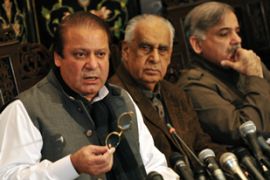
Nawaz Sharif, the country’s leading opposition figure, said Zadari’s attempt to appoint two judges opposed by the court showed he was “the biggest threat to democracy”.
|
“Today, if there is really a danger to democracy, it is through these kinds of acts by Zardari” Nawaz Sharif, Pakistan’s leading opposition figure |
“Today, if there is really a danger to democracy, it is through these kinds of acts by Zardari,” Sharif told reporters.
“The government is attacking the judiciary to protect its corruption.”
Zardari has previously clashed with the judiciary over his refusal to reappoint Iftikhar Mohammed Chaudhry, the chief justice, for many months after he was sacked by Pervez Musharraf, Pakistan’s former president.
He was eventually forced to reinstate Chaudhry after demonstrations that exposed his political vulnerability and the clout of the judiciary.
After being returned to his post, Chaudhry struck down an amnesty protecting Zardari and several other senior politicians from corruption charges.
“Historically, clashes between these two institutions have led to disastrous consequences for democracy and constitutional continuity in the country,” the Dawn newspaper said in an editorial.
“The fate of a high court judge here or a retired supreme court judge there should not hold the country’s political future hostage.”