Dozens killed in Pakistan attacks
Bombings trigger deadly blaze at Lahore market hours after suicide attack in Peshawar.
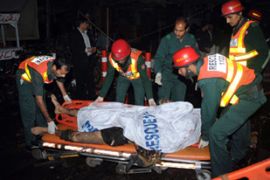
About 100 people were wounded in the attack in Lahore’s Iqbal Town, which was timed to take place when the Moon Market was as its busiest.
The explosions set off a fire that quickly engulfed the busy market with its wooden stalls packed tightly together.
In a separate attack on Tuesday, a US missile hit a car killing three people and injuring another three in Aspalga village, southeast of Miranshah, the main town of the restive North Waziristan tribal district, security and intelligence officials have said.
Fragile situation
Al Jazeera’s Imran Khan, reporting from Pakistan’s capital, Islamabad, said the attacks underscored, yet again, how fragile and dangerous the situation in the country is.
No one has claimed responsibility for Monday’s attacks, and while the Taliban is often quick to claim responsibility for attacks on government targets, there is usually no claim for civilian targets, our correspondent said.
| In depth | |||||||||||
|
The Taliban says it only attacks the government forces, not civilians, but the government and military say the Taliban is to blame for Monday’s attacks.
The authorities initially said both bombs at the market were believed to be remote-controlled, but later said a suicide bomber was suspected to have carried out at least one of the attacks.
The near-simultaneous blasts left dozens of cars and shops ablaze late into the night.
Many victims were women and children, including a two-year-old, a police officer said.
In the Peshawar attack, a bomber blew himself up at the gate to the court building after police stopped him, officials said, adding that three of those killed were policemen.
Peshawar, near the Afghan border, has been targeted repeatedly since Pakistan sent its troops to fight the Taliban in the tribal region of South Waziristan.
Also on Monday, eight people, including a child, were injured in a bomb attack in the southwestern city of Quetta, police said.
Police suspect the bomb, hidden in a motorcycle parked outside the gate of a government residential complex, was detonated by remote control.
Meanwhile, in the northwestern Swat valley, the military said on Monday that its troops had killed four suspected fighters in a search operation.
The army launched an offensive there in April and has since launched another offensive against fighters in the tribal regions along the country’s border with Afghanistan.
The government says its resolve to root out the Taliban and deny its fighters havens in the border area with Afghanistan is strong, but public support for the offensive against the Taliban is waning, with violent, apparently revenge attacks in the cities on the increase, exacting a heavy toll on the population.