Iran denies violating IAEA rules
Ahmadinejad says second nuclear-enrichment facility was neither secret nor illegal.
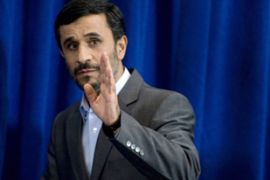
Even as he insisted that Iran, as a sovereign state, did not need to report to Washington, Ahmadinejad said that Tehran would allow IAEA inspectors to visit the site.
Marc Vidricaire, an IAEA spokesman, told Al Jazeera on Friday that Tehran had notified the body of the second enrichment plant’s existence in a letter earlier this week.
Iran was previously known to have one enrichment plant at Natanz, in central Isfahan province, which is under daily surveillance by IAEA inspectors.
The New York Times reported that the facility was being built inside a mountain near the city of Qom, where Iran’s supreme leader and the country’s influential religious leadership are based.
Criticism rejected
Ahmadinejad’s comments came just hours after Barack Obama, the US president, took to the stage in Pittsburgh – site of a G20 summit – to condemn the building of the new plant, describing it as a “direct challenge” on the NPT regime.
“Iran is on notice that when we meet with them in October, they are going to have to come clean and they are going have to make a choice: Are they going to go down the path of giving up the acquisition of nuclear weapons and abide by international standards in their pursuit of peaceful nuclear energy, or continue going down a path that will lead to confrontation?” Obama said.
| in depth | |||||||||||||
|
“The international community has spoken. It is up to Iran to respond. I am not going to speculate on the type of action we are going to take. I am going to give October 1st a chance. But we do not rule out any options when it comes to US security interests.”
For his part, Gordon Brown, the UK prime minister, accused the Iranians of “serial deception”, saying: “Iran must abandon any military ambitions for its nuclear programme.”
And Nicolas Sarkozy, the French president, described the situation as a challenge to the entire international community.
But Ahmadinejad dismissed their criticism and said the three Western leaders were trying to gain a negotiating advantage before planned talks in Geneva on October 1.
“What Mr Brown and Sarkozy say isn’t very important to us … they want to set up a media game to get the upper hand in the upcoming negotiations,” he said.
“When you go into negotiations you are supposed to go in with honesty and sincerity. And respect for international law.”
‘No smoking gun’
Speaking to Al Jazeera from Washington DC on Saturday, Gareth Porter, a Middle East policy analyst, played down the importance of the new nuclear facility under construction near the city of Qom.
“This is very far from a smoking gun, certainly with regard to Iranian intentions as far as nuclear weapons are concerned and also to the capablity of manufacturing a nuclear weapon.”
Porter also said that under existing regulations, Iran had a strong case that it was in legal compliance with the NPT as it never ratified an additional protocol that it signed in 2003.
“I think they have a case … they never ratifiied the protocol that is at stake here, the one that involves an additional obligation to notify immediately upon a decision to begin construction of a nuclear related facility.
“They voluntarily accepted many of the conditions …. that is why they make the argument and I think there is something to that.”
Understanding the West
Sadegh Zibakalam, political science professor at Tehran University, said it seems Tehran is finding it hard to understand the West’s reaction.
“It seems that Ahmadinejad was trying to do something positive ahead of the October talks in Geneva. He was doing something postive for the 5+1 talks – an olive branch,” he told Al Jazeera.
“If anything, Ahmadinejad says that Iran must actually be praised [for its declaration to the IAEA] even before its legal obligation to do so. I presume that this will be the attitude of the Iranian leaders.”
Zibakalam further said that Obama’s reaction had probably “poured some cold water” on the forthcoming nuclear negotiations.
“For the first time, Obama employed the term ‘the military option on the table’ – this was a term previously associated with [former US predecessor] George Bush. This was a signal to Tehran that they shouldn’t expect too much of the breakthrough,” he said.