India announces security revamp
Investigative agency to be created and police training improved in wake of Mumbai attacks.
For his part, India’s foreign minister told parliament on Thurday that India wants Pakistan to hand over 40 people that it believes are behind violent attacks and other crimes.
Speaking during a debate on the Mumbai attacks, Pranab Mukherjee said: “We have given them lists of 40 persons, not one, not 20 – lists of 40 persons – and we have also pointed out that their denial is not going to resolve the issue.”
Co-ordinated effort
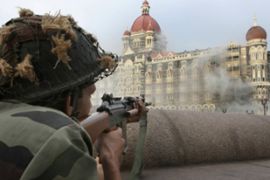
The flurry of steps come after India’s government became the focus of public anger for security and intelligence failures in last month’s co-ordinated attacks in Mumbai, India’s financial capital.
The security revamp is an effort to better co-ordinate criminal investigations at the state level, Prakash Singh, a former director-general of India’s police force, said.
“It was felt that the interstate co-ordination – in the sharing of intelligence and in co-ordinating the investigative links in different states – was not there. Every state was pursuing its own line of investigation,” Singh told Al Jazeera.
“Some of these measures should be in position within the next month or so, like the setting-up of the federal investigation agency. All the government has to do is pass an ordinance until a law on the subject is enacted by the parliament.
“The government will have to move quickly or they will lose credibility and lose the next parliamentary election.”
Suspect held
As the security measures were announced, police in Mumbai reversed plans to take the only surviving attacker, Mohammed Ajmal Kasab, to court for a routine hearing.
A magistrate granted authorities permission to hold Kasab for a further two weeks, Eknath Dhamal, public prosecutor, said on Thursday.
Kasab has been interrogated by Indian authorities on several occasions and has reportedly offered to give details about the planning of the November 26 attack.
Police on Wednesday said that Lashkar-e-Taiba, the Pakistan-based armed group blamed by New Delhi for the Mumbai assault, referred to an Indian man to shepherd the attackers into India.
Sabauddin Ahmed, who is accused by Indian police of managing safe houses for armed groups in Nepal, will be brought to Mumbai for questioning, police said.
“He was [the attackers] main point man in Kathmandu, a very trusted man by Lashkar,” Amitabh Yash, director of the police task force that arrested Ahmed, said.