Timeline: Mumbai assault
A chronology of the deadly attacks that unfolded across India’s financial capital.
The following are the key events from the crisis:
Wednesday 26, 2008:
Shooting starts at Chhatrapati Shivaji rail station, one of the world’s busiest, handling thousands of passengers each day.
Within the hour other attacks occur at four other locations: the Nariman House, home of the ultra-orthodox Jewish outreach group Chabad Lubavitch; Leopold’s restaurant, a landmark popular with foreigners; the Trident-Oberoi hotel, a five-star landmark; the Taj Mahal Palace and Tower hotel, a landmark of Mumbai since 1903.
Shooting breaks out in south Mumbai, quickly followed by attacks near the Bombay Municipal Corporation, the civic body that governs Mumbai, and the Cama hospital and the GT hospital in the city centre.
Just after midnight, armed men attack the Vidhan Sabha, the legislative assembly, the lower house of state legislature in India.
Thursday 27
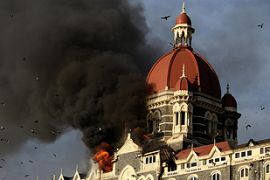
A large fire breaks out at the Taj Palace hotel and an hour later authorities begin escorting people out of the hotel.
Indian security forces are brought in to try to regain control of the Taj hotel and the Oberoi hotel.
Members of the National Security Guard start doing room-to-room searches at the Taj hotel and within the hour surround the Nariman House. Local media show people being rescued from the Oberoi hotel.
A little-known group calling itself the Deccan Mujahedeen claims responsibility for the attacks.
Indian troops continue to battle armed men in the city.
Friday 28
Firing and explosions are reported from both the Taj Mahal and Trident-Oberoi hotels.
Officers kill two gunmen inside the Trident-Oberoi hotel and ended the attack.
Dozens of people are evacuated from the Trident-Oberoi. A bus carrying the rescued guests was seen leaving the scene and police are said to have control of the building.
Meanwhile explosions and gunfire continue intermittently at the Taj Mahal hotel.
An airborne assault gets under way at the Nariban House, where commandos are beseiging a centre run by the ultra-orthodox Jewish outreach group Chabad Lubavitch. Attackers holed up in the building are said to have hostages. The seige is punctuated by gunshots and explosions.
Troops storm the Nariman House, reportedly killing the gunmen inside. The troops emerged from the building to applause but the bodies of five hostages are recovered, including that of the rabbi that ran the centre.
Pakistan warns India not to play politics over the incident, but says the two countries face a common enemy and agrees to send its spy chief to share intelligence on the attacks.
Saturday 29
Siege ends at the Taj Mahal hotel in the early hours of the morning. Commandos say they have killed the last remaining attacker inside.
Officials announce the death toll as over 180 people and there are fears it will grow, but in the end the toll is revised down 166.
India mourns its dead and thousands of people turn out to attend the cremation of Hemant Karkare, Mumbai’s anti-terrorism squad chief, who was killed in the first of the attacks.