Mongolia moratorium on executions
President Tsakhiagiin Elbegdorj cites cases of innocent people given death penalty.

“From tomorrow, I’ll pardon those on death row,” he added. “I suggest commuting the death penalty to a 30-year severe jail sentence.”
Before Thursday’s announcement, Mongolia had been considering changing its criminal code to limit the death penalty to cases of assassination and premeditated murder.
Currently, the eight crimes that carry the death penalty include treason, espionage and certain cases of rape.
‘Risky move’
While the power to commute death sentences rests with the president, the country’s opposition-held parliament will have to approve a more permanent change.
|
“[Changing the law is] clearly a harder step… the opposition party has control of the legislature” Roseann Rife, Amnesty Asia-Pacific deputy programme director |
Nyamdorj Tsend, the Mongolian justice and internal affairs minister who is also an opposition legislator, called the president’s speech a risky political move.
“The president’s moratorium on the death penalty is a very complicated matter,” he told Eagle TV.
Mongolia’s legal system follows the former Soviet legal system, and many lawyers and legislators favour harsh punishment for criminals.
Execution in Mongolia is carried out by gunshot to the back of the head. The death penalty does not apply to women or to men under the age of 18 or over 60.
But information on the punishment is a state secret, and it is not clear how many people the country has executed or when the most recent execution took place.
According to Amnesty International office in Mongolia, at least five people were executed in 2008, and nine people were thought to be on death row as of last July.
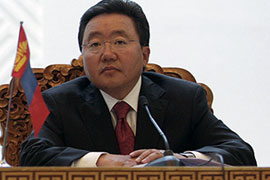 |
| Elbegdorj said recent cases had shown innocent people could be executed [EPA] |
An Amnesty statement released on Thursday said families of those executed in Mongolia are not told before the execution, and bodies are not returned to the family.
Commenting on Thursday’s announcement Roseann Rife, the deputy programme director for Amnesty’s Asia-Pacific office, told The Associated Press that changing the law is “clearly a harder step”.
“It involves a lot more people, and the opposition party has control of the legislature.”
Rife said Elbegdorj has commuted at least three death sentences since taking office in May, but added that if he is not re-elected after his four-year term, Mongolia’s stance on executions could change “just like that”.