Thailand’s Samak bows out of PM bid
Samak to step down as leader of the country’s ruling party, aide says.
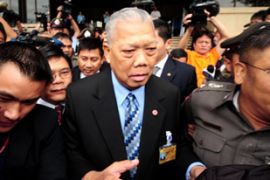
The vote had been called three days after the country’s constitutional court forced Samak to quit as PM over his hosting of a TV cooking show while in office – a position the court said constituted a conflict of interest.
The opposition Democrat Party, which has 164 seats, and even some partners of Samak’s own party stayed away from the parliamentary session amid anger over his decision to re-contest the post.
Support lost
Members of the ruling coalition had criticised Samak’s bid saying his return to office was likely to lead to further protests from the People’s Alliance for Democracy (PAD), whose members have been occupying the prime ministerial office complex in Bangkok for more than two weeks.
“We honour the core party’s nomination, but we think the new prime minister should be someone who can help resolve the political crisis,” Somsak Prisana-anantakul of the Chart Thai Party, the coalition’s second-largest member, said.
Larry Jagan, an expert on South-East Asia affairs, told Al Jazeera Samak’s support base had “trickled away over the last 24 hours”.
“The PPP is in difficult circumstances. The party is really very fractionally divided,” he said.
National unity
A split in the ruling coalition raises the possibility of Abhisit Vejjajiva, leader of the Democrat Party, becoming a viable candidate for the top post.
Abhisit has called for a new prime minister to lead a non-partisan government of national unity made up of all parties and bring what he says is much needed stability to Thai politics.
“It doesn’t have to include me or the Democrats,” he told Al Jazeera. “I just want to see the new government reconciling and taking Thailand to its full potential.”
But Giles Ungpakorn, a Bangkok-based political analyst, said such a move would be “a step backwards for democracy”.
“Such a prime minister will not represent the majority of the electorate,” he told Al Jazeera.
Friday’s announcements have been seen as a potentially critical juncture after weeks of instability and occasionally violent clashes between government supporters and protesters from the PAD.
With the threat of protests from both Samak opponents and supporters, hundreds of police had been deployed around the Thai parliament, equipped with batons and riot gear.