Lee also pledged to boost the economy, saying “economic revival is our most urgent task”.
The conservative, pro-US Lee, 66, is nicknamed “The Bulldozer” for the can-do image he honed as CEO and later as mayor of Seoul.
He ended a decade of liberal rule that critics say hindered economic growth, was too soft on communist North Korea and fomented tension with traditional close ally Washington.
|
|
Born on December 19, 1941 in Japan
Returned to Korea shortly after Japan‘s 1945 wartime defeat
Rose from poverty that gripped peninsula after Korean War
Worked as cleaner to put himself through college
Became youngest chief executive of Hyundai Group construction arm at 37, earning nickname “The Bulldozer”
Entered parliament in 1992 but quit in 1998 after overspending of campaign funds
Elected mayor of Seoul in 2002, driving through huge project to open up scenic stream through heart of capital, earning him environmental credibility
Has declared assets of $38m and has pledged to give poor most of fortune
|
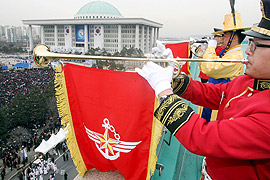
Tens of thousands of officials and ordinary citizens attended the inauguration at the National Assembly on Monday, along with foreign dignitaries including Yasuo Fukuda, the Japanese prime minister, and Condoleezza Rice, the US secretary of state.
Lee, the 10th man to be South Korea’s president and the first to come from a business background, won December’s election by a record margin on a promise to make the economy his top priority.
He has promised to achieve annual growth of 7 per cent, double the country’s per capita income to $40,000 over a decade and make South Korea one of the world’s top seven economies.
South Korea’s economy grew 4.9 per cent last year and 5 per cent the year before, but Lee says it has underperformed.
To realise the goal, Lee says he will slash regulations, initiate tax reforms, streamline government and draw in more foreign investment.
Ethical lapses
But Lee’s inauguration was clouded by accusations of fraud and ethical lapses.
A special prosecutor cleared him only last Thursday of various allegations, including that he was involved in a 2001 stock price manipulation.
Lee, who flatly denied the charges, was the country’s first president-elect to undergo a criminal inquiry.
His selection of some cabinet ministers and a key aide has also come under fire over their allegedly dubious ethical standards, with one resigning amid suspicions that she had engaged in real-estate speculation.
“I am stepping down as nominee to be minister of gender equality in order not to become a stumbling block to the government of Lee Myung-bak,” Lee Choon-ho said on Sunday.
Another minister-designate and a senior presidential aide have been accused of real-estate speculation and plagiarism.
On North Korea, Lee has vowed to broadly continue Seoul’s policy of detente with the North but says he will maintain a more critical eye.
Ties with North
Lee’s liberal predecessors – Roh Moo-hyun and Kim Dae-jung – gave unconditional aid and concessions as part of reconciliation efforts.
 |
Lee expressed a willingness to discuss
unification issues with Kim [EPA] |
But Lee wants to use his business-oriented mind-set for dealing with North Korea.
He has said that if Kim abandons his nuclear programmes, the South will launch massive investment and aid projects in the impoverished North.
Lee also says he will bolster Seoul’s ties with the US to help resolve the nuclear issue.
International talks on North Korea reported significant progress last year after Pyongyang shut down its main nuclear reactor and began disabling key atomic facilities.
The talks, however, have not been held since October due to a dispute over whether Pyongyang kept its promise to declare all its nuclear programmes by the end of last year.

