Chavez’s body ‘unlikely’ to be embalmed
Venezuela’s acting president says it could be too late to preserve late president’s body for permanent display.
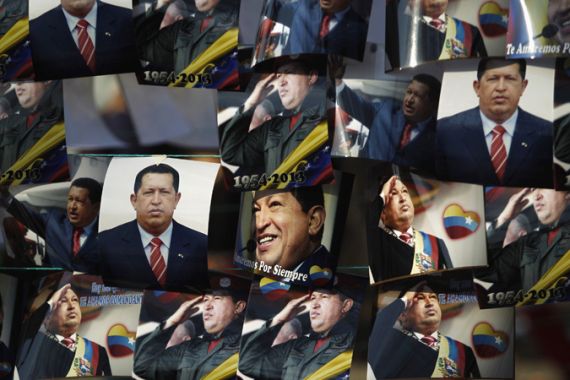
The Venezuelan government has said that it may not be possible to embalm the body of late President Hugo Chavez as planned.
Nicolas Maduro, Venezuela’s acting president, acknowledged on Wednesday that it could be too late to do so, as “preparatory steps would have to have been taken much earlier”.
“Russian and German scientists have arrived to embalm Chavez and they tell us it’s very difficult because the process should have started earlier … Maybe we can’t do it,” Maduro said.
“So I have the duty to report on these steps so that everyone knows that there are difficulties that could make it impossible to do what was done with Lenin, Ho Chi Minh or Mao Tse Tung,” Maduro said.
Two days after Chavez’s death Maduro had announced that he wanted Chavez preserved “eternally” so his body could be on permanent.
Camilo Jaramillo, a Colombian embalmer, said that in order to forestall decomposition, a body needs to be chemically treated within hours of death, unless refrigerated.
“What I really thought was odd, and what raised a lot of questions, is that they were putting him on display in vigil,” said Jaramillo.
The late Venezuelan leader died on March 5, and his body was still on display at the military academy in the capital city of Caracas where tens of thousands of supporters have paid tribute.