Cuban leader proposes term limits
Raul Castro says politicians and other officials, including himself, should be restricted to two, five-year terms.
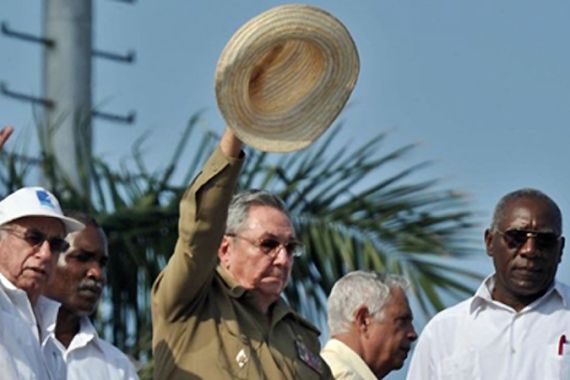
| Al Jazeera’s Lucia Newman reports on the major reforms proposed by President Raul Castro at the congress [EPA] |
Raul Castro, the Cuban president, has proposed term limits for Cuban politicians — including himself — a remarkable gesture on an island ruled for 52 years by him and his brother.
Castro said politicians and other important officials should be restricted to two, five-year terms, including “the current president of the Council of State and his ministers” — a reference to himself.
The proposal was made on Saturday at the opening of the congress where delegates are meeting to ratify sweeping economic reforms proposed last year.
The 79-year-old president lamented the lack of young leaders in government, saying the country was paying the price for errors made in the past.
Castro told delegates attending a crucial Communist Party summit that he would launch a “systematic rejuvenation” of the government.
The proposal was made at the latter stage of a two-and-a-half hour speech in which the Cuban leader forcefully backed a laundry list of economic changes to the country’s socialist system, including the eventual elimination of the ration book and other subsidies, the decentralisation of the economy and a new reliance on supply and demand in some sectors.
Economic woes
Castro said that economic changes would not allow the accumulation of private property.
He said some proposals along those lines had been rejected for being “in contradiction with the essence of socialism”.
Al Jazeera’s Latin America editor Lucia Newman said this was undoubtedly the most important Cuban Communist Party congress in decades.
“In fact, 20 years after the collapse of the Soviet Union Cuba is now attempting to decentralise its Soviet-style economy while maintaining a one-party state. This very, very significant.
“President Raul Castro made it very, very clear that the days of the Cuban state providing from cradle-to-grave are over and that Cubans have to decentralise or ‘we will go over the precipice’.
“He also said that no Cuban will be left destitute but that subsidies and others will only be earmarked for the most needy.”
The 1,000 delegates will, over four days, vote on economic reforms proposed by Castro and officially relieve
Fidel Castro, Raul’s brother and former president, as party leader.
The congress will elect a new 100-member Central Committee, as well as the more elite 19-member Politburo and 10-member Secretariat.
The government has said the congress will formally enshrine many economic reforms the government has adopted over the past year.
Reforms
Reforms are desperately awaited in a country where the average salary is $17 a month, domestic food production is a problem and corruption widespread.
Among the moves put on track in 2010: eliminating 20 per cent of state employees.
To help pick up slack on the unemployment front, Havana is expanding the categories of legal self-employment, decentralising the food distribution system, expanding allowable areas of foreign investment, slashing subsidies and imposing a tax system.
“Let’s see what comes out of all this. It is unbelievable that this country does not produce what it eats,” said Ana Rosa Rodriguez a 28-year-old worker in Havana.
“Raul is trying to improve the economy and he’s started to approve some steps, but you don’t see results yet.”